
Automating compliance is the process of implementing technology-driven workflows that execute regulatory tasks continuously, accurately, and with minimal manual intervention. Compliance officers at organizations subject to SOC 2, ISO 27001, and HIPAA face a growing volume of controls, evidence requests, and audit cycles that manual processes simply cannot handle at scale. 92% of companies are already deploying or planning compliance automation tools. That figure reflects a hard reality: regulatory complexity has outpaced spreadsheet-based workflows, and the teams responsible for governance need a better operational model.
What prerequisites are essential for automating compliance?
Successful compliance automation starts with clean data and clearly defined control mappings. Automating messy processes only replicates inefficiencies at speed. Before your team touches any automation platform, audit your existing data sources, document every control, and map each control to its regulatory requirement.
The technology layer comes second. Governance, Risk, and Compliance (GRC) platforms with control cross-mapping capabilities are the core infrastructure for automated compliance processes. One piece of evidence can satisfy up to 60 different regulatory controls across frameworks like SOC 2, ISO 27001, and HIPAA when cross-mapping is configured correctly. That single capability eliminates enormous amounts of duplicated work.

Integrations with live business systems are equally critical. Your GRC platform needs to pull data from HR systems, cloud infrastructure, ticketing tools, and access management platforms in real time. Without live data feeds, your compliance evidence goes stale between collection cycles, and stale evidence fails audits.
The table below outlines the key requirements before launching any automation initiative:
| Requirement | Why it matters |
|---|---|
| Clean, documented data | Prevents replicating errors at scale |
| Defined control mappings | Enables evidence reuse across frameworks |
| GRC platform with cross-mapping | Satisfies multiple standards from one evidence set |
| Live system integrations | Keeps evidence current and audit-ready |
| Human review checkpoints | Preserves oversight and auditability |
-
Audit all data sources before selecting a platform
-
Document every control and its regulatory reference
-
Map controls across SOC 2, ISO 27001, HIPAA, and any other applicable frameworks
-
Confirm your chosen platform supports API integrations with your existing tech stack
-
Assign a compliance owner responsible for integration health
How to implement automated compliance workflows step by step
Effective implementation follows a deliberate sequence. Rushing to automate before the foundation is solid produces the same audit failures as manual processes, just faster.
Step 1: Decompose compliance tasks into sub-tasks. Break every major compliance obligation into discrete, assignable sub-tasks. Map the dependencies between them. A SOC 2 access review, for example, involves pulling user lists, confirming role assignments, flagging exceptions, and documenting approvals. Each step is a separate workflow node, not a single task.
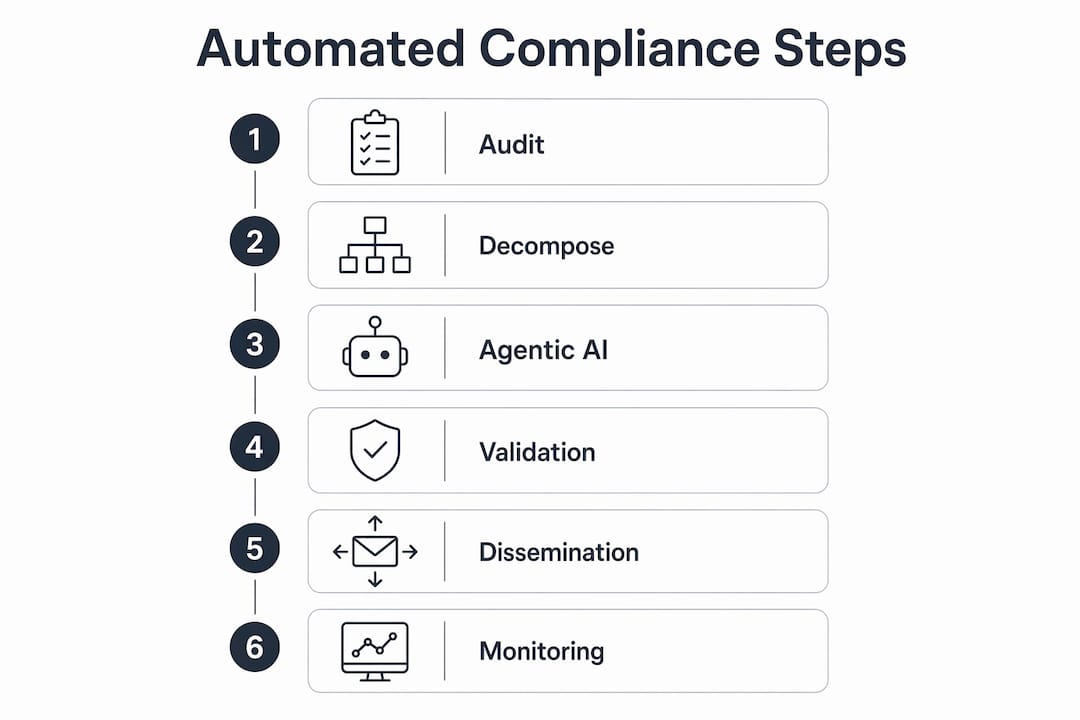
Step 2: Deploy agentic AI for evidence gathering and control mapping.AI-powered compliance tools reduce hours of manual evidence collection to minutes, enabling small teams to handle larger audit scopes. Agentic AI can gather screenshots, pull configuration data, score questionnaire responses, and map evidence to controls without human intervention at each step.
Step 3: Embed human-in-the-loop validation. Human-in-the-loop workflows keep final decision authority with compliance officers, preserving auditability and ensuring AI assistance remains high quality. The AI handles the repetitive gathering; your team handles the judgment calls. This is not a limitation of the technology. It is the correct design.
Step 4: Automate policy dissemination and acknowledgments. Workflow engines can send policy documents to employees, collect digital acknowledgments, log completion timestamps, and escalate non-responses automatically. This removes a significant administrative burden from compliance teams while creating a clean audit trail.
Step 5: Schedule and monitor workflow execution. Set automated triggers for recurring tasks: quarterly access reviews, annual policy renewals, monthly vendor risk assessments. Each trigger should generate a task, assign an owner, and log the outcome.
Pro Tip: Schedule integration health checks on a weekly cadence. A broken API connection between your GRC platform and your identity provider will silently produce stale access data, and you will not discover it until an auditor does.
What challenges arise when automating compliance?
The most common failure mode in compliance automation is automating a process that was never well-defined. Clean data and clear control mapping are prerequisites, not outputs. Teams that skip the documentation phase discover this when their automated workflows produce inconsistent or incomplete evidence packages.
Compliance automation is not a project with a finish line. It is a continuous operational cycle requiring regular maintenance, integration health checks, and updates to keep evidence valid and avoid last-minute audit surprises.
Maintaining integrations over time is the second major challenge. Business systems change. Cloud providers update APIs. HR platforms migrate to new versions. Each change can break a data feed silently. Regular maintenance and health checks of integrations are necessary to sustain effectiveness. Assign ownership of each integration to a specific team member and review connection status on a fixed schedule.
Additional challenges compliance officers encounter include:
-
Evidence freshness decay when integrations go unmonitored
-
Compliance drift when controls are not updated after regulatory changes
-
Alert fatigue from poorly tuned dashboards that flag too many low-priority issues
-
Treating automation as a one-time implementation rather than an ongoing operational function
-
Underestimating the change management effort required to get business units to participate in automated workflows
Pro Tip: Build for scale from day one. A workflow that handles 50 controls cleanly should be designed to handle 200 without restructuring. Retrofitting scalability after the fact costs more time than building it in upfront.
Automation in manufacturing inspection follows the same principle: the documentation and process definition work must precede the technology deployment, not follow it.
How does continuous compliance monitoring transform audit readiness?
Compliance automation shifts organizations from reactive annual audits to continuous, proactive compliance monitoring. That shift changes the economics of audit preparation entirely. Instead of a six-week scramble before an audit, your team maintains a live, evidence-backed compliance posture year-round.
The operational benefits are concrete:
-
Real-time dashboards surface control failures and evidence gaps as they occur, not weeks later
-
Audit portals give external auditors direct, read-only access to organized evidence, reducing back-and-forth by days
-
AI-powered analytics predict compliance violations and recommend remediation before issues escalate, supporting risk-based prioritization
-
Cross-mapping lets organizations collect evidence once and apply it across multiple frameworks, removing redundant collection cycles
-
Continuous control monitoring replaces point-in-time snapshots with live status indicators
The Stripe case illustrates the scale of impact possible with well-designed agentic AI. Agentic AI workflows at Stripe identified 95% of card-testing attacks in real time, reduced customer friction by 20%, and saved analysts 80% of the time previously spent on manual document gathering. The lesson for compliance officers is direct: when AI handles evidence collection and pattern detection, skilled analysts shift to higher-value risk assessment work.
Compliance automation replaces fragmented spreadsheets with real-time dashboards that surface vulnerabilities immediately. That visibility is not just operationally useful. It is what boards and regulators increasingly expect from mature compliance programs.
Key Takeaways
Automating compliance requires clean data, defined control mappings, and continuous monitoring to shift organizations from reactive audit preparation to proactive regulatory management.
| Point | Details |
|---|---|
| Start with clean data | Audit and document all controls before deploying any automation platform. |
| Use cross-mapping to reduce work | One evidence set can satisfy up to 60 controls across SOC 2, ISO 27001, and HIPAA. |
| Keep humans in the loop | AI handles evidence gathering; compliance officers retain final decision authority. |
| Treat automation as ongoing | Schedule regular integration health checks to prevent evidence staleness and compliance drift. |
| Continuous monitoring beats annual audits | Real-time dashboards and AI analytics surface gaps before auditors do. |
The case for treating compliance as an operational rhythm
Compliance automation done right does not feel like a technology project. It feels like a well-run operation. I have seen organizations invest in GRC platforms, configure impressive dashboards, and then treat the whole system as “done” after go-live. Six months later, half the integrations are broken, the evidence is stale, and the team is back to manual collection two weeks before an audit. The technology did not fail them. Their operating model did.
The organizations that get lasting value from automated compliance processes are the ones that assign clear ownership, build review cadences into their calendars, and update their control mappings every time a regulation changes. They treat compliance the way a finance team treats the monthly close: a recurring, non-negotiable operational cycle with defined inputs, outputs, and owners.
The cross-framework efficiency argument is also underappreciated. When your team collects evidence once and maps it to SOC 2, ISO 27001, and HIPAA simultaneously, you free up weeks of analyst time per audit cycle. That time should go toward genuine risk assessment, not document chasing. AI handles the chasing. Your people handle the judgment. That division of labor is the real value proposition of compliance automation, and it only works when the operational foundation is solid.
The technology landscape will keep evolving. Agentic AI capabilities are expanding rapidly, and the compliance tools available in 2026 are meaningfully more capable than those from three years ago. The organizations positioned to benefit are not the ones with the biggest budgets. They are the ones with the clearest processes and the discipline to maintain them.
— Yasam
Qa-report accelerates compliance documentation in quality operations
Compliance documentation in manufacturing and quality environments carries the same demands as enterprise GRC: evidence must be current, traceable, and audit-ready on demand. Qa-report addresses this directly.
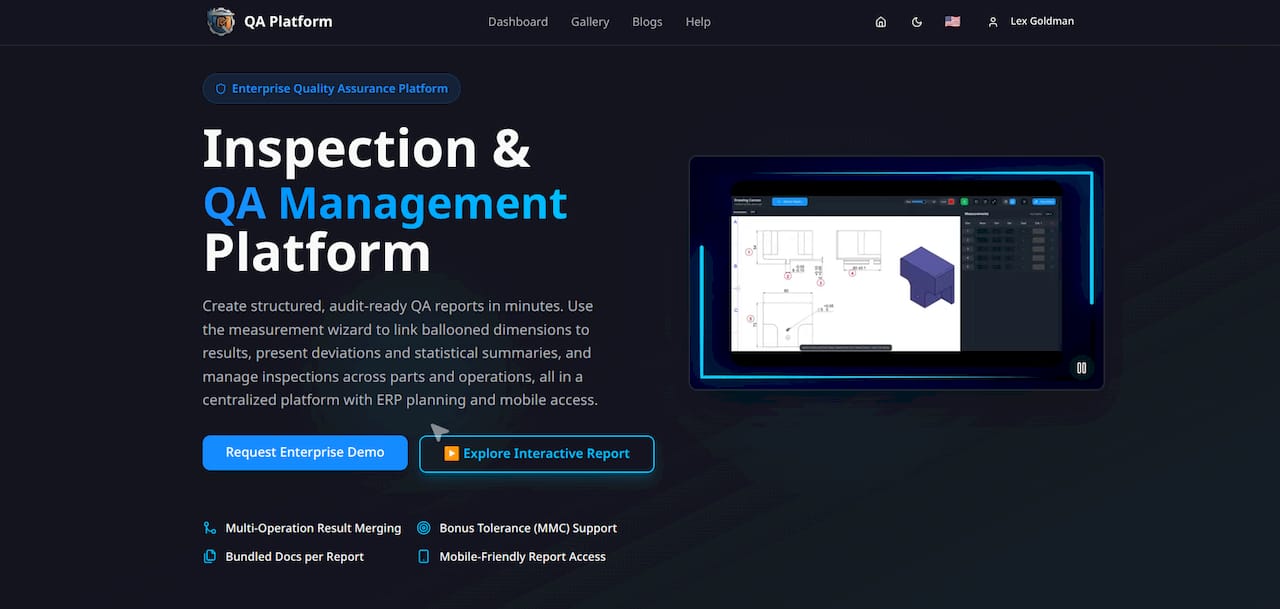
Qa-report is a QA inspection and production planning platform that generates structured, audit-ready QA reports in minutes. The measurement wizard links ballooned dimensions to inspection results, presents deviations and statistical summaries, and manages inspections across parts and operations in a centralized platform with ERP planning and mobile access. For compliance officers in manufacturing environments managing AS9102, IATF 16949, or ISO 9001 requirements, Qa-report replaces manual report assembly with a systematic, repeatable documentation workflow. Explore CMM inspection automation to see how automated reporting fits your audit cycle.
FAQ
What is automating compliance?
Automating compliance is the use of technology-driven workflows to execute regulatory tasks continuously and accurately with minimal manual effort. It replaces fragmented, spreadsheet-based processes with integrated platforms that collect evidence, map controls, and monitor compliance status in real time.
What tools do compliance teams use for automation?
Compliance teams use GRC platforms with control cross-mapping, agentic AI for evidence gathering, workflow engines for policy dissemination, and real-time dashboards for monitoring. The right combination depends on the regulatory frameworks your organization must satisfy, such as SOC 2, ISO 27001, or HIPAA.
How do you start automating compliance processes?
Start by auditing your existing data, documenting every control, and mapping each control to its regulatory requirement. Clean data and clear control mappings are the foundation; deploying a GRC platform before completing this step replicates existing inefficiencies at scale.
What is human-in-the-loop compliance automation?
Human-in-the-loop compliance automation is a design approach where AI handles repetitive evidence gathering and control mapping while compliance officers retain final decision authority. This preserves auditability and ensures that judgment-dependent decisions remain with qualified professionals.
How does continuous compliance monitoring reduce audit risk?
Continuous compliance monitoring replaces point-in-time audits with real-time dashboards that surface control failures and evidence gaps as they occur. AI-powered analytics can predict compliance violations and recommend remediation before issues escalate, keeping organizations audit-ready year-round.