
Incoming inspection is defined as the formal verification of purchased materials, components, and subassemblies against specified requirements before they enter production. ISO 9001:2015 Clause 8.4.3 and AS9100 both mandate documented incoming verification processes, making this the last independent quality checkpoint your team controls before supplier-sourced material touches your production line. A failed incoming check costs far less than a nonconforming part discovered mid-assembly or, worse, after delivery to your customer. Getting this process right is not optional in aerospace, automotive, or medical device manufacturing. It is the frontline of cost prevention.
What does an effective incoming inspection process look like?
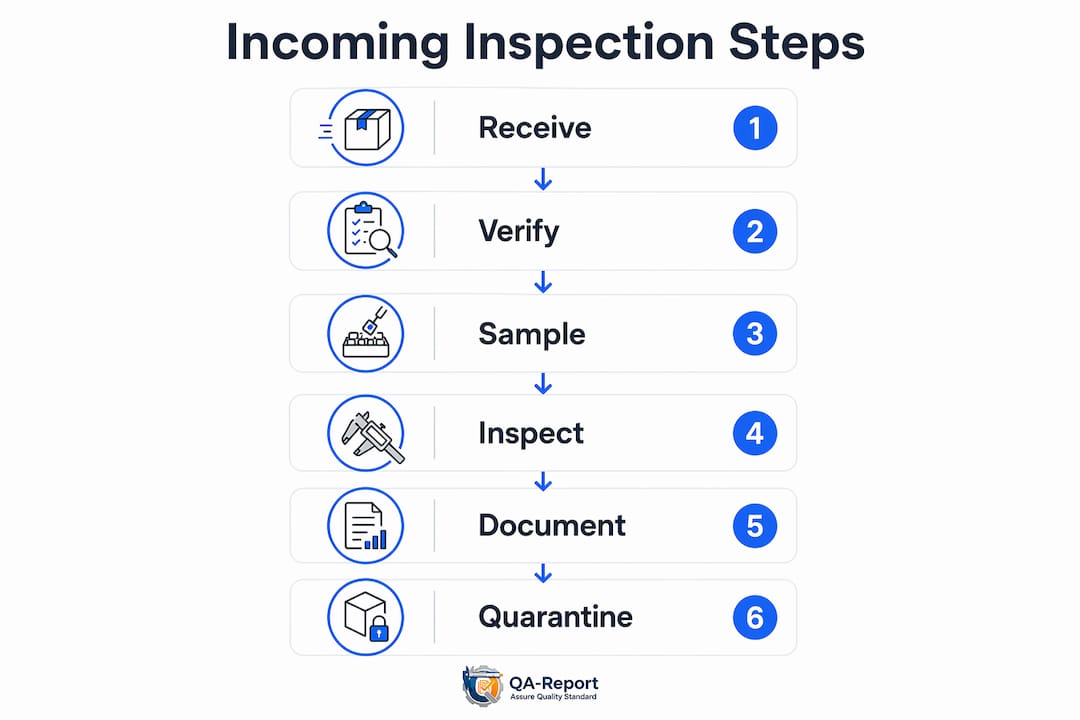
An effective incoming inspection follows a defined sequence, with assigned ownership at every step. A complete procedure covers everything from dock receipt through quarantine or acceptance into stock, and every step must be documented for traceability.
The process breaks down into six stages:
- Receipt and identification. Verify the shipment against the purchase order. Check part numbers, revision levels, lot numbers, and quantities. Apply a quarantine label immediately. No material moves to stock or production before inspection is complete.
- Documentation review. Confirm Certificates of Conformance (CoCs), Material Test Reports (MTRs), and shipping documents are present and match the order. Missing or mismatched paperwork is a rejection trigger, not a minor administrative gap.
- Physical inspection. Perform visual checks for damage, contamination, and workmanship. Verify quantities against the packing list. 60–70% of inbound discrepancies stem from quantity shortages, which means a careful count is not a formality.
- Measurement and testing. Use calibrated instruments traceable to NIST standards for dimensional checks. NIST-traceable calibration is a requirement in regulated frameworks, not a best practice suggestion. Record all measurements directly to the inspection record.
- Disposition decision. Accept, reject, place on hold, or approve for conditional use. Rejected material goes to a physically separated nonconforming area immediately. Conditional use requires documented engineering authorization.
- Record keeping. Close the inspection record with the inspector's name, date, instrument IDs, and final disposition. Traceability is only as strong as its weakest link. A missing instrument ID breaks the chain.
The key supporting documents your team needs at each stage include:
- Purchase order and approved drawing revision
- Supplier CoC and MTRs
- Approved Supplier List (ASL) status confirmation
- Completed incoming inspection form or template
- Nonconformance report (NCR) if disposition is rejection or hold
Pro Tip: Time-sensitive or temperature-controlled goods require inspection immediately upon arrival. Delaying inspection on these items risks product compromise and eliminates your right to file damage claims against the carrier.
How do sampling plans and ANSI/ASQ Z1.4 shape inspection protocols?
Inspecting every unit in every lot is rarely practical. Statistical sampling lets your team balance inspection cost against risk, provided you apply the right standard.
ANSI/ASQ Z1.4 is the dominant attribute sampling standard for incoming quality control. It uses Acceptable Quality Levels (AQL) to define the maximum defect rate considered acceptable for a given lot. AQL values range from 0.065% for critical defects to 4.0% for commercial manufacturing applications. Choosing the right AQL is a risk decision, not a default setting.
Attribute vs. variable sampling
ANSI/ASQ Z1.4 evaluates characteristics as pass or fail. ANSI/ASQ Z1.9 measures actual values and uses statistical inference. Variable sampling under Z1.9 generally requires smaller sample sizes than attribute sampling for equivalent statistical confidence, but it only applies when the characteristic follows a normal distribution and you have a measurement value to record. For most visual and conformance checks, Z1.4 remains the correct choice.
When to use 100% inspection vs. sampling
The table below maps common scenarios to the appropriate inspection intensity:
| Scenario | Recommended approach |
|---|---|
| New supplier, first shipment | 100% inspection |
| Critical safety or flight-critical parts | 100% inspection |
| Approved supplier, stable history | Sampling per Z1.4 |
| Preferred supplier, 10+ consecutive accepted lots | Skip-lot or reduced inspection |
| Conditional or probationary supplier | Increased sampling or 100% |
ANSI/ASQ Z1.4 skip-lot eligibility requires 10 consecutive accepted lots without a rejection. That threshold exists because supplier performance data, not optimism, should drive your inspection frequency decisions.
Pro Tip: Never apply skip-lot inspection to safety-critical characteristics, regardless of supplier history. Separate your inspection plan by characteristic criticality, not just by supplier status.
What impact does supplier qualification have on inspection intensity?
Supplier qualification status is the single biggest driver of how much inspection effort a given shipment demands. A tiered approach lets your team allocate resources where risk is highest.
Supplier status directly determines inspection intensity, and most quality management systems recognize at least four tiers:
- Preferred or approved suppliers have a documented track record of conformance. They qualify for reduced sampling, skip-lot inspection, or dock-to-stock programs where material bypasses incoming inspection entirely based on certified data.
- Conditional suppliers have had recent nonconformances or are undergoing corrective action. They receive increased sampling rates or 100% inspection until performance recovers.
- Probationary suppliers are new to your ASL or have failed a supplier audit. Every shipment receives 100% inspection until a minimum number of accepted lots establishes a baseline.
- New suppliers for high-risk or regulated materials require First Article Inspection (FAI) per AS9102 before any production quantities are accepted. FAI is not a substitute for incoming inspection on subsequent lots. It establishes the baseline your team measures against.
The practical implication is that your incoming inspection template and sampling plan should reference ASL status at the top of every inspection record. An inspector who does not know the supplier's qualification tier cannot apply the correct inspection level. That gap creates both quality risk and audit exposure.
Dock-to-stock programs carry the highest risk if your supplier data is stale. Review ASL status at least annually, and trigger an immediate re-evaluation after any customer complaint or field return traced to a specific supplier.
What tools and best practices improve accuracy and efficiency?
The right tools and checklist design eliminate the most common failure modes in quality control in warehouse and receiving environments.

Checklist and documentation discipline
Formal checklists improve putaway confirmation accuracy to 99.2%, compared to 91% without them. That 8-point gap represents real inventory errors that compound over time. Your incoming inspection template should cover:
- SKU and part number verification against the PO
- Quantity count with unit of measure confirmation
- Visual damage and condition check
- Packaging integrity and labeling review
- Storage location confirmation and temperature requirements
Combining multiple purchase orders on a single checklist increases error risk significantly. Enforce one inspection form per PO, without exception. End-of-shift verification by a second inspector or supervisor catches errors before material moves.
Barcode scanning and data capture
Barcode scanning reduces SKU misidentification by up to 67% in incoming inspection. Manual part number transcription is one of the highest-frequency error sources in quality assurance in warehouse operations. Scanning eliminates the transcription step entirely and creates an automatic timestamp and audit trail.
For dimensional inspection, importing CMM data directly into your inspection records removes manual data entry errors and accelerates report generation. This is especially valuable for high-volume or complex machined components where dozens of dimensions require verification.
Nonconforming material handling
Nonconforming materials must be quarantined immediately with red tags and placed in physically isolated storage. Failing to quarantine promptly is one of the most common causes of audit compliance violations. The quarantine area must be clearly marked, access-controlled, and separate from accepted stock. Every nonconforming item needs an NCR with the part number, lot, quantity, description of the nonconformance, and disposition instructions.
Pro Tip: Use inspection data from incoming checks as direct input to your supplier scorecard. Lot rejection rates, quantity discrepancy frequency, and documentation failure rates give you objective data for supplier performance reviews and re-qualification decisions.
Key Takeaways
Incoming inspection is the most cost-effective quality intervention available, catching supplier defects before they generate rework, scrap, or compliance failures downstream.
| Point | Details |
|---|---|
| Regulatory requirement | ISO 9001:2015 Clause 8.4.3 and AS9100 mandate documented incoming verification for all externally provided products. |
| Sampling standard | ANSI/ASQ Z1.4 governs attribute sampling; AQL values range from 0.065% for critical defects to 4.0% for commercial applications. |
| Supplier tier drives intensity | Preferred suppliers may qualify for skip-lot after 10 consecutive accepted lots; new or conditional suppliers require 100% inspection. |
| Checklist accuracy | Formal checklists raise putaway confirmation accuracy to 99.2%, versus 91% without structured documentation. |
| Quarantine is non-negotiable | Nonconforming material must be red-tagged and physically isolated immediately to prevent audit violations and accidental use. |
Where most incoming inspection programs quietly fail
I have reviewed incoming inspection programs across aerospace and medical device facilities for over a decade. The technical steps are rarely the problem. Most teams know the sequence. What breaks down is the gap between what the procedure says and what actually happens at the dock.
The most common failure I see is treating the incoming inspection form as a formality rather than a decision record. Inspectors sign off on documentation they have not fully reviewed because the pressure to move material is real and immediate. A CoC with the wrong revision level gets waved through because the part "looks right." That shortcut costs ten times more to fix when it surfaces during a customer audit or a field return.
The second failure is disconnected data. Inspection results sit in paper binders or isolated spreadsheets and never feed back into supplier performance reviews. Your team collects the data and then discards the intelligence. Connecting incoming inspection results to a supplier scorecard turns a compliance activity into a continuous improvement tool.
The third failure is treating all parts equally. Not every incoming lot carries the same risk. A team that applies the same inspection intensity to commodity fasteners and flight-critical castings is either over-inspecting low-risk material or under-inspecting high-risk material. Tiered inspection by criticality and supplier status is not a shortcut. It is the correct engineering response to finite inspection resources.
The balance between thoroughness and efficiency is not a compromise. It is a design problem. Build your inspection program around risk, supplier data, and standard-compliant sampling, and you get both.
— Michael Chen
How QA-Report supports your incoming inspection process
Quality assurance teams that rely on paper forms and manual data entry spend hours on documentation that should take minutes.
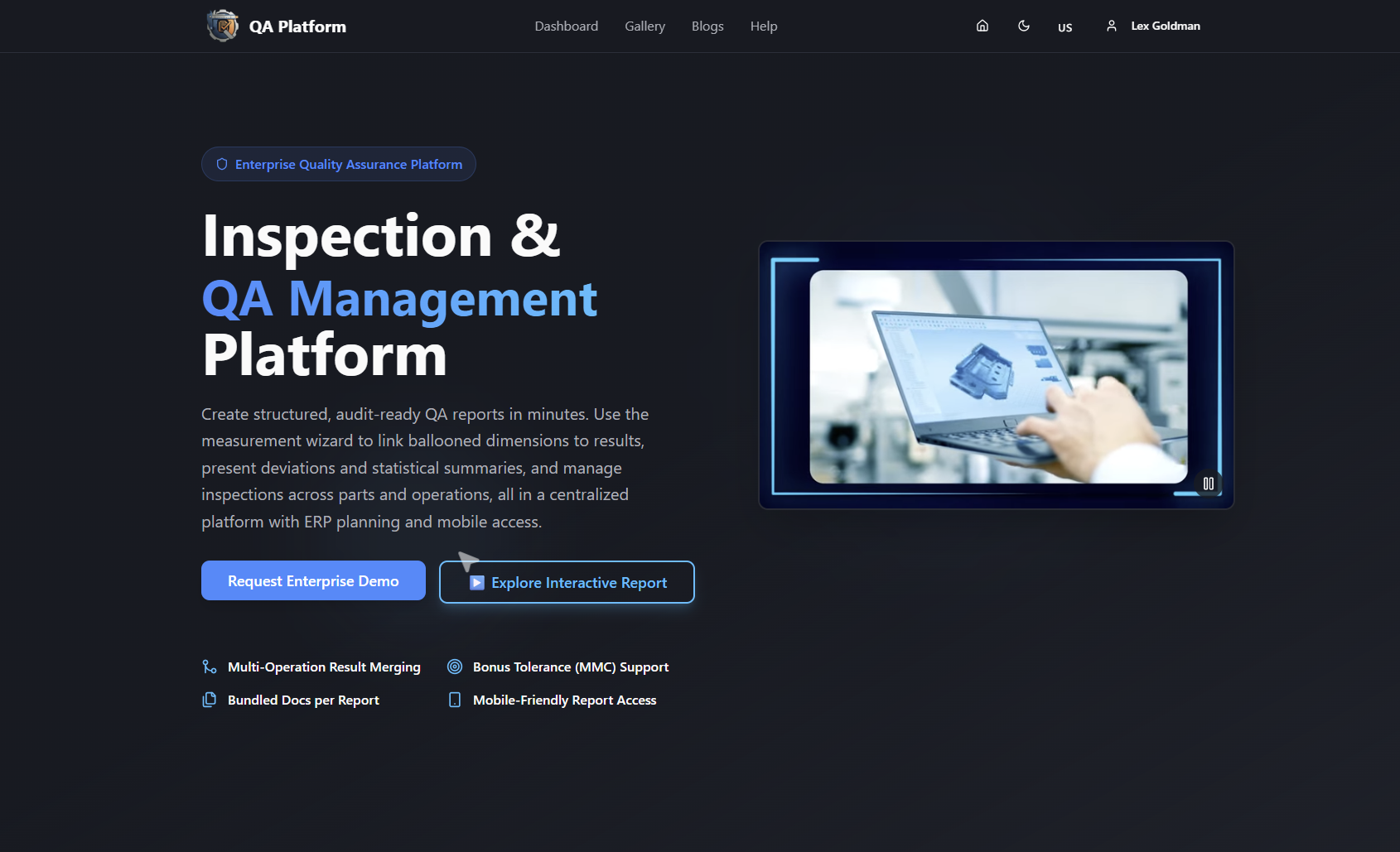
QA-Report is a cloud-based inspection platform built for manufacturers in aerospace, automotive, and medical device production. It generates audit-ready inspection reports that satisfy ISO 9001, AS9100, and PPAP requirements, with automatic tolerance flagging, CMM data import, and a built-in 3D CAD viewer for STEP and IGES files. Inspectors on the floor use mobile access to record results in real time, and the platform manages nonconformance tracking, supplier data, and role-based access in one centralized system. If your team is still reconciling paper inspection records at the end of a shift, QA-Report removes that bottleneck entirely.
FAQ
What is incoming inspection in manufacturing?
Incoming inspection is the formal verification of purchased materials and components against specified requirements before they enter production. ISO 9001:2015 Clause 8.4.3 requires documented incoming verification for all externally provided products.
What is an AQL in incoming quality control?
AQL stands for Acceptable Quality Level, the maximum defect rate considered acceptable for a given lot under ANSI/ASQ Z1.4. AQL values range from 0.065% for critical defects to 4.0% for commercial manufacturing applications.
How do I conduct incoming inspections for a new supplier?
New suppliers require 100% inspection on initial shipments, and high-risk or regulated materials require First Article Inspection per AS9102 before production quantities are accepted. Skip-lot or reduced inspection only applies after a documented history of conforming lots.
What should an incoming inspection form include?
A complete incoming inspection form covers part number and revision verification, quantity count, visual and dimensional check results, CoC and MTR review, calibrated instrument IDs, and final disposition with the inspector's signature and date.
When can a supplier qualify for dock-to-stock?
A supplier qualifies for dock-to-stock when it has a sustained record of conformance, an approved status on your ASL, and meets your organization's defined threshold for consecutive accepted lots, typically aligned with ANSI/ASQ Z1.4 skip-lot criteria.