
A manufacturing execution system, or MES, is the software layer that monitors, tracks, and controls production between your ERP and the machines on the floor. For a manufacturing manager, its core value is straightforward: real-time visibility into every part and batch, traceability you can hand an auditor without panic, and a measurable lift in OEE once the data starts flowing cleanly.
TL;DR:
- An MES is essential for regulated industries and complex manufacturing environments, especially when operations still rely on paper and manual data entry.
- Core MES functions include resource management, scheduling, data collection, quality control, traceability, and performance analysis, with data collection and analysis being the highest priority initially.
- MES benefits depend heavily on clean data and user adoption; it enhances visibility but does not replace quality management systems or improve profitability without proper data.
- Deployment can take 4 to 12 months, with full ROI often realized within two years, emphasizing the importance of early KPIs like first-pass yield and real-time OEE components.
- Start with a lightweight OEE tool if regulation is not strict; for regulated production, a full MES with comprehensive traceability and quality modules is mandatory to meet compliance audits.
Table of Contents
- What Is MES and Where Does It Fit in Manufacturing?
- What Are the Core Functions of an MES?
- What Benefits Does MES Deliver, and What Are the Real Limits?
- How Does MES Integrate With ERP, PLM, and Shop-Floor Systems?
- How Long Does MES Implementation Take, and What ROI Should You Expect?
- Should You Start With an OEE Tool or Commit to Full MES?
- How QA-Report Supports MES-Style Shop-Floor Workflows
- Why Compliance Should Drive Your MES Scope, Not Vendor Hype
- Get Audit-Ready Faster With QA-Report
- Sources
What Is MES and Where Does It Fit in Manufacturing?
Before going further, a quick disambiguation: this article means Manufacturing Execution System, not the Microsoft "My Apps" portal that shares the same three letters in enterprise IT circles. Different world entirely.
In the ISA-95 framework, MES occupies Level 3, the operational layer sitting between enterprise planning at Level 4 (your ERP, handling orders, financials, and materials planning) and the physical control systems at Levels 0 through 2 (PLCs, SCADA, sensors). SAP describes MES as the system that monitors, tracks, documents, and controls manufacturing from raw material to finished part. That is the technical definition. The manager-facing version is simpler: MES answers "what is happening on the floor right now, and can I prove it happened correctly?"
MES becomes necessary, not optional, in a specific set of conditions:
- Regulated production where electronic batch records or full genealogy are required (aerospace, medical devices, pharmaceuticals)
- Complex scheduling across multiple work centers, shifts, or product mixes
- Operations still running on paper travelers, whiteboards, or spreadsheets for shop-floor data
- Multi-plant environments where leadership needs comparable performance data across sites
MESA International, the industry body behind the original functional model, has tracked how MES scope has evolved since the 1990s, and its functional breakdown remains the reference checklist vendors and buyers still use today.
What Are the Core Functions of an MES?
MESA's functional model groups MES capability into distinct areas, and understanding them helps you separate marketing language from what the software actually does. Wikipedia's summary of the standard breakdown covers product definition management, resource allocation, scheduling and dispatch, data collection, quality management, performance analysis, and traceability.
Here is what each looks like in practice on a shop floor:
- Resource management tracks machine, tooling, and labor availability in real time
- Scheduling and dispatch sequences jobs based on capacity, priority, and material readiness
- Data collection pulls cycle times, scrap counts, and downtime reasons directly from equipment or operator entry
- Quality management enforces inspection checkpoints and flags out-of-spec results before a part moves downstream
- Traceability links raw material lots to finished parts, batch by batch, operation by operation
- Maintenance integration ties machine condition data to work orders, reducing unplanned downtime
- Performance analysis calculates OEE and related metrics from the data collected above
Pro Tip: If you can only fund one MES module in year one, pick data collection and performance analysis. Every other function depends on that data existing, and the OEE numbers alone often justify the next phase's budget.
Connectivity determines how painful this gets. Equipment that speaks OPC-UA or MQTT integrates far faster than legacy machines requiring custom drivers, and that difference can shift a rollout timeline by months.
What Benefits Does MES Deliver, and What Are the Real Limits?
Well-implemented MES produces benefits that show up on a P&L: tighter quality control, higher uptime, less excess inventory sitting between operations, and shop-floor records that no longer live in a binder. Plant Engineering's analysis of MES benefits confirms these gains but is candid about the ceiling: MES improves visibility, but visibility only translates into better decisions when the underlying data is clean and people actually use the system.
That is the part vendors rarely lead with. Common gaps include:
- MES tracks production execution; it does not replace a formal quality management system for document control and CAPA workflows, which is why understanding where MES ends and QMS begins matters before you buy either
- Garbage data in means garbage OEE out. Operators need training, not just system access
- Change management, not software configuration, is usually the longest phase of a rollout
On KPIs: resist the urge to chase a single "OEE score" as your only success metric. High OEE without context can mislead, particularly when overhead allocation problems mask whether that efficiency is actually profitable. Track availability, performance, and quality separately at first.
How Does MES Integrate With ERP, PLM, and Shop-Floor Systems?
MES deployment falls into three broad patterns. On-premise installations still dominate in high-security or air-gapped environments, particularly defense and some medical device plants. Cloud MES has become the default for mid-sized manufacturers chasing faster deployment and lower upfront infrastructure cost. Hybrid setups, running core execution logic on-site with analytics and reporting in the cloud, are increasingly common where connectivity is inconsistent but leadership still wants remote dashboards.
Integration flows typically look like this, and IBM's overview of MES architecture frames it the same way: ERP pushes down order and material data, MES executes and reports back actuals, and PLC/SCADA systems feed machine-level data upward. PLM systems contribute engineering specs and revision control. LIMS integration matters heavily in regulated industries where lab results must tie back to a specific batch. CMMS integration connects maintenance history to equipment performance.
A few standards and protocols make this connectivity practical rather than theoretical:
- B2MML (Business to Manufacturing Markup Language) standardizes the data exchange format between ERP and MES
- OPC-UA provides secure, platform-independent communication with PLCs and sensors
- MQTT handles lightweight messaging for high-volume sensor data, especially useful across distributed equipment
A systems integrator specializing in enterprise automation can be worth bringing in early when your equipment mix spans several generations of controllers, since retrofitting older machines for MES connectivity is usually the slowest part of any integration project.
How Long Does MES Implementation Take, and What ROI Should You Expect?
MES rollouts move through four phases, and rushing any one of them is the most common way projects stall.
- Assess (4 to 8 weeks): Baseline your current OEE, document existing workflows, and map data sources. Skipping this step is why so many projects discover integration problems mid-build instead of upfront.
- Pilot (2 to 4 months): Deploy on one line or cell, focused on a single high-value function like data collection or quality checkpoints.
- Roll-out (6 to 12 months): Extend proven configuration across additional lines or plants, adjusting for local process differences.
- Optimize (ongoing): Refine dashboards, tighten alert thresholds, and expand functional scope as adoption matures.
Full OEE gains from an MES rollout often take 12 to 24 months to fully materialize, largely because performance improvement depends on operators trusting and correctly using the system, not just having it installed. Compliance and documentation benefits, by contrast, tend to show up much sooner on regulated lines, sometimes within the pilot phase, because electronic records replace paper immediately rather than requiring a behavior shift.
Build your ROI case around KPIs that are visible early: first-pass yield, time-to-audit-readiness, and the individual OEE components (availability, performance, quality) rather than a single blended score. A production tracking system that gives real-time visibility into these components from day one makes the pilot phase far easier to defend to finance.
Should You Start With an OEE Tool or Commit to Full MES?
The decision usually comes down to which problem is more urgent: performance or compliance. TeepTrak's framing of this trade-off is useful because it maps cleanly to how fast each option pays back.
- Fast performance wins, low regulatory pressure → Start with a focused OEE platform. Deployment is faster, cost is lower, and you get usable downtime and efficiency data within weeks.
- Regulated production requiring electronic batch records or full genealogy → Full MES is close to mandatory, particularly in aerospace, medical devices, or pharmaceutical manufacturing, where auditability is non-negotiable.
- Both matter, and neither can wait → A hybrid architecture, running OEE monitoring immediately while phasing in quality and traceability modules, reduces the risk of committing to a large system before proving value.
Pro Tip: Measure baseline OEE with a lightweight proof-of-concept before you sign any MES contract. It gives you a defensible before-and-after number and keeps vendors honest about what their system actually improved.
When evaluating vendors, ask pointed questions: Who owns the data once it leaves the machine? What connectivity protocols does the platform support natively? Can it support validation documentation if you're regulated? How does pricing scale as you add lines?
How QA-Report Supports MES-Style Shop-Floor Workflows
QA-Report combines inspection reporting with an MES layer built for parts, batches, and operations. Its measurement wizard links ballooned drawing dimensions to measured results and auto-flags deviations, while CMM data import and batch and route card tracking keep genealogy intact from raw material to finished part.
That combination shortens the gap between inspection and shop-floor execution. Instead of quality data sitting in a separate silo, it feeds directly into the same platform managing kanban and Gantt planning, rejection tracking, and role-based mobile access for inspectors on the floor.
Why Compliance Should Drive Your MES Scope, Not Vendor Hype
Most MES buying decisions get framed as a performance question. What OEE lift can you show me? What is the payback period. That framing is not wrong, but it misses the more consequential decision most managers actually face: whether your compliance obligations, not your efficiency ambitions, should be setting the scope of the project.
The evidence points in an unglamorous direction. If you are not regulated, an OEE-first tool wins on speed and cost almost every time, and there is little reason to buy more MES than that. But if you build medical devices, aerospace hardware, or pharmaceutical products, the traceability and electronic record requirements are not negotiable, and a partial MES deployment that skips quality and genealogy modules will leave you exposed at your next audit regardless of how good your uptime numbers look.
The conventional advice, "start small and expand," is fine for performance-driven plants, but dangerous for regulated ones. Know which category you're in before you scope the project, not after the pilot fails an audit.
— Michael Chen
Get Audit-Ready Faster With QA-Report
QA-Report is built for exactly the scenario this article just walked through: manufacturers who need MES-level shop-floor visibility without losing the inspection rigor that regulated production demands. Where a standalone OEE tool stops at performance data, The system ties dimensional inspection, CMM data import, and batch traceability into the same system that manages your route cards and production planning.
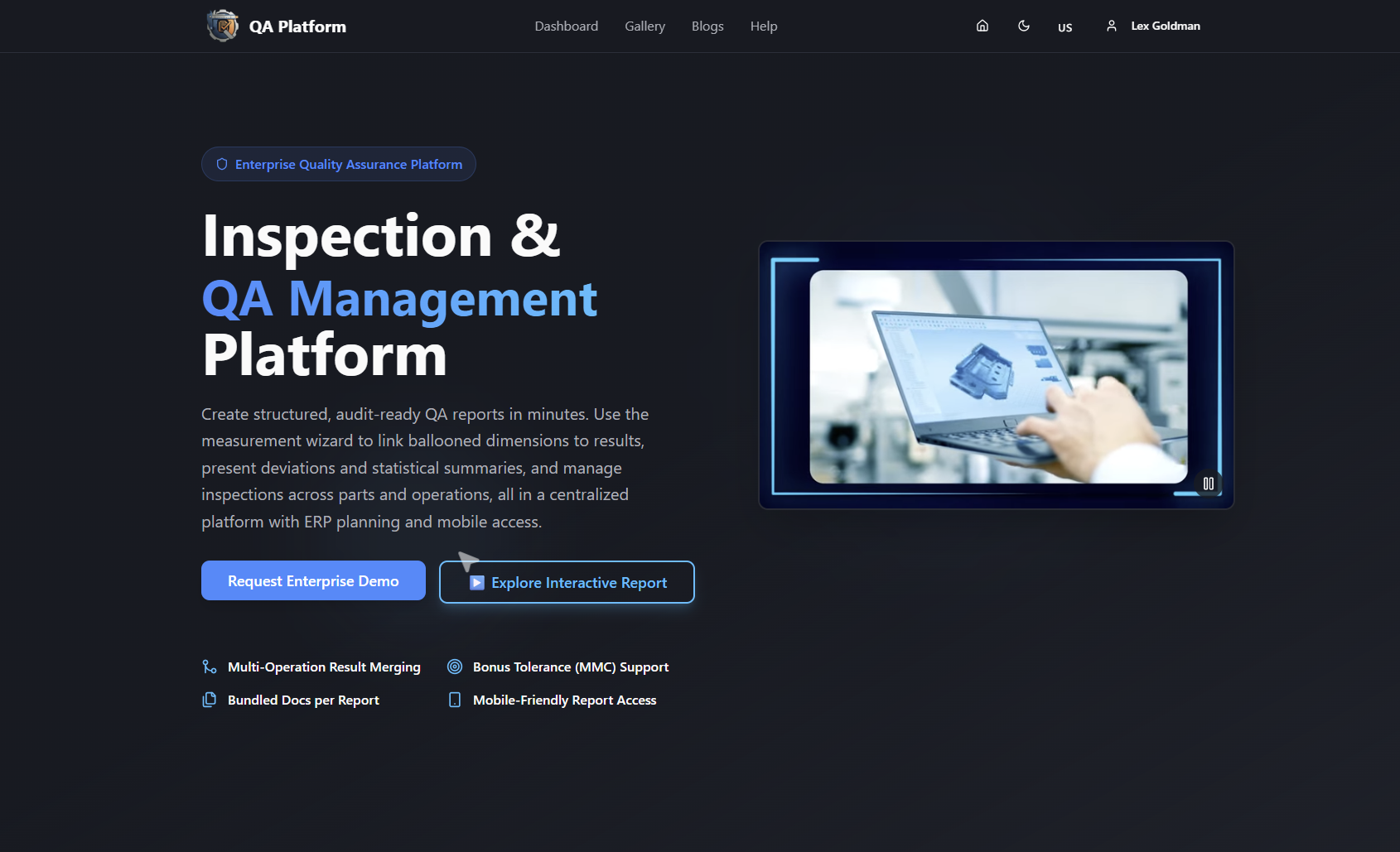
That means First Article Inspection reports, GD&T validation, and out-of-tolerance flagging happen inside the same workflow that tracks your batches and operations, not in a separate spreadsheet someone forgets to update. For regulated manufacturing shops facing various industry standards, that connection helps turn audit preparation into a more efficient reporting process.
If your next audit is closer than your MES budget cycle, start with a QA-Report trial and see how quickly ballooned drawings and CMM imports turn into a report you can hand an auditor today.