
BLUF: MES enforces execution on the shop floor; QMS governs quality processes and continuous improvement. Most manufacturers need both, integrated, so nonconformances flow automatically between systems instead of getting re-typed by hand. Your immediate action: pick one data type, such as genealogy records, and assign it a single system of record before you build anything else.
- MES answers "what happened on the floor right now?"
- QMS answers "was it right, and what do we do about it if it wasn't?"
- Integration closes the loop between the two, enabling closed-loop CAPA
ISA-95 draws the boundary between execution and governance, and ISO 9001 sets the requirements a QMS has to satisfy. Platforms like QA-Report now combine both layers so the handoff happens automatically rather than through spreadsheets.
Key Takeaways
Closed-loop quality between MES and QMS depends on assigning clear system-of-record ownership before any technical integration begins.
| Point | Details |
|---|---|
| Know the split | MES owns execution and real-time shop-floor data; QMS owns governance, CAPA, and audits. |
| Fix ownership first | Assign system-of-record status for specs, genealogy, and nonconformance using ISA-95 before building integrations. |
| Integrate for closed-loop CAPA | Automatic nonconformance creation and real-time holds cut investigation and audit prep time. |
| Match the setup to your risk | Regulated, multi-site, or high-mix manufacturers generally need both systems integrated, not one alone. |
| Consider a unified platform | QA-Report combines audit-ready inspection reporting with an MES layer, removing the need for custom middleware. |
Standards and Authority Pages to Consult Next
- ISA-95 knowledge overview for drawing execution vs. governance boundaries
- ISO 9001 standard information for QMS requirements and audit expectations
- MESA model resources for practical guidance on system-of-record governance and canonical IDs
Table of Contents
- MES vs QMS: What Is a QMS and What Does It Own?
- MES vs QMS: What Is an MES and What Does It Own?
- What Are the Key Differences Between MES and QMS?
- Where Do MES and QMS Overlap and What Does Integration Buy You?
- When Do You Need QMS Alone, MES Alone, or Both?
- How Do You Integrate MES and QMS Without Breaking Traceability?
- How Does QA-Report Bring MES and QMS Together?
- How Have MES and QMS Converged Over the Past Two Decades?
- What Goes Wrong When You Deploy MES and QMS Separately or Together?
- What Business Outcomes Come From MES-QMS Integration?
- What managers underestimate about MES vs QMS
- Get an Integrated MES and QMS Without the Middleware Headache
- Sources
MES vs QMS: What Is a QMS and What Does It Own?
A quality management system is the governance layer that turns your quality policy into repeatable process. ISO 9001 requires a process-oriented approach: you define how work should happen, verify it happened that way, and prove it with records an auditor can follow without asking you to explain gaps.
A QMS typically owns:
- Document control — controlled revisions of specs, work instructions, and procedures
- CAPA management — corrective and preventive action tracking from root cause to closure
- Audit management — internal audits, supplier audits, and regulatory audit prep
- Training records — who is qualified to do what, and when that qualification expires
- Change control — how engineering or process changes get evaluated and approved
The primary users are quality managers, quality engineers, and auditors, and the time horizon is longer than a single shift. A QMS cares about trends across weeks and quarters, not what happened on station 4 ten minutes ago. Typical KPIs include CAPA closure time, the number of repeat audit findings, and training compliance rate. When a QMS runs well, an external auditor can trace any nonconformance back to a root cause and forward to a verified fix without a single phone call to the floor.
MES vs QMS: What Is an MES and What Does It Own?
A manufacturing execution system runs at ISA-95 Level 3, the layer between shop-floor equipment and business planning software. It exists to dispatch work, capture data as it happens, and record exactly what was built, by whom, on which machine.
Core MES responsibilities include:
- Work dispatch — routing jobs to the right station in the right sequence
- Work instructions — delivering the current revision directly to the operator, not a printout from last month
- Real-time data capture — cycle times, scrap counts, machine states, operator actions
- Genealogy tracking — linking every component, lot, and serial number to the parent assembly
- Production performance — OEE, throughput, and downtime by cause
MES users are operators, production supervisors, and shop-floor managers, and the time horizon is now, this shift, this batch. The KPIs are immediate: OEE percentage, cycle time variance, first-pass yield by station. This is also where the as-built record comes from. When a customer complaint or a field failure triggers an investigation, the genealogy and time-stamped process data MES captured are usually the only evidence that reconstructs what actually happened on the line that day.
What Are the Key Differences Between MES and QMS?
The cleanest way to separate the two is by what each system owns, not by feature lists that overlap on the surface.
| Dimension | MES | QMS |
|---|---|---|
| Primary purpose | Execute and record production | Govern quality processes and drive improvement |
| Data source | Machines, operators, sensors, scans | Inspections, audits, CAPA investigations, training logs |
| Primary users | Operators, supervisors | Quality managers, auditors |
| Core KPIs | OEE, cycle time, throughput | CAPA closure time, audit findings, repeat defects |
| Time horizon | Real-time, per shift | Trend-based, weeks to quarters |
The practical consequence of blurring that line shows up first at audit time. If genealogy records live half in MES and half in a QMS spreadsheet someone updates when they remember, an auditor pulling a random lot number will find two different stories. That is a system-of-record failure, not a data-entry mistake, and it is the single most common finding in facilities running MES and QMS without integration.
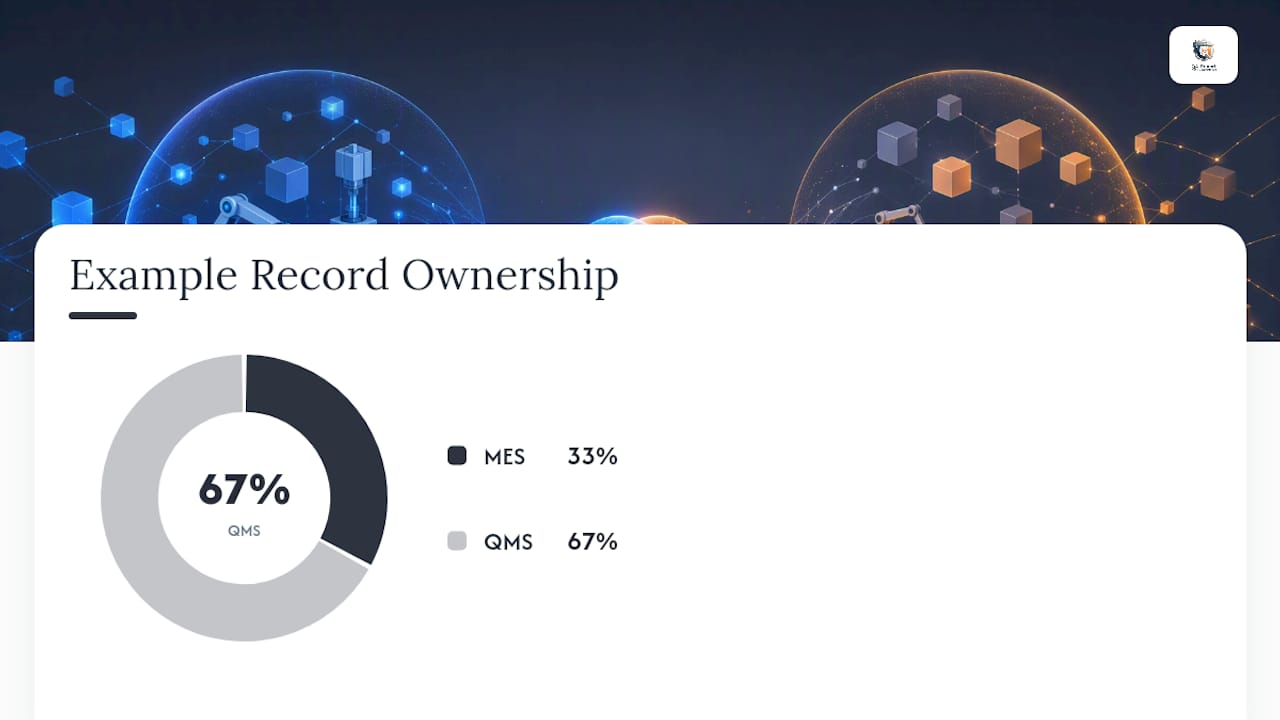
A few concrete examples make the ownership split obvious. A nonconformance should always live in the QMS, because that is where root cause, disposition, and CAPA tracking belong. Genealogy and as-built process data should always live in MES, because that is where the timestamps and machine data originate. Training records belong in the QMS, since qualification status is a governance decision, not a shop-floor event. When teams try to duplicate any of these across both systems "just in case," they get copy-paste drift, where the two records disagree and nobody trusts either one.
Where Do MES and QMS Overlap and What Does Integration Buy You?
The overlap zone is smaller than most people assume, but it is where the real payoff lives. Inspections, deviations, in-process holds, and the downstream effects of an engineering change all touch both systems at once. An inspection happens on the floor (MES event) but a failed inspection needs a formal disposition (QMS process). A deviation gets caught during production (MES) but requires root cause analysis and sign-off (QMS).
Integrating the two systems delivers benefits that are hard to get any other way:
- Automatic nonconformance creation. An out-of-tolerance measurement in MES generates a QMS nonconformance record instantly, with the measured data already attached.
- Real-time quality holds. A failed inspection can trigger a lineside hold before the next 50 parts get built the same wrong way.
- Faster CAPA verification. Once a corrective action is implemented, MES data can confirm the fix worked in production, not just on paper.
- Audit-ready evidence on demand. Traceability chains connect automatically instead of getting reconstructed under deadline pressure.
A typical closed-loop workflow runs like this: an MES event flags a dimension out of tolerance, the system generates a QMS nonconformance automatically, the CAPA process runs its root cause and correction, and MES verifies the fix on the next production run.
Pro Tip: Start integration with your highest-volume nonconformance type, not your most complex one. Quick wins on repetitive issues build the case for expanding the integration to edge cases later.
When Do You Need QMS Alone, MES Alone, or Both?
Company size, product complexity, and regulatory exposure decide which setup fits.
- QMS alone works for small, low-complexity shops where documentation and audit readiness matter more than real-time shop-floor visibility, such as a job shop running a handful of stable part numbers.
- MES alone can fit simple, high-volume production lines, but it carries real risk once CAPA volume or audit frequency grows, because quality records end up scattered across spreadsheets nobody owns.
- Both, integrated, become close to mandatory in regulated industries like medical device and aerospace manufacturing, and for any multi-site or high-mix operation where traceability has to hold up across locations and part families.
How Do You Integrate MES and QMS Without Breaking Traceability?
Integration fails most often for a governance reason, not a technical one: nobody decided which system owns which piece of data before the project started. Practitioners consistently point to unclear ownership of specs and routings as the cause of most post-integration defects.
- Assign system-of-record status using ISA-95. Specs and routings typically belong to engineering systems, genealogy and as-built data belong to MES, and nonconformance and CAPA belong to QMS. Write this down before any code gets written.
- Define canonical IDs. Every part, lot, batch, and work order needs one ID that both systems reference, not two IDs that a mapping table tries to reconcile after the fact.
- Build five event contracts. At minimum: inspection result, out-of-tolerance flag, nonconformance created, disposition issued, CAPA closed. Each needs a defined payload and a defined trigger.
- Write validation test cases. Test what happens when an event arrives twice, arrives late, or references an ID that doesn't exist yet in the receiving system.
- Set a governance cadence. Mapping ownership and canonical IDs before writing integration code reduces rework, but the payoff only holds if someone checks monthly for ID mismatches, failed retries, and deviations sitting open past their SLA.
Regulated manufacturers building integrations involving electronic signatures or device history records need to account for 21 CFR Part 11 controls from the start, not retrofit them later.
How Does QA-Report Bring MES and QMS Together?
QA-Report treats FAI, dimensional, and GD&T inspection as a native part of production, not a bolt-on. The measurement wizard links ballooned drawing dimensions to measured results and auto-flags deviations, so an out-of-tolerance reading can trigger a hold without a manual handoff.
- Audit-ready FAI, dimensional, and PPAP reports built for ISO 9001, AS9100, and PPAP requirements
- AI drawing ballooning and a built-in 3D CAD viewer for STEP/IGES files
- CMM data import with automatic mapping to reduce transcription errors
- An MES layer with route cards, kanban and Gantt planning, and rejection/recovery tracking in the same platform
| Point | Details |
|---|---|
| Single platform | Inspection, tolerance validation, and MES scheduling run in one system instead of two reconciled manually. |
| Traceability by design | Batch and serial tracking connects measured results directly to production records. |
| Audit prep | Reports are formatted to satisfy ISO 9001, AS9100, and PPAP reviewers without rework. |
How Have MES and QMS Converged Over the Past Two Decades?
MES and QMS started as separate disciplines with separate vendors, and for most of their history they stayed that way. Early MES platforms in the 1990s focused almost entirely on scheduling and data collection, built to talk to PLCs and answer "what's running right now." Quality management systems grew out of paper-based ISO 9001 documentation programs, designed to satisfy auditors rather than operators.
The two worlds started colliding as regulatory pressure increased, particularly in medical device and aerospace manufacturing, where a nonconformance discovered on the floor had to be traceable back to a specific serial number, operator, and machine cycle. That pressure pushed MES vendors to add quality modules and pushed QMS vendors to add real-time data feeds. Neither retrofit worked especially well, because the underlying data models were built for different purposes.
The more recent convergence has been architectural rather than feature-driven. Cloud platforms made it practical to run execution and quality logic against a shared data layer instead of stitching two on-premise systems together with custom middleware. That shift is why platforms combining inspection, ballooning, and MES scheduling in one interface have become a realistic option instead of a theoretical one. The convergence trend also tracks with tightening supplier quality requirements, where OEMs increasingly expect suppliers to produce traceable batch records on demand rather than after a formal request.
What Goes Wrong When You Deploy MES and QMS Separately or Together?
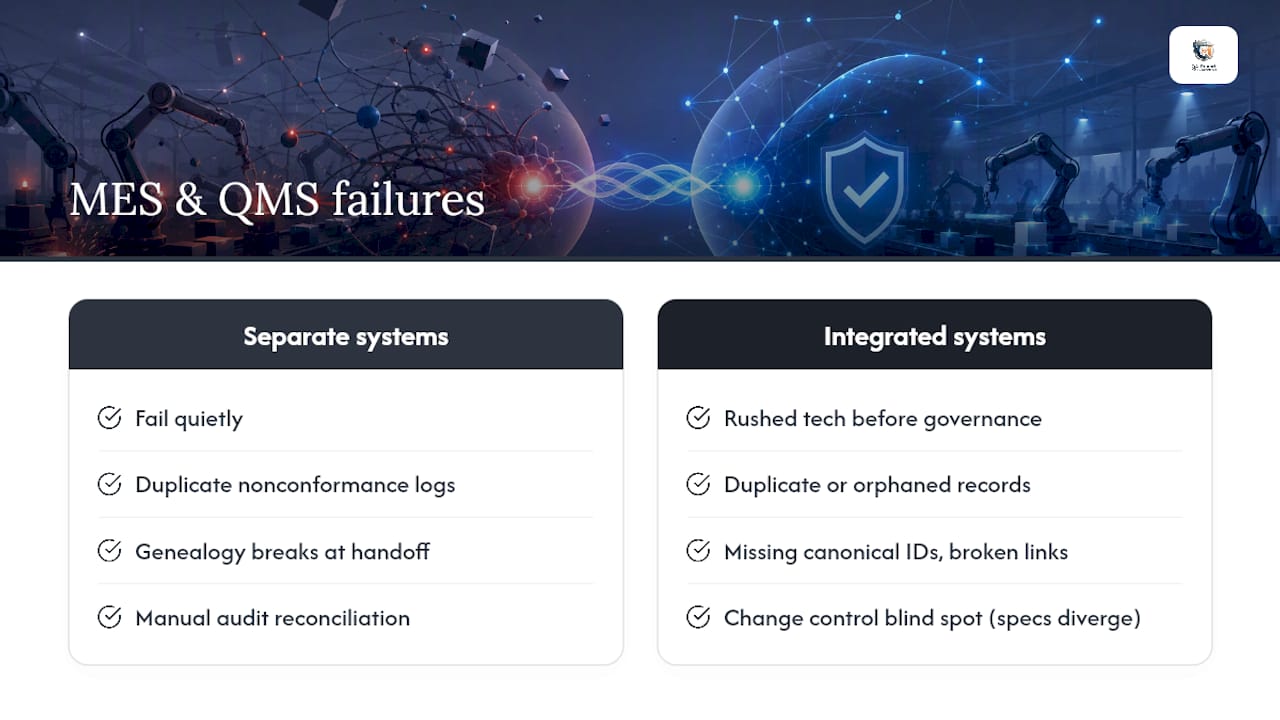
Running MES and QMS separately creates a predictable set of problems, and running them together without planning creates a different set.
Separate systems tend to fail quietly. Nonconformance data gets logged twice, once by an operator in a shared drive and once by quality staff in the QMS, and the two versions drift apart within weeks. Genealogy records that should trace a component from raw material to finished assembly break at the handoff point between systems, usually because nobody owns the ID that would keep them linked. Audit prep becomes a manual reconciliation project every single time, because the systems were never designed to answer each other's questions.
Integrated systems fail differently, usually from rushing the technical work before the governance work. Teams build event pipelines between MES and QMS without first agreeing on canonical IDs, so the integration produces duplicate or orphaned records instead of clean ones. Change control is a frequent blind spot: an engineering change updates a spec in one system but the routing or work instruction in the other system doesn't get the update, and operators keep building to the old revision. Retry logic for failed events is often missing entirely, so a single dropped nonconformance record can sit invisible for weeks.
The common thread across both failure modes is the same: governance decisions about ownership and identifiers get skipped, and the systems' technical capabilities can't compensate for that gap.
What Business Outcomes Come From MES-QMS Integration?
The most measurable outcomes from integrating MES and QMS show up in three areas: investigation speed, audit prep time, and defect containment.
Investigation speed improves because the as-built record MES captures becomes immediately available to the QMS team running root cause analysis, instead of requiring a manual pull of production logs. A quality engineer investigating a customer complaint can trace a serial number through genealogy data and see the exact machine, operator, and cycle parameters without submitting a request to production and waiting for a response.
Audit prep time drops for a similar reason. When MES events automatically generate QMS nonconformance records, the traceability chain an auditor wants to follow already exists in the system rather than needing reconstruction from multiple sources under deadline pressure. Facilities that have built this connection report spending less time preparing evidence binders and more time addressing actual findings.
Defect containment improves most visibly in high-mix or regulated environments, where a real-time quality hold triggered by an out-of-tolerance MES reading can stop a bad lot before it reaches 50 more units instead of after. That containment window, measured in parts rather than days, is often the clearest business case a plant manager can put in front of leadership when justifying the integration project.
What managers underestimate about MES vs QMS
Most guidance on MES vs QMS treats it like a shopping decision: pick the system that fits your industry and move on. That misses the actual problem. The failures I keep seeing in integration writeups aren't technology failures. They're governance failures dressed up as software problems.
Teams buy both systems, wire them together with middleware, and then discover six months later that genealogy records disagree between MES and QMS because nobody decided which one was authoritative. That's not a bug. That's a decision nobody made.
The conventional advice, "integrate MES and QMS for closed-loop quality," is correct but incomplete. It skips the part that actually determines whether the integration works: assigning system-of-record status to specific data types before any code gets written. ISA-95 gives you that framework for free. Most teams never open it.
If you take one thing from this article, take this: the technical integration is the easy part. The governance conversation about who owns what is the part that determines whether your audit trail holds up two years from now.
— Michael Chen
Get an Integrated MES and QMS Without the Middleware Headache
QA-Report gives you audit-ready inspection reports and shop-floor execution in one platform, so you never have to build the MES-to-QMS integration this article just walked you through.
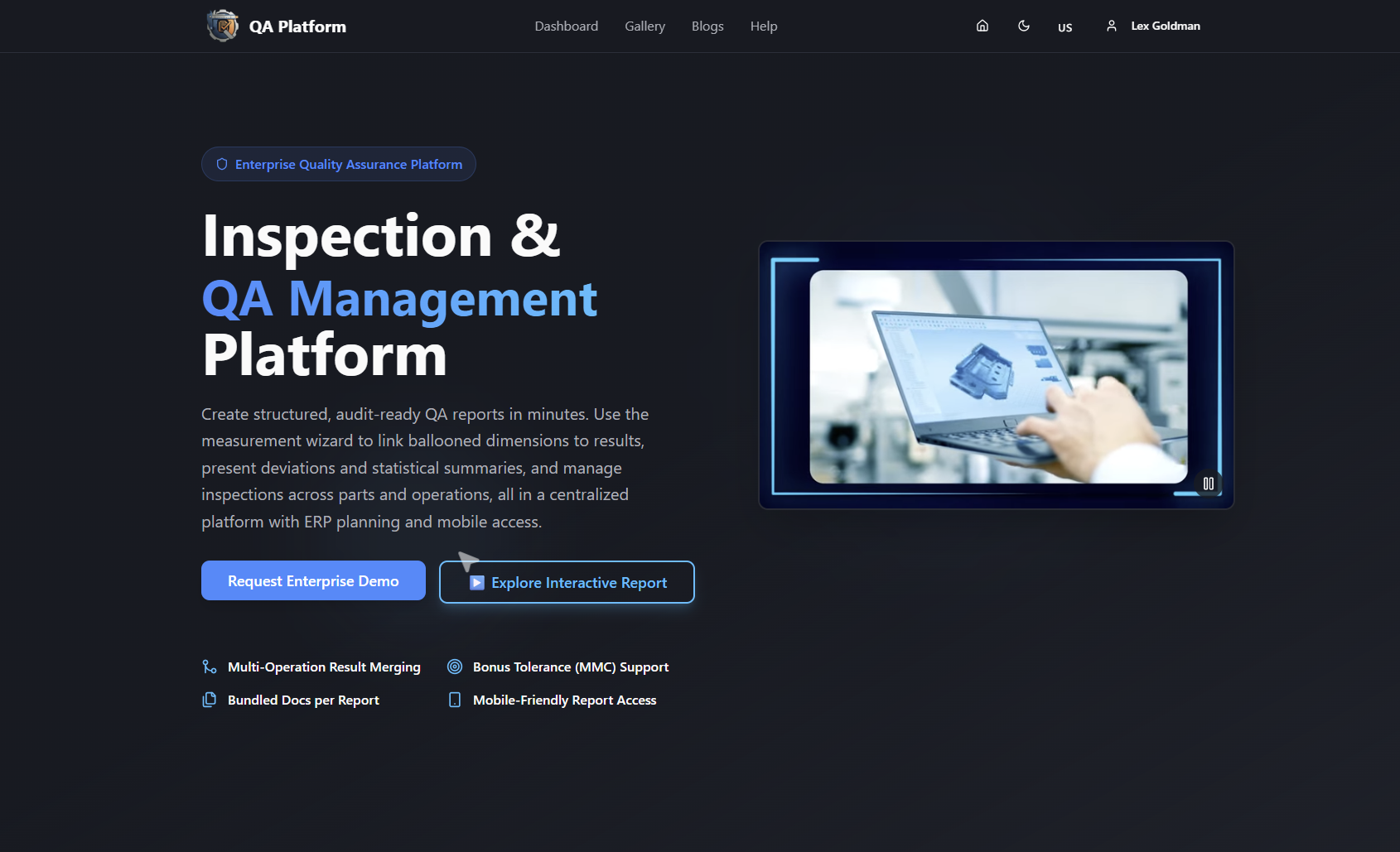
Instead of stitching together separate systems and defining event contracts yourself, you get a measurement wizard that links ballooned drawing dimensions to measured results, auto-flags out-of-tolerance deviations, and feeds directly into route cards and production planning. There's no reconciliation project between two vendors, no canonical ID mapping exercise, no monthly health check on integration retry rates. The traceability chain your auditors want already exists because inspection and execution run on the same data model from day one.
If your team is weighing whether to buy separate MES and QMS platforms and integrate them, or run both in a single connected system, start with a trial and see how First Article Inspection, CMM import, and production scheduling behave when they're not fighting each other across a middleware layer.