
Batch traceability is the system-level practice that links every production lot to its input materials, process events, and downstream shipments so your team can trace forward to affected customers or backward to root-cause inputs within minutes. For U.S. manufacturers, the immediate priority is threefold: design your records around FDA FSMA Traceability Lot Code (TLC) and Key Data Element (KDE) requirements, build material genealogy that captures parent-to-child lot relationships end-to-end, and run a 30-day pilot on a single product line before scaling.
Three things to get right from day one:
- Compliance first: The FDA FSMA Food Traceability Rule requires a persistent TLC linked to KDEs on shipping documents or electronic records for covered foods. A lot number alone does not satisfy this.
- Technical foundation: Material genealogy, event-data capture, and a binding point between physical items and digital records are the architecture that makes fast recalls possible.
- Business payoff: Faster recall containment, shorter root-cause investigations, and reduced waste are the measurable outcomes of a well-designed lot traceability program.
Start by mapping a single product's genealogy and identifying its required KDEs. That one exercise will reveal most of the gaps in your current system.
Table of Contents
- What is batch traceability, and how does it differ from serial tracking?
- How does a batch traceability system actually work?
- What features should you require in a batch traceability system?
- What are the real business benefits of lot traceability?
- What U.S. regulatory requirements govern batch traceability?
- How do GS1 EPCIS and data standards support interoperability?
- How do you evaluate and choose the right batch traceability solution?
- What does a realistic implementation roadmap look like?
- What are the most common implementation pitfalls, and how do you avoid them?
- How QA-Report supports batch and lot traceability
- Key Takeaways
- The part of batch traceability most teams get wrong
- QA-Report gives you inspection-linked batch traceability from day one
- Useful sources for further reading
What is batch traceability, and how does it differ from serial tracking?
Batch traceability, also called lot traceability, is the ability to track a defined group of products manufactured or processed under the same conditions as a single unit. The batch or lot shares a common identifier, and every record tied to that identifier, including input materials, process parameters, quality results, and shipment destinations, travels with it through the supply chain.

The distinction from serial number tracking matters operationally. Serial number traceability assigns a unique identifier to each individual item. That granularity is necessary when items have high individual value, unique configurations, or regulatory requirements at the unit level, such as an implantable medical device or a serialized aerospace fastener. Batch-level tracing is sufficient, and far more practical, when items within a lot are functionally identical and the risk is shared across the group rather than unique to each unit.
When batch tracking is the right choice
In food manufacturing, a lot of canned tomatoes processed on the same line in the same shift shares the same risk profile. If a contamination event occurs, the entire lot is the unit of concern, not individual cans. Pharmaceutical manufacturers use lot traceability for tablets, vials, and bulk drug substance, where a batch record documents every input and process step for the entire production run. Discrete manufacturers producing identical machined components in a production run typically track by lot as well, unless a customer contract or regulatory standard requires serialization.
Forward and backward traceability
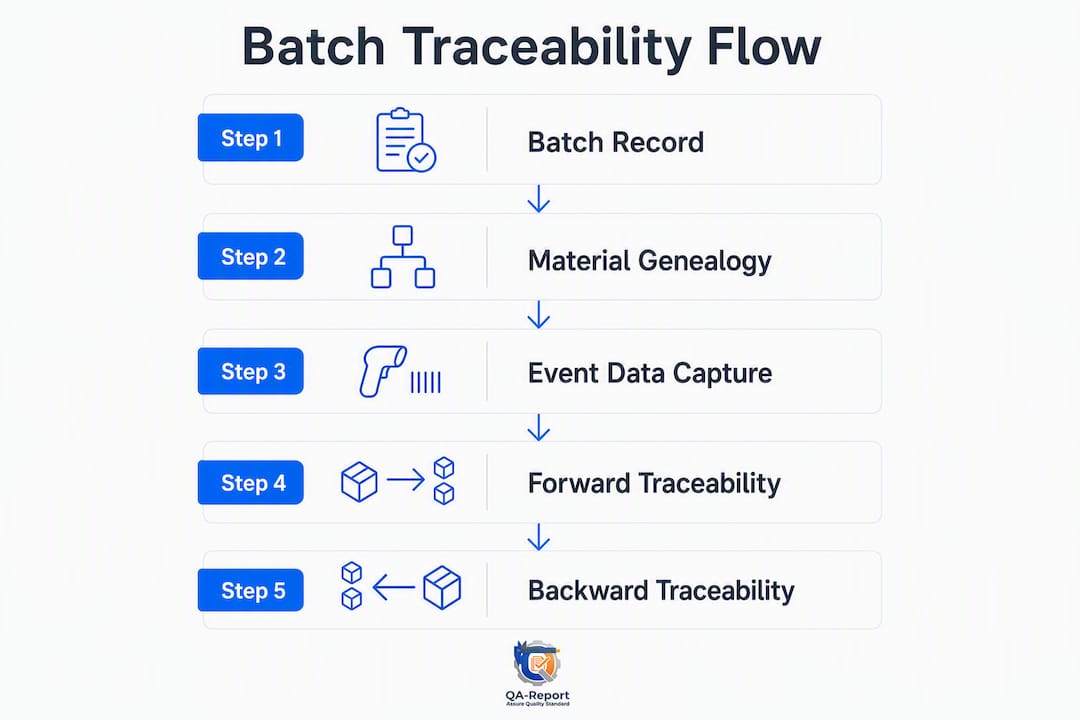
Forward traceability answers: "Which finished goods and customers received this input lot?" Backward traceability answers: "Which input lots, suppliers, and process conditions contributed to this finished product?" Both directions are required for an effective recall or investigation. A system that can only trace backward tells you what went in; one that can only trace forward tells you where product went. You need both, and they must be queryable within minutes, not hours.
How does a batch traceability system actually work?
The mechanics rest on three building blocks: the batch record, the material genealogy, and the event-data capture model. Get all three right and you have a system that supports both compliance and operational efficiency.

Batch records and what they must contain
A batch record is the authoritative document for a production lot. At minimum it should capture: the batch or lot ID, all input material lot IDs and quantities, the equipment and workstation used, the operator and shift, start and end timestamps, process parameters (temperatures, speeds, pressures), QC results and inspection data, and any deviations or nonconformances. These fields are not arbitrary. Effective lot tracking gives manufacturers visibility across the entire product lifecycle, from raw material sourcing through distribution and returns, and that visibility depends entirely on the completeness of the underlying record.
Material genealogy: parent-to-child lot relationships
Material genealogy models the relationships between input lots and output lots as a directed graph. A supplier lot of steel bar stock (parent) is consumed to produce a machined component lot (child). That component lot becomes a parent when it is assembled into a sub-assembly lot, which in turn feeds a finished goods lot. Every node in that chain carries its own batch record. When a defect surfaces at the finished-goods level, you traverse the graph backward to the raw material. When a supplier issues a recall on the steel bar stock, you traverse forward to every finished goods lot that consumed it.
Material genealogy and fast trace queries materially shorten recall response times and shrink recall scope by letting manufacturers identify exactly which finished products consumed a given raw-material lot and which customers received those outputs.
Event-data capture: what, when, where, how, and why
Beyond the batch record itself, event-data capture records discrete supply chain events: a receiving scan, a production transformation, a quality hold, a shipment. Each event answers five questions: what object (lot ID, GTIN), when (timestamp), where (location), how (business step), and why (disposition or reason). This model maps directly to how GS1 EPCIS structures visibility data for multi-party sharing, which is covered in the standards section below. Internally, your MES or ERP captures these events; externally, EPCIS-formatted events let trading partners and regulators query the same data.
Pro Tip: Create a new output sublot at every production boundary where conditions change: job completion, material changeover, or shift boundary. Mixing output from two shifts into one lot ID destroys the precision of your genealogy and makes root-cause analysis significantly harder.
What features should you require in a batch traceability system?
Evaluating lot tracking software means separating table-stakes capabilities from genuine differentiators. The list below reflects what compliance-driven manufacturers in the U.S. actually need, not a generic feature matrix.
Item capture and data entry
- Barcode and QR code scanning at receiving, production, and shipping points
- Manual entry fallback with validation rules to prevent duplicate or malformed lot IDs
- IoT and sensor integration for automated capture of process parameters (temperature, humidity, pressure) directly into the batch record
- Mobile scanning support for shop-floor operators who cannot be tethered to a workstation
Data linking and TLC persistence
- Persistent lot/TLC IDs that follow the product through every custody transfer without reassignment, unless a transformation event occurs
- Explicit modeling of transformation events (e.g., raw material to finished good) that generate a new TLC while retaining the parent-lot reference
- Linkage of the TLC to all required KDEs on shipping documents, bills of lading, invoices, or electronic records
Genealogy visualization and trace queries
- Forward and backward trace queries executable in under five minutes for any lot ID
- Visual genealogy trees showing parent-child lot relationships across multiple tiers
- Recall-scoping reports that output the list of affected lots, quantities, and customer destinations in a format suitable for regulatory submission
Reporting, audit trails, and integrations
- Automated KDE export in formats compatible with FDA submission requirements
- GS1/EPCIS support for external visibility and trading-partner data sharing
Labeling and document requirements
Labels, advance shipping notices (ASNs), bills of lading, and invoices must carry the TLC and associated KDEs wherever the FDA Food Traceability Rule applies. For non-food manufacturers, customer contracts and quality standards (ISO 9001, AS9100, IATF 16949) typically specify label content and lot identification requirements.
Key insight: The FDA FSMA design forces traceability system architecture around record linkages. The TLC is not merely an internal identifier — it must appear on documents or in electronic rows to link KDEs for rapid investigations. Systems that treat lot numbers as internal-only fields will fail compliance audits.
What are the real business benefits of lot traceability?
The compliance case for batch traceability is well understood. The business case is often underestimated.
Faster recall containment and smaller scope
Without end-to-end genealogy, a recall defaults to the broadest possible scope: every unit produced in a date range, every customer who received a product family. With full traceability, the scope narrows to the specific lots that consumed the affected input material and the specific customers who received those lots. The difference between recalling 50,000 units and 3,000 units is not just cost; it is brand reputation, regulatory credibility, and the speed at which you can get clean product back to market.
Shorter root-cause investigations
Quality investigations without lot traceability typically involve manual record searches, supplier phone calls, and production log reviews that can take days. A well-structured genealogy query surfaces the relevant batch records, process parameters, and QC results in minutes. That speed matters whether you are responding to a customer complaint, a supplier deviation, or an internal nonconformance.
Operational efficiencies that compound over time
Fewer manual investigations mean fewer hours spent by quality engineers on reactive work. Automated KDE capture reduces the administrative burden of compliance documentation. Expiry management becomes systematic rather than ad hoc when lot-level dates are tracked in the system. Production tracking software that integrates with your traceability layer compounds these gains by linking production records directly to quality outcomes.
Statistic: Effective lot tracking is described by NetSuite as a powerful tool for managing product recalls and for identifying and resolving inefficiencies in the manufacturing process — outcomes that directly reduce the cost and duration of quality events.
The ROI calculation for a traceability program typically weighs implementation cost (software, hardware, integration, training) against the reduction in recall scope, the reduction in investigation hours, and the avoided cost of over-broad recalls. For manufacturers in regulated industries, the avoided cost of a compliance failure often dwarfs the implementation investment.
What U.S. regulatory requirements govern batch traceability?
The FDA FSMA Food Traceability Rule is the most specific federal requirement shaping traceability system design for food manufacturers and distributors in the U.S. Its central technical concept is the Traceability Lot Code.
The Traceability Lot Code and its persistence rules
The TLC is defined by FDA as an identifier that must remain the same as a food moves through the supply chain. It can only change when the food is transformed, for example, when raw ingredients are processed into a finished product. This persistence rule has a direct architectural implication: your system must model TLC assignment as an event, not just a field. The TLC must be assigned at a defined trigger point and must not be reassigned arbitrarily.
When to assign a TLC
FDA specifies three assignment triggers: initial packing of a raw agricultural commodity or processed food, receipt by the first land-based receiver for fishing-vessel products, and transformation events that produce a new food. At each trigger, the firm assigns a TLC and links it to the required KDEs on the accompanying documentation.
KDEs and how they must be linked
KDEs vary by Critical Tracking Event (CTE) type: growing, receiving, transforming, creating, and shipping each have their own required data elements. The TLC must appear on the bill of lading, invoice, or in an electronic record row alongside the KDEs so that FDA investigators can rapidly reconstruct the supply chain during a foodborne illness investigation. FDA guidance provides examples of how TLC and TLC Source can appear on shipping documents and requires firms to describe their TLC assignment process in their Traceability Plan.
"Firms must document their TLC assignment process in their Traceability Plan and ensure the TLC Source is captured alongside the TLC on required records. A lot number that exists only in an internal ERP field, with no linkage to shipping documents or KDEs, does not satisfy the rule." — FDA FSMA Food Traceability Rule guidance
Pro Tip: Write your TLC assignment logic into your Traceability Plan before you configure your software. Define which production event triggers a new TLC, who is responsible for assignment, and which document or electronic record carries the TLC and TLC Source. Auditors will ask for this document first.
For pharmaceutical manufacturers, the Drug Supply Chain Security Act (DSCSA) imposes serialization and transaction data requirements at the unit level for prescription drugs. Medical device manufacturers must comply with FDA UDI (Unique Device Identification) requirements. Aerospace and automotive manufacturers face AS9100 and IATF 16949 traceability clauses. The FDA FSMA Food Traceability Rule is the most prescriptive for lot-level traceability design, but the architectural principles, persistent identifiers, event-based record linkage, and genealogy, apply across all regulated industries.
How do GS1 EPCIS and data standards support interoperability?
Internal batch records are necessary but not sufficient for supply chain visibility. When your trading partners, co-manufacturers, or regulators need to query traceability data, you need a shared data model and a shared vocabulary. That is what GS1 EPCIS and the Core Business Vocabulary (CBV) provide.
What EPCIS does
GS1 EPCIS is an event-oriented data standard that enables interoperable sharing of visibility data across supply chain participants. It captures the what (EPC/GTIN + lot), when (timestamp), where (location), why (business step and disposition), and how (read point, sensor data) of every supply chain event. The standard is designed so that disparate systems, your ERP, your trading partner's WMS, a third-party logistics provider's TMS, can all exchange and query the same event data without custom point-to-point integrations.
EPCIS event types for batch traceability
EPCIS and CBV define three event types that matter most for lot traceability:
- ObjectEvent: Records a change in state or location for a lot (e.g., a receiving scan, a quality hold, a shipment departure)
- AggregationEvent: Records the packing of lot-identified items into a logistics unit (e.g., cases onto a pallet with an SSCC)
- TransformationEvent: Records the consumption of input lots and the creation of output lots, which is the core event for manufacturing genealogy
CBV standardizes the businessStep values (e.g., commissioning, shipping, receiving, transforming) and disposition values (e.g., in_progress, active, recalled) so that every party in the chain interprets event data the same way.
Practical interoperability considerations
Shared identifiers are the foundation. Use GTINs for products, GS1 batch/lot numbers for lots, and SSCCs for logistics units. Without a shared identifier scheme, EPCIS events from different parties cannot be linked into a coherent chain. Successful interoperability programs include an event-messaging layer and a shared vocabulary rather than only internal databases, because disparate systems need a common context to exchange disposition data meaningfully.
Pro Tip: Include business transaction references, purchase order numbers and bill of lading numbers, in your EPCIS events as bizTransaction elements. This links your EPCIS event data directly to your ERP and WMS records, making investigations faster and audit trails more complete.
How do you evaluate and choose the right batch traceability solution?
The evaluation process should be structured around compliance readiness, integration effort, and total cost of ownership. Work through this checklist before any vendor demo.
- KDE export and reporting: — Does it generate recall-scoping reports and export KDEs in formats suitable for FDA submission or trading-partner sharing?
- EPCIS support: Can it generate and consume EPCIS-formatted events for external visibility and partner interoperability?
Vendor questions to ask in demos
Ask the vendor to run a live trace query on a sample lot ID, showing both forward and backward results. Request a demonstration of the recall-scoping report output. Ask for evidence of implementations in your regulated industry. Ask specifically how the system handles TLC reassignment at transformation events. If the vendor cannot demonstrate these in a 30-minute demo, that is a meaningful signal.
Red flags
No persistent lot/TLC model, inability to export KDEs in a standard format, closed proprietary identifiers with no API access, and no immutable audit log are disqualifying gaps for compliance-driven manufacturers. Also watch for systems that treat lot traceability as a reporting add-on rather than a core data model.
For manufacturing quality control software evaluation, the same integration and data-model criteria apply: the traceability layer must connect to your inspection and QC records, not sit in a separate silo.
What does a realistic implementation roadmap look like?
Most successful implementations follow four phases. The timeline below reflects typical durations for manufacturers starting from a baseline of manual or ERP-only lot tracking.
| Phase | Activities | Typical duration | Go/No-Go Checkpoint |
|---|---|---|---|
| Prepare | Data mapping, KDE definition, TLC assignment logic, gap analysis | several weeks | Data model approved; TLC logic documented in Traceability Plan |
| Pilot | Single product line, one site; label generation, scanning, batch record capture, trace query testing | several weeks | Successful forward/back trace on 10 production lots; KDE export validated |
| Expand | Additional SKUs and sites; ERP/MES integration; partner onboarding | several months | Integration test passed; partner data sharing live on at least one trading partner |
| Optimize | Automation of capture points, IoT integration, continuous improvement of data quality | Ongoing | regular data quality KPIs; audit readiness review |
Who owns what
Data mapping and KDE definition belong to quality and regulatory affairs. IT owns integration architecture and security. Operations owns labeling hardware, scanning device deployment, and changeover procedures. Quality engineering owns validation testing and audit-trail review. Change management and training belong to a cross-functional team, but someone in quality leadership must own the overall program.
Major cost drivers
Labeling hardware (printers, applicators) and scanning devices (fixed scanners, handheld units, mobile devices) are often the largest capital items. Integration effort for ERP and MES connections is typically the largest services cost. Software licensing varies widely by vendor and deployment model. Data governance, including defining retention policies and data quality rules, is frequently underestimated. Staff training, particularly for shop-floor operators who must change scanning habits, is the most common source of pilot delays.
Incoming inspection best practices are a useful starting point for the data-mapping phase, since supplier lot IDs and certificates of conformance captured at receiving become the first nodes in your genealogy chain.
What are the most common implementation pitfalls, and how do you avoid them?
Even well-resourced programs stall on predictable problems. Knowing them in advance is half the solution.
Common pitfalls
- Treating a lot number as sufficient: A lot number in your ERP is not batch traceability. Without KDE linkage, TLC persistence rules, and genealogy modeling, it is just a label.
- Poor changeover handling: Failing to create a new sublot at a material changeover is the single most common source of genealogy contamination. Mixed-input lots produce ambiguous trace results.
- Inconsistent labeling: Labels that are applied inconsistently, or that carry different lot ID formats at different production stages, break the chain. Standardize label formats and scanning points before go-live.
- Weak partner data sharing: Internal traceability that stops at your shipping dock is incomplete. If your downstream customers or co-manufacturers cannot receive or query your lot data, your recall response still depends on phone calls and spreadsheets.
- Lack of downstream visibility: Forward traceability to the customer level requires that your shipping records link lot IDs to customer orders and delivery addresses. Many systems capture this data but do not link it to the genealogy model.
Best practices that prevent these failures
- Enforce TLC persistence rules in software configuration, not just in policy documents.
- Create sublots automatically at every material changeover and shift boundary.
- Automate capture at binding points (receiving dock, production line start, shipping dock) rather than relying on manual entry.
- Define data retention and governance policies before go-live, including who can correct records, under what conditions, and with what audit trail.
- Use an event-data layer for partner interoperability rather than bilateral data exports.
Pro Tip: Start your pilot with your highest-risk SKU, not your simplest one. A pilot on a low-complexity product will pass easily but will not surface the edge cases — material changeovers, rework loops, multi-supplier inputs — that will challenge your system at scale.
Safety and compliance workflows often intersect at the traceability layer; manufacturing safety management programs that integrate with your lot traceability records can strengthen both recall response and incident documentation.
How QA-Report supports batch and lot traceability
QA-Report's integrated MES and quality inspection platform is built around the data model that batch traceability requires: persistent lot IDs, batch-level production records, inspection result linkage, and ERP integration.
| Required Capability | QA-Report Feature |
|---|---|
| Batch/lot ID persistence and genealogy | MES layer tracks parts, batches, and operations with parent-child lot relationships |
| Inspection and QC result linkage | CMM data import and auto-mapping links measured results directly to batch records |
| ERP integration | Production planning integrates with ERP for lot-level order and inventory data |
| Audit-ready documentation | PDF inspection reports (FAI, dimensional, GD&T) with immutable records satisfy ISO 9001, AS9100, and PPAP |
| Shop-floor capture | Mobile access and role-based shop-floor access support scanning and data entry at production boundaries |
| Deviation and rejection tracking | Rejection and recovery tracking captures nonconformances at the batch level for root-cause analysis |
Running a pilot with QA-Report
A typical pilot starts with importing your existing part and batch data, mapping your inspection dimensions to the measurement wizard, and configuring route cards for the target product line. Shop-floor operators scan lot IDs at each production boundary; the system auto-flags out-of-tolerance results and links them to the batch record. At the end of the pilot, you run a trace query on a test lot to validate forward and backward genealogy, then export the batch record and inspection report as a PDF for audit review.
Pro Tip: Use QA-Report's CMM inspection software integration during your pilot to import dimensional measurement data directly into batch records. This eliminates manual transcription errors and gives you a complete, audit-ready record from day one.
Key Takeaways
Compliance-ready batch traceability requires persistent TLC assignment, KDE linkage on shipping documents, and end-to-end material genealogy — a lot number alone satisfies none of these requirements.
| Point | Details |
|---|---|
| TLC persistence is non-negotiable | FDA requires the TLC to remain unchanged through the supply chain; it can only change at a transformation event. |
| Genealogy depth determines recall speed | Parent-to-child lot relationships across all tiers let you scope a recall to specific lots and customers within minutes. |
| Pilot on your highest-risk SKU | Starting with a complex product surfaces edge cases — changeovers, rework, multi-supplier inputs — that a simple pilot will miss. |
| EPCIS enables partner visibility | GS1 EPCIS event types (ObjectEvent, AggregationEvent, TransformationEvent) provide the shared data model for multi-party trace queries. |
| QA-Report connects inspection to genealogy | QA-Report's MES layer links CMM inspection results, batch records, and production events in one audit-ready platform. |
The part of batch traceability most teams get wrong
Most traceability programs fail not because of technology gaps but because of a modeling gap. Teams configure a lot number field in their ERP, scan barcodes at shipping, and call it traceability. What they have built is a label system, not a genealogy. The difference surfaces the first time they try to answer a real question under time pressure: "Which customers received product made from supplier lot X?" A label system sends you to spreadsheets. A genealogy sends you to a report.
The second failure mode is treating compliance as a documentation exercise rather than a system design exercise. The FDA FSMA TLC requirements are not satisfied by writing a procedure that says "assign a lot number at packing." They require that the TLC be captured on the bill of lading, linked to KDEs, and queryable by an investigator who has never seen your internal systems. That is a data architecture requirement, not a paperwork requirement.
The third, and least obvious, failure mode is stopping at your own four walls. Internal genealogy that does not extend to your suppliers' lot IDs and your customers' receipt records is a partial solution. It will narrow your recall scope, but it will not eliminate the phone calls and manual reconciliation that slow response time. The manufacturers who get this right invest in the partner data-sharing layer early, even when it feels premature for a pilot.
The good news is that none of these problems require exotic technology. They require clear data modeling, disciplined configuration, and the organizational will to enforce scanning at every binding point. Start with one product, one site, and one complete genealogy chain. The rest follows from that foundation.
QA-Report gives you inspection-linked batch traceability from day one
Batch traceability built on disconnected tools — a lot number in your ERP, inspection results in a spreadsheet, shipping records in your WMS — leaves gaps that surface exactly when you need them least: during a recall, an audit, or a customer complaint investigation. QA-Report closes those gaps by connecting CMM inspection data, batch production records, deviation tracking, and ERP planning in a single cloud-based platform.
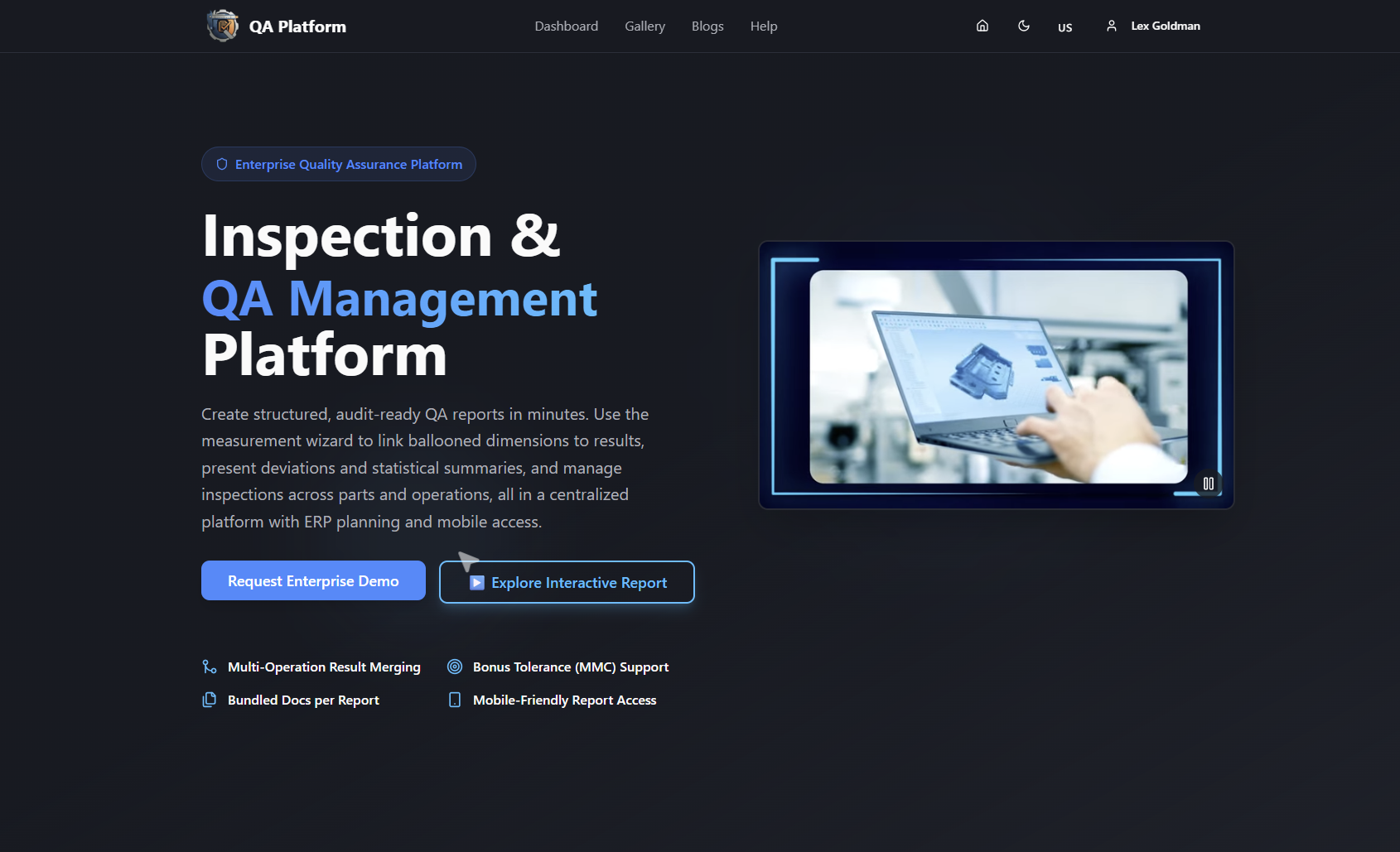
Your quality team gets audit-ready FAI, dimensional, and GD&T inspection reports that link directly to batch records. Your operations team gets route cards, kanban and Gantt planning, and rejection tracking at the lot level. Your compliance team gets immutable audit trails and PDF exports that satisfy ISO 9001, AS9100, and PPAP requirements. All of it runs on mobile for shop-floor access, with role-based permissions that keep data clean.
Start a free trial at QA-Report to see how the platform handles your product's genealogy, or request a demo to walk through a recall-scoping report on a sample lot.
Useful sources for further reading
- FDA FSMA Traceability Lot Code guidance — The primary FDA page explaining TLC assignment rules, persistence requirements, and linkage to KDEs. Start here for compliance design.
- FDA Food Traceability Rule — supporting documentation — FDA's detailed documentation on the Food Traceability Rule, including examples of TLC and TLC Source on shipping documents and Traceability Plan requirements.
- FDA traceability guidance media download — Supplementary FDA guidance with worked examples of KDE linkage and TLC assignment logic for covered foods.
- GS1 EPCIS standard overview — GS1's authoritative page on EPCIS as a data-sharing standard for supply chain visibility events.
- EPCIS and CBV implementation guideline — Detailed GS1 implementation guidance covering event types, CBV businessStep and disposition values, and interoperability design.
- EPCIS Version 1.0 specification — The formal EPCIS specification, including interface standards for capturing and querying visibility event data across repositories.