
Production reporting software is a cloud-based system that centralizes quality inspection data, automates report generation, and delivers audit-ready documentation compliant with standards like AS9102, PPAP, and ISO 9001. For manufacturers and quality engineers, it replaces fragmented spreadsheets and manual drafting with a single, structured workflow that connects shop-floor measurements directly to compliance-ready outputs. The core value is straightforward: your inspection data, your dimensional results, and your audit records all live in one place, updated in real time.
Key capabilities that define a purpose-built platform:
- Automated FAI and dimensional inspection report generation from live measurement data
- CMM data import with auto-mapping to drawing dimensions and tolerance validation
- Integration with ERP and MES systems to synchronize production and quality workflows
- Role-based access and mobile data entry for shop-floor inspectors
- Centralized document vaults with revision control for audit traceability
- Real-time dashboards displaying OEE, downtime, and quality metrics
General-purpose BI tools like Microsoft Power BI or Tableau can visualize production data, but they lack specialized inspection features such as drawing ballooning and tolerance validation. That gap forces quality engineers into redundant manual work, which is exactly the problem purpose-built production reporting software solves.
Table of Contents
- What modern production reporting software actually does
- How production reporting software supports compliance and audit readiness
- Why cloud-based platforms improve manufacturing operations
- How to choose the right production reporting software
- Deployment options and scalability
- Data security and privacy in production reporting software
- Implementation challenges and onboarding best practices
- QA-Report brings all of this into one platform
- Key Takeaways
What modern production reporting software actually does
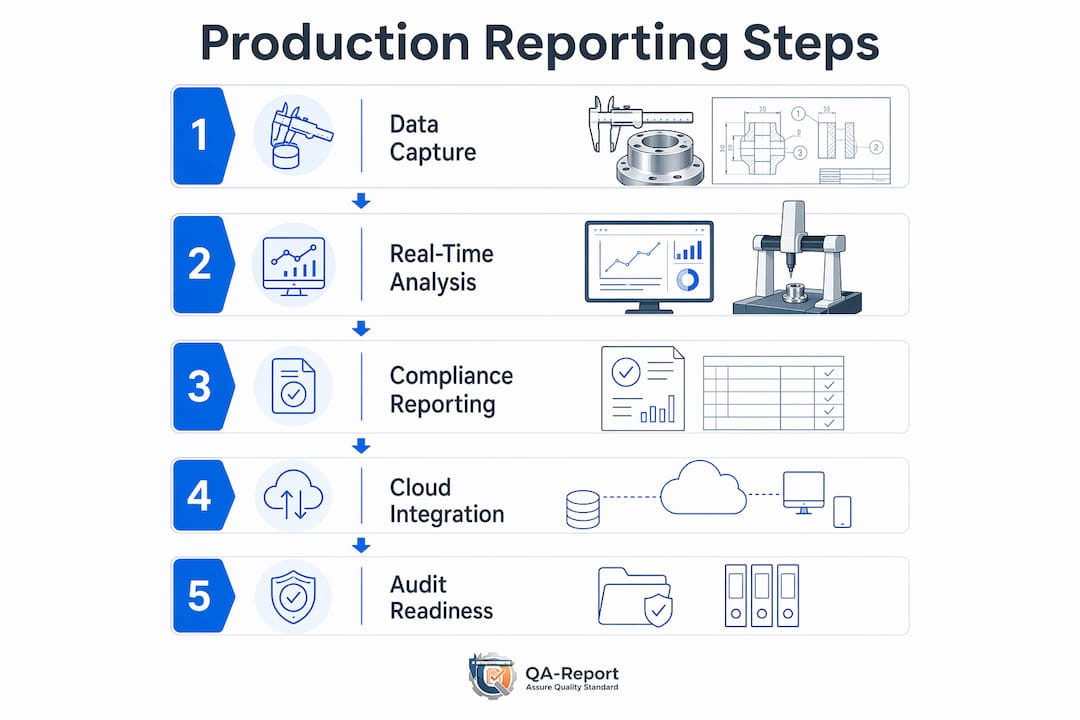
The capabilities that matter most to quality engineers go well beyond dashboards. A purpose-built platform handles the full inspection and reporting cycle, from drawing markup to final PDF output.
- Automatic drawing ballooning: AI-powered numbering links each balloon on a PDF drawing to the corresponding measurement row, eliminating manual cross-referencing.
- CMM data import: Measurement results from CMM output files map directly to drawing dimensions, with tolerance validation flagging any out-of-tolerance deviation automatically. QA-Report's CMM inspection software handles this import and auto-mapping without manual re-entry.
- FAI report generation: Automated FAI reporting compliant with AS9102 and PPAP standards replaces hours of manual drafting with a structured, repeatable process.
- Real-time dashboards: Production analytics tools surface OEE, downtime events, and quality metrics in live dashboards, reducing reliance on compiled spreadsheets.
- Role-based access and mobile entry: Role-based shop-floor access and mobile data collection reduce errors from outdated paper forms and improve data accuracy across shifts.
- ERP and MES integration: Bidirectional data flow with ERP and MES systems keeps production schedules, work orders, and quality records synchronized.
- Document vault: Centralized storage with revision control ensures inspectors always work from the current drawing revision, and auditors can retrieve any historical record instantly.
Pro Tip: Choosing software with embedded inspection tools, such as drawing ballooning and CMM import, eliminates the manual step of transferring measurement data between systems. That single change removes the most common source of transcription errors in quality reporting.
How production reporting software supports compliance and audit readiness
Audit preparation should not be a reactive scramble. Cloud-native platforms make compliance a continuous state rather than a periodic project.
- AS9102 and PPAP support: Purpose-built platforms generate structured FAI reports in the exact format these standards require, with all required data fields populated from live inspection records.
- ISO 9001 alignment: Centralized data management, revision control, and documented inspection workflows satisfy the quality management system requirements auditors verify.
- Automated compliance documents: Replacing manual report assembly with automated generation reduces the risk of transcription errors and missing data fields.
- End-to-end traceability: Cloud MES systems provide traceability across materials, operations, and finished goods, giving auditors a complete, unbroken chain of evidence.
- Batch and serial tracking: Linking inspection results to specific batches or serial numbers means any nonconformance can be traced back to its source without manual record searches.
- Ongoing audit readiness: Cloud-based quality management enables instant generation of AS9102-compliant reports from live data, so your team is never caught assembling records the night before an audit.
The practical difference between reactive and continuous audit readiness is significant. When a customer or certification body requests documentation, a cloud-based system produces it in minutes from current data rather than requiring days of manual extraction and formatting.
Why cloud-based platforms improve manufacturing operations
The operational case for modern reporting solutions for manufacturers extends beyond compliance. Real-time visibility changes how quality and production teams make decisions.
- Faster decisions: Live quality and production data surfaces problems as they occur, not after a shift report is compiled hours later.
- Reduced manual reporting: Centralized data eliminates redundant spreadsheet maintenance and the version-control problems that come with it.
- Scalability and remote access: Cloud deployment scales with production volume and gives engineers access to inspection data from any location.
- Automated out-of-tolerance alerts: The system flags deviations the moment a measurement falls outside tolerance, allowing immediate corrective action before a batch progresses further.
- Improved team collaboration: Role-based access lets quality engineers, production supervisors, and management each see the data relevant to their function without exposing unrelated records.
Those figures reflect what happens when quality data stops living in disconnected spreadsheets and starts flowing through a system designed to act on it.
How to choose the right production reporting software
Selecting the right platform requires evaluating more than feature lists. The criteria below reflect what actually determines whether a system delivers value in a manufacturing environment.
- Integration depth: Confirm the platform connects to your CMMs, ERP, and MES systems with documented data mapping, not just generic API access.
- Compliance coverage: Verify that AS9102, PPAP, and ISO 9001 report formats are built in, not configured from scratch by your team.
- Inspection-specific features: Drawing ballooning, GD&T support, tolerance validation, and CMM data import are non-negotiable for quality engineers. General-purpose BI tools do not provide these.
- Usability on the floor: Mobile access and intuitive data entry matter as much as back-office reporting. If inspectors cannot use the system efficiently, data quality suffers.
- Vendor support and training: Look for educational resources, video tutorials, and responsive support. QA-Report's video tutorial library demonstrates platform capabilities in real inspection scenarios.
- Scalability: Confirm the platform handles your current part and batch volume and can grow with production without requiring a platform migration.
Pro Tip: Engage stakeholders from quality, production, and IT during the evaluation phase, not after a purchase decision. Each group will surface requirements the others miss, and early alignment prevents costly implementation surprises.
Deployment options and scalability
Most modern manufacturing reporting platforms offer two primary deployment paths: fully cloud-hosted SaaS and hybrid configurations that combine cloud reporting with on-premises data sources.
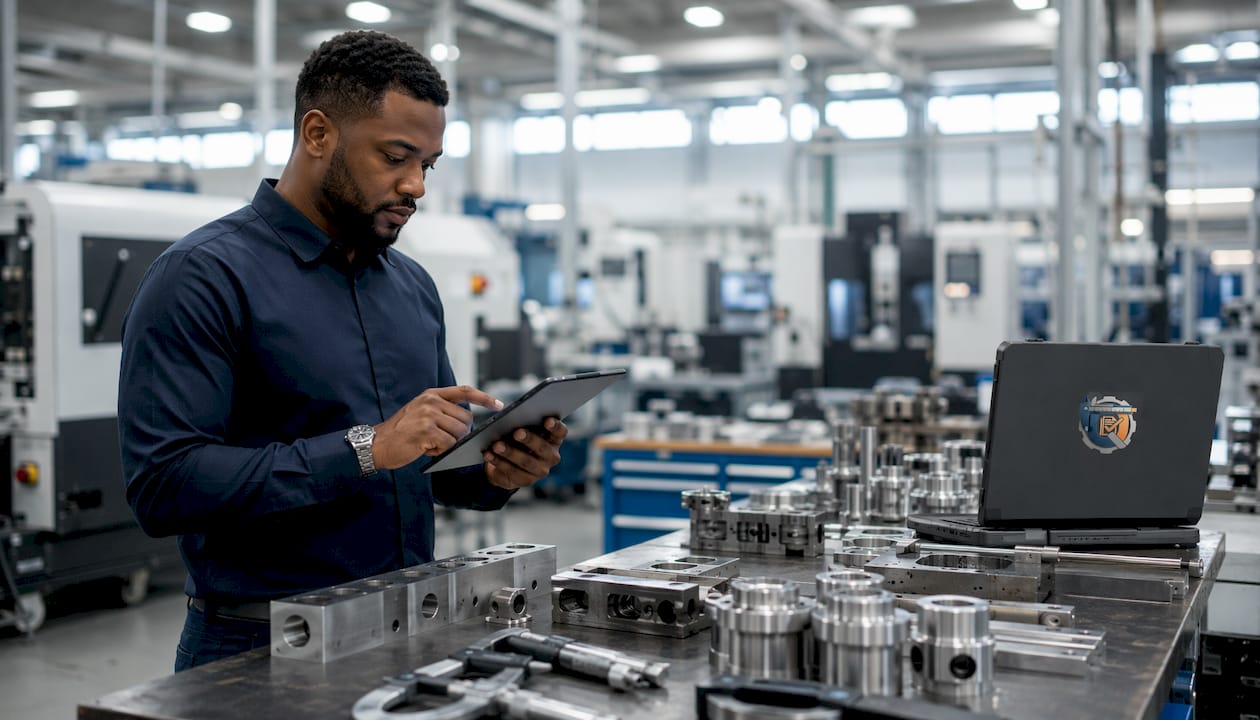
Fully cloud-hosted SaaS is the most common choice for small to mid-size manufacturers. There is no server infrastructure to maintain, updates deploy automatically, and users access the system from any device with a browser. Scalability is handled by the vendor, so adding users, parts, or production lines does not require IT projects.
Hybrid deployments suit manufacturers with strict data residency requirements or legacy shop-floor systems that cannot push data directly to a cloud endpoint. In these configurations, a local agent or connector collects data from CMMs and machine controllers, then transmits it securely to the cloud platform for reporting and analysis.
Enterprise organizations sometimes require private cloud or on-premises deployment for regulatory or contractual reasons. Platforms that support containerized deployment, such as Kubernetes-based configurations, offer that flexibility without sacrificing the reporting and compliance features of the cloud version.
Data security and privacy in production reporting software
Manufacturing data, particularly inspection records tied to aerospace, automotive, or medical device production, carries significant confidentiality requirements. A production reporting platform must address security at multiple layers.
Encryption in transit and at rest is the baseline. Any platform handling CMM data, drawing files, or inspection records should use TLS for data transmission and AES-256 or equivalent encryption for stored data. Role-based access controls ensure that inspectors, engineers, and managers each see only the records their function requires, limiting exposure of sensitive part data.
Audit trails within the platform itself matter for both security and compliance. Every record access, edit, and report generation event should be logged with a timestamp and user identity, giving your team and your auditors a verifiable chain of custody. For manufacturers working under ITAR or export-control requirements, confirm that the vendor's data centers are located in the United States and that access by non-US personnel is restricted.
Implementation challenges and onboarding best practices
The most common implementation failure is not a technology problem. It is a data and process problem that the technology exposes.
Common challenges:
- Inconsistent part numbering or drawing revision conventions across departments slow CMM data mapping during setup.
- Inspectors accustomed to paper forms resist digital entry until they see that the new workflow is faster, not just different.
- ERP and MES integration requires IT involvement that is often underestimated in project timelines.
- Incomplete training on inspection-specific features, such as drawing ballooning and tolerance validation, leads to underuse of the platform's core value.
Best practices for a successful rollout:
- Start with one part family or production line to validate the workflow before expanding.
- Standardize drawing revision and part numbering conventions before importing historical data.
- Run parallel reporting (paper and digital) for a short period to build inspector confidence without disrupting production.
- Use vendor-provided tutorials and onboarding resources from day one. The practical CMM data import guide for quality engineers is a useful starting point for teams new to automated dimensional reporting.
- Assign a platform champion in the quality department to own adoption and answer floor-level questions.
QA-Report brings all of this into one platform
Audit-ready FAI reports, CMM import, drawing ballooning, GD&T validation, and a full MES layer, all in one cloud platform, is exactly what QA-Report delivers to manufacturers in aerospace, automotive, and medical device production.
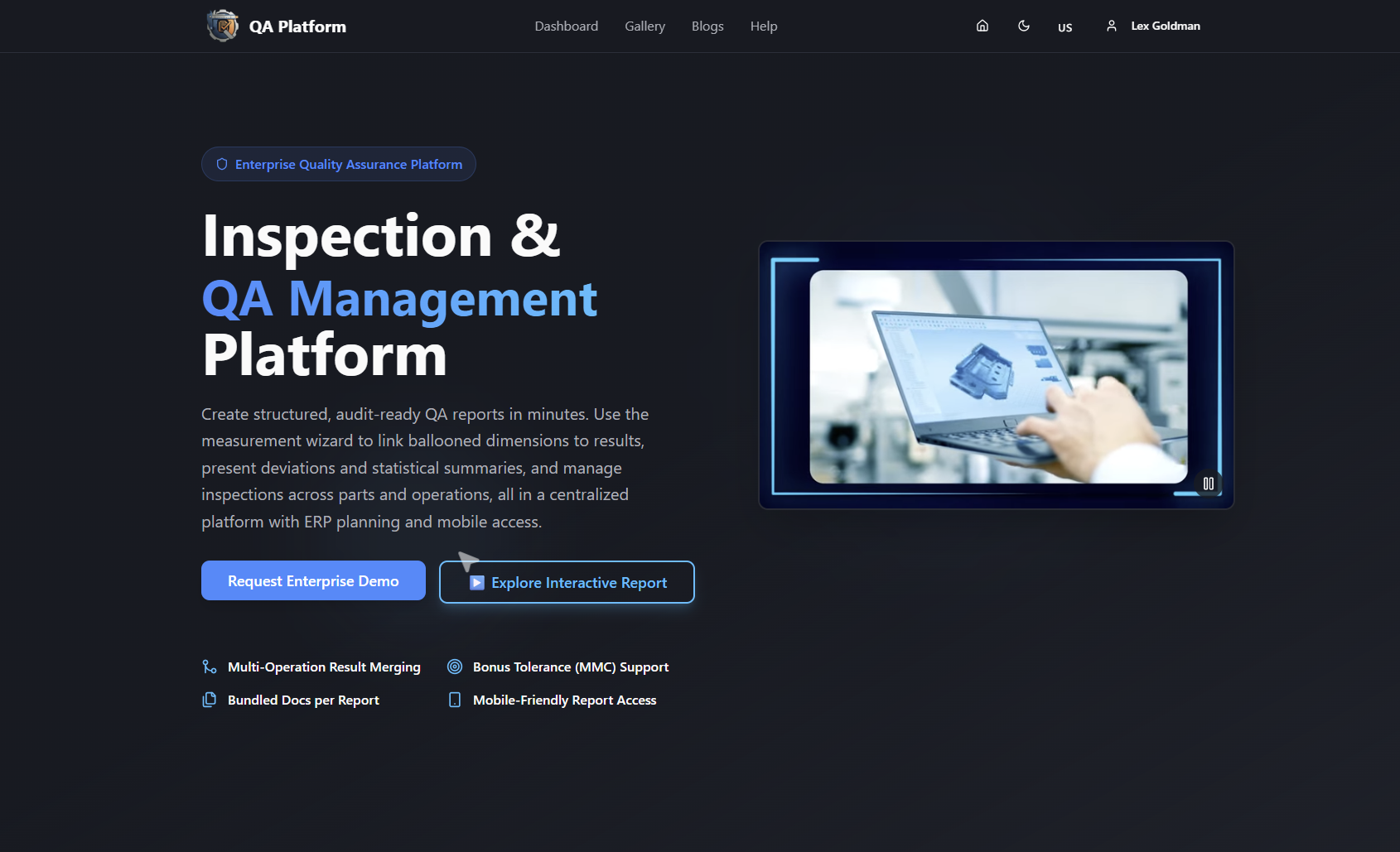
Where general-purpose reporting tools require custom configuration to approximate inspection workflows, QA-Report is built specifically for quality engineers who need AS9102, PPAP, and ISO 9001 compliance without building it from scratch. The measurement wizard links ballooned drawing dimensions to measured results, auto-flags deviations, and generates professional PDF reports in minutes. CMM data imports and maps automatically. The integrated MES layer handles route cards, batch tracking, and rejection recovery alongside the inspection workflow, so quality and production data share the same record rather than living in separate systems.
Start a free trial at QA-Report to see how your team's next FAI or dimensional inspection report comes together without the manual assembly.
Key Takeaways
Purpose-built production reporting software, with embedded inspection tools and compliance-ready report formats, delivers measurably better outcomes than general-purpose BI platforms adapted for manufacturing quality.
| Point | Details |
|---|---|
| Compliance built in | AS9102, PPAP, and ISO 9001 report formats should be native to the platform, not custom-configured. |
| CMM integration is critical | Auto-mapping CMM data to drawing dimensions eliminates transcription errors and speeds dimensional reporting. |
| Rework and productivity gains | Cloud-based platforms report up to a 54% decrease in rework and 29% productivity gains from improved quality reporting. |
| Audit readiness is continuous | Cloud-native systems generate compliant reports from live data instantly, removing reactive report assembly before audits. |
| QA-Report | Delivers FAI, CMM import, drawing ballooning, GD&T validation, and MES in one platform built for manufacturing compliance. |