
A supplier quality management system (SQMS) is a proactive, collaborative framework that ensures suppliers consistently deliver products and services meeting defined quality, regulatory, and contractual standards across the entire product lifecycle. At its core, an SQMS connects supplier selection, design evaluation, performance monitoring, corrective action management, and continuous improvement into a single, traceable process. It does not operate in isolation. Effective systems integrate with broader quality frameworks like ISO 9001, and in automotive and aerospace contexts, they extend to IATF 16949 and the AIAG Core Tools suite.
The core components of a well-structured SQMS include:
- Supplier selection and qualification based on certifications, process capability, and financial stability
- Quality assurance processes covering specifications, inspection criteria, and acceptance standards
- Performance monitoring using KPIs, scorecards, and audit data
- Corrective action management with structured root cause analysis and verification
- Continuous improvement programs tied to supplier development initiatives
- Compliance monitoring against ISO 9001, IATF 16949, and AIAG Core Tools (APQP, FMEA, MSA, SPC)
- Integration with ERP, MES, and procurement systems for real-time data accuracy
What are the key benefits of a supplier quality management system?
A well-implemented SQMS reduces risk at every stage of the supply chain, from raw material sourcing through final delivery. When quality issues are caught at the supplier level rather than on the production floor, the cost of correction drops sharply. Defect prevention is far cheaper than rework, scrap, or a product recall.
Beyond cost, the system creates consistency. Your customers receive the same quality regardless of which supplier produced a given component. That consistency is what separates organizations that maintain certifications from those that scramble before every audit.
Key benefits include:
- Risk reduction by identifying supplier weaknesses before they become production disruptions
- Cost savings through defect prevention, reduced incoming inspection, and fewer warranty claims
- Regulatory compliance with FDA, ISO, and customer-specific requirements
- Supply chain transparency giving procurement and quality teams a shared, accurate view of supplier health
- Stronger supplier relationships built on clear expectations and structured feedback
- Reduced production downtime from early detection of nonconforming materials
- Audit readiness at any point in the product lifecycle
How should you select and qualify suppliers?
Supplier selection is where quality is either built in or compromised from the start. ASQ defines supplier selection as a cross-functional process involving purchasing, quality, engineering, and production teams. Each function brings a different lens, and all of them matter.

The criteria your team evaluates should cover both technical capability and business stability. A supplier with excellent process capability but shaky finances is a supply chain risk waiting to materialize.
Evaluation criteria to assess before onboarding:
- Certification status: ISO 9001 at minimum; IATF 16949 for automotive; AS9100 for aerospace
- Quality history: defect rates, corrective action responsiveness, and past audit results
- Process capability: Cpk and Ppk indices relative to your tolerance requirements
- Financial stability: credit ratings, years in operation, and customer concentration risk
- Technical support: engineering resources available for design reviews and PPAP submissions
- AIAG Core Tools compliance: demonstrated use of APQP, FMEA, MSA, and SPC in daily operations
- Communication infrastructure: ERP connectivity, portal access, and response time benchmarks
Documentation review is non-negotiable. Request current quality system certificates, recent internal audit results, and any customer-issued corrective action requests. Site visits remain the most reliable way to verify what a supplier's quality manual actually describes.
Pro Tip: When evaluating a new supplier, ask for their last three Supplier Corrective Action Requests (SCARs) and the closure timelines. A supplier who resolves SCARs quickly and with documented root cause analysis tells you far more about their quality culture than any certificate.
How is supplier quality performance measured?
Supplier performance scorecards combine quantitative audit data with qualitative stakeholder feedback to produce a complete picture of supplier health. The most effective scorecards weight KPIs by business impact rather than treating every metric equally. On-time delivery matters less for a sole-source critical component than for a commodity fastener.
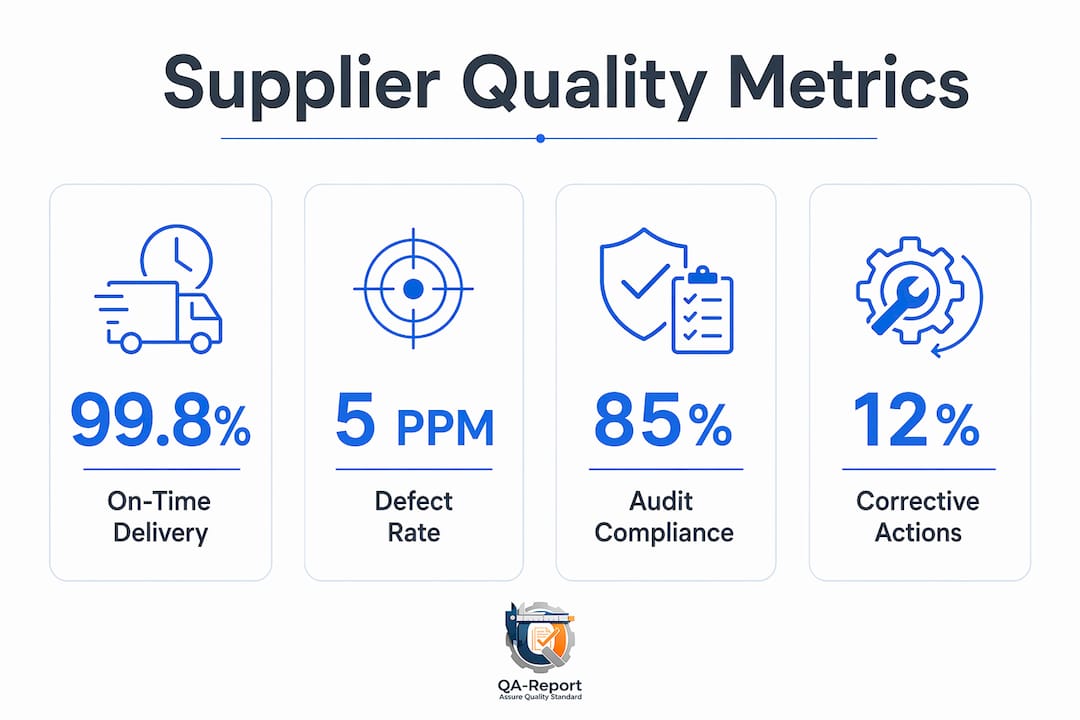
Quarterly reviews are a common cadence for formal scorecard evaluations, though high-risk or underperforming suppliers warrant monthly tracking. The goal is not to generate a score but to trigger action when performance deviates from targets.
| KPI | Description | Target Benchmark |
|---|---|---|
| Defect rate (PPM) | Parts per million defective received | Supplier-specific; typically very low defect rates |
| On-time delivery | Percentage of orders delivered on or before the agreed date | High percentage meeting criteria |
| SCAR response time | Days from issuance to initial containment submission | Within one day |
| Cost competitiveness | Price variance against market benchmarks | Within agreed tolerance band |
| Audit score | Composite score from scheduled quality system audits | Majority passing |
| PPAP approval rate | First-time PPAP submissions accepted without rejection | High percentage approved |
Relying on periodic audits alone creates blind spots. Dynamic, data-driven models that combine quantitative metrics with qualitative procurement and engineering feedback keep supplier assessments current between formal review cycles. Stale data is one of the most common reasons organizations miss early warning signs of supplier deterioration.
Best practices for managing ongoing supplier quality
Maintaining supplier quality over time requires more than a scorecard. The real value of supplier evaluation comes from what happens after the score is assigned: structured corrective actions, supplier development initiatives, and collaborative problem solving.
Proven practices for ongoing management:
- Conduct regular audits covering both quality system compliance and process-level verification
- Run structured corrective action cycles using 8D or Six Sigma DMAIC methodology for root cause resolution
- Hold quarterly business reviews with key suppliers to align on performance trends and improvement targets
- Share real-time data from incoming inspection and production rejection tracking directly with suppliers
- Develop supplier capability through joint training, process improvement projects, and shared best practices
- Escalate systematically using a tiered improvement process (such as a Supplier Improvement Process) before moving to disqualification
- Track improvement project outcomes against baseline metrics to confirm corrective actions are effective
Supplier evaluations become valuable only when followed by structured improvement projects. Collaboration among procurement, quality, sustainability, and operations teams is what converts a scorecard finding into a lasting performance gain.
Pro Tip: Integrate qualitative feedback from your production floor supervisors into the supplier scorecard. They often notice subtle shifts in material consistency or dimensional variation weeks before formal inspection data flags a trend. That early signal can prevent a line stoppage.
What certifications and standards govern supplier quality?
Automotive manufacturers require suppliers to hold quality systems certified to at least ISO 9001, with many OEMs mandating IATF 16949 and full AIAG Core Tools compliance. These are not optional benchmarks. They are contractually binding requirements embedded in purchase orders.
Key certifications and standards:
- ISO 9001: The internationally recognized baseline for quality management systems. It establishes the framework for process control, customer focus, and continuous improvement. Any supplier operating without ISO 9001 certification carries elevated risk.
- IATF 16949: The automotive-specific extension of ISO 9001, required by most Tier 1 and Tier 2 automotive suppliers globally. It adds requirements for product safety, defect prevention, and supply chain management specific to vehicle production.
- AIAG Core Tools: A suite of five integrated tools mandated across the automotive supply chain:
- APQP (Advanced Product Quality Planning): structures the product development process to prevent defects
- FMEA (Failure Mode and Effects Analysis): identifies and prioritizes potential failure modes before production
- MSA (Measurement Systems Analysis): validates that measurement equipment and methods are capable
- SPC (Statistical Process Control): monitors process variation in real time to detect drift before defects occur
- PPAP (Production Part Approval Process): confirms that production processes can consistently meet customer requirements
- AS9100: The aerospace equivalent of IATF 16949, covering additional requirements for safety-critical components and traceability
DENSO's supplier quality assurance manual requires suppliers to conduct internal audits across all quality management system processes on a three-year audit cycle, with annual programs sampling customer-specific requirements. Maintaining certification is not a one-time event. It requires ongoing internal audit discipline and management review.
Why do buyer-supplier relationships determine quality outcomes?
Quality problems rarely stay on one side of the relationship. When a supplier ships nonconforming material, the buyer's production schedule, customer commitments, and cost structure all absorb the impact. That shared exposure is exactly why trust and transparency between buyer and supplier are prerequisites for effective quality management, not optional extras.
Formal feedback loops close the gap between what buyers expect and what suppliers understand. Without them, suppliers optimize for what they can measure, which may not align with what actually matters to your production process.
Relationship-building strategies that directly support quality outcomes:
- Establish joint quality improvement programs with shared goals, timelines, and accountability
- Provide suppliers with direct access to incoming inspection data so they can see exactly how their product performs at your facility
- Define role clarity around who owns corrective action initiation, verification, and closure
- Conduct supplier recognition programs to reinforce positive performance and motivate continuous improvement
- Communicate specification changes early to give suppliers adequate lead time for process adjustments
How does technology improve supplier quality management?
The gap between organizations that manage supplier quality reactively and those that manage it proactively often comes down to their technology infrastructure. Integrating supplier quality data into ERP and procurement platforms transforms fragmented signals into accurate, actionable insights. Manually aggregated data from disconnected spreadsheets limits the speed and reliability of every decision downstream.
Modern quality management software handles audit scheduling, real-time data capture, scorecard tracking, and corrective action workflows in a single platform. When that platform also connects to CMM measurement data, rejection tracking, and production planning, your team can correlate supplier performance with shop-floor outcomes rather than reviewing them in separate systems.
| Software Feature | Operational Benefit |
|---|---|
| Automated audit scheduling | Eliminates missed review cycles and ensures consistent supplier coverage |
| CMM data import and mapping | Links measured results directly to drawing dimensions for traceable inspection records |
| Real-time scorecard dashboards | Surfaces performance trends before they escalate to production disruptions |
| Corrective action workflow | Tracks SCAR issuance, root cause submission, and closure verification in one place |
| PPAP and FAI report generation | Produces audit-ready documentation that satisfies ISO 9001, AS9100, and PPAP requirements |
| ERP and MES integration | Connects supplier performance data to production planning and rejection tracking |
| Role-based access control | Ensures the right personnel see and act on the right data at every stage |
QA-Report's cloud-based platform addresses several of these needs directly. Its measurement wizard links ballooned drawing dimensions to measured results, auto-flags out-of-tolerance deviations, and generates PDF reports that satisfy ISO 9001, AS9100, and PPAP requirements. For teams managing CMM inspection workflows, the platform imports CMM data automatically and maps it to the correct drawing characteristics, removing hours of manual transcription.
Pro Tip: When selecting quality management software, prioritize platforms that offer mobile access for shop-floor inspectors. An inspector who can capture and submit data at the point of measurement, rather than transcribing it later at a desk, eliminates one of the most common sources of documentation error.
What challenges arise when implementing an SQMS?
Implementation rarely fails because of a bad plan. It fails because the plan underestimates the organizational change required. Cross-functional alignment between procurement, quality, engineering, and operations is the single most common bottleneck. Each function has different priorities, and without a shared framework, supplier quality data gets siloed and acted on inconsistently.
Common implementation challenges and how to address them:
- Data fragmentation: Supplier performance data scattered across spreadsheets, email threads, and disconnected systems makes reliable evaluation impossible. Centralizing data in an integrated platform resolves this, but it requires upfront data migration and process standardization.
- Resistance to structured corrective actions: Teams accustomed to informal problem resolution often resist the documentation discipline that 8D or DMAIC requires. Phased rollout with training and visible leadership support accelerates adoption.
- Supplier capability gaps: Some suppliers lack the internal resources to meet AIAG Core Tools requirements. Supplier development programs, co-funded training, and phased compliance timelines help bridge that gap without disrupting supply continuity.
- Inconsistent audit frequency: Organizations that audit only when problems arise miss the early warning signals that prevent those problems. Building audit schedules into the quality calendar, with defined frequencies by supplier risk tier, creates the consistency that reactive auditing cannot.
- Misaligned KPIs: KPIs that do not reflect actual business risk produce scorecards that look healthy while real problems accumulate. Revisiting KPI weighting annually against actual nonconformance data keeps the measurement system calibrated.
How does continuous improvement work within an SQMS?
Continuous improvement in supplier quality is not a separate program. It is the output of a well-functioning SQMS operating as designed. Every corrective action closed, every audit finding addressed, and every scorecard trend analyzed feeds back into the system as an improvement signal.
The most effective frameworks borrow from methodologies already embedded in ISO 9001 and IATF 16949: Plan-Do-Check-Act (PDCA) at the process level, and Six Sigma DMAIC for more complex, data-intensive problems. What distinguishes organizations that improve from those that stagnate is the discipline to verify corrective action effectiveness rather than simply closing the ticket.
Supplier development initiatives extend continuous improvement beyond reactive problem solving. When a buyer invests in a supplier's process capability, the return is lower defect rates, faster PPAP approvals, and a more resilient supply chain. That investment also deepens the relationship in ways that purely transactional supplier management cannot replicate. Explore quality management software options that support structured improvement tracking across your supplier base.
How should you train personnel involved in supplier quality management?
Training for SQM personnel covers two distinct areas: technical competency and process discipline. Technical competency includes proficiency in AIAG Core Tools, statistical methods like SPC and MSA, measurement system validation, and audit techniques. Process discipline covers how your organization's specific SQMS workflows operate, from supplier onboarding through corrective action closure.
ASQ certifications provide a recognized external benchmark for both areas. The Certified Supplier Quality Professional (CSQP) credential specifically targets professionals who track data, identify improvement projects, and manage cross-functional implementation to improve supplier performance. The Certified Manager of Quality/Organizational Excellence (CMQ/OE) addresses the leadership and measurement system skills needed at a program management level.
Internal training should not stop at initial onboarding. Supplier quality requirements evolve as standards are revised (IATF 16949 and AIAG Core Tools both update periodically), and personnel who are not kept current become a compliance gap. Annual refresher training tied to audit findings and corrective action trends keeps the team's knowledge aligned with actual performance challenges. For teams managing corrective action workflows, software-guided processes can reinforce procedural discipline without requiring constant retraining.
See how QA-Report supports your supplier quality workflows
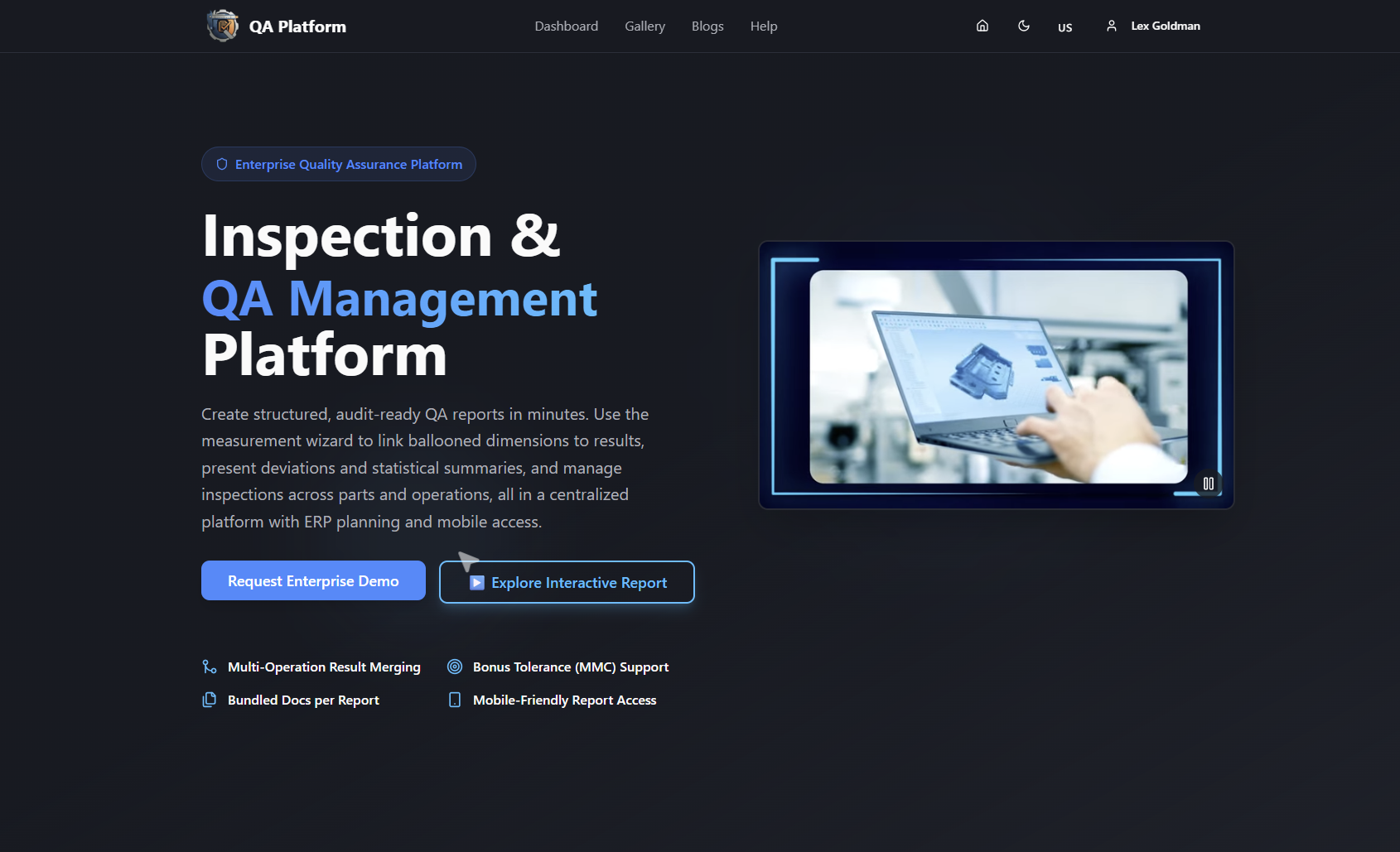
QA-Report gives quality engineers and supply chain teams the tools to build audit-ready inspection records, track nonconformances, and generate PPAP and FAI documentation without manual transcription errors. The platform's CMM data import, automatic drawing ballooning, and out-of-tolerance detection work together to close the gap between what your suppliers deliver and what your drawings require. Start with QA-Report and see how it fits your current quality workflows.
Key Takeaways
An effective supplier quality management system requires integration of structured evaluation, certified standards, real-time data, and cross-functional collaboration to prevent defects and maintain supply chain reliability.
| Point | Details |
|---|---|
| Standards are contractually binding | ISO 9001 is the minimum; automotive suppliers must meet IATF 16949 and AIAG Core Tools requirements. |
| Scorecards must trigger action | KPIs like defect rate, on-time delivery, and SCAR response time are only useful when tied to structured corrective action workflows. |
| Technology closes the data gap | Integrating supplier quality data with ERP and MES platforms replaces fragmented spreadsheets with reliable, real-time performance insights. |
| Continuous improvement requires verification | Closing a corrective action ticket is not improvement; verified root cause resolution and confirmed effectiveness are. |
| Training must stay current | AIAG Core Tools and ISO standards update periodically; annual refresher training tied to audit findings keeps personnel aligned with current requirements. |