
PFMEA software is a specialized digital solution that structures the analysis of process failure modes to prevent defects and protect manufacturing quality. Known formally as Process Failure Mode and Effects Analysis, PFMEA is a core discipline governed since 2019 by the AIAG-VDA FMEA Handbook, which replaced the older Risk Priority Number system with the Action Priority methodology. For quality engineers working under IATF 16949 or preparing PPAP submissions, dedicated PFMEA software is not optional. It is the difference between a documented risk management system and a collection of disconnected spreadsheets that fail the first audit.
What are the core features of PFMEA software?
The best PFMEA software does more than digitize a spreadsheet. It enforces structure, automates data transfer, and connects risk analysis directly to production controls.
The most capable platforms deliver these core functions:
- AIAG-VDA compliant templates. Structured forms align with the seven-step FMEA methodology, covering scope definition, structure analysis, function analysis, failure analysis, risk analysis, optimization, and results documentation.
- Action Priority matrices. The AP system replaces the legacy RPN score. Software applies High, Medium, and Low priority ratings based on Severity, Occurrence, and Detection combinations, producing more consistent prioritization across teams.
- Automated S/O/D rating tables. Standardized rating tables with customizable criteria keep scoring consistent across engineers and sites. Inconsistent scoring is one of the most common reasons FMEA reviews stall.
- Integrated Process Flow and Control Plan. PFMEA does not exist in isolation. Effective FMEA analysis tools link failure modes directly to process steps and control methods, so changes in one document propagate automatically.
- Version control and change tracking. Every revision is logged with a timestamp and author. Audit-ready traceability requires this, and manual document management cannot reliably provide it.
- Collaboration features. Cross-functional teams need simultaneous access. Cloud-based platforms allow production, engineering, and quality to work in the same document without emailing file versions back and forth.
- Drag-and-drop tree structures. Automated data transfer via drag-and-drop structures reduces redundant entry and speeds up FMEA creation significantly.
Pro Tip: When evaluating any FMEA management solution, ask specifically whether the Control Plan updates automatically when you change a detection control in the PFMEA. If the answer is no, you will be reconciling documents manually every time a process changes.
How does PFMEA software improve compliance and audit readiness?

PFMEA is a mandatory deliverable within PPAP under IATF 16949 for new or changed processes. That requirement alone makes structured software a necessity for any supplier in the automotive supply chain. Outside of customer-mandated cases, the AIAG-VDA handbook strongly recommends PFMEA as standard practice.
Audit readiness depends on four things: complete documentation, consistent scoring, synchronized records, and evidence of action follow-through. Software addresses all four.
- Standardized risk assessment. The Action Priority methodology requires consistent application of Severity, Occurrence, and Detection criteria. Software enforces the rating scale so two engineers in different facilities score the same failure mode the same way.
- Automatic synchronization. Disconnected tools cause audit non-conformance. When PFMEA, Process Flow Diagrams, and Control Plans live in one database, version mismatches disappear.
- Critical characteristics traceability. Software flags characteristics identified as special or critical in the PFMEA and carries them automatically into the Control Plan, satisfying IATF 16949 traceability requirements.
- Scheduled review triggers. IATF 16949 and PPAP requirements dictate review frequency. Good software supports calendar-based review reminders and event-triggered reviews when a new failure mode appears or a process changes significantly.
- Action status tracking. Auditors do not just check that actions were planned. They check that actions were completed and verified. Software with built-in action tracking provides the evidence trail.
"Disconnected manual tools are a major root cause of audit non-conformance. Centralized, integrated software platforms are critical to quality system compliance. When PFMEA, Control Plan, and Process Flow live in separate files, document divergence is not a risk. It is a certainty."
Experts recommend PFMEA reviews at least annually for ongoing production, and immediately after any event that reveals a new failure mode. Software that automates review scheduling removes the risk of missing that trigger.
What integration considerations matter when choosing PFMEA software?
Integration is where most PFMEA deployments either succeed or stall. A tool that works in isolation from your ERP, SPC system, and inspection software creates the same document divergence problem it was supposed to solve.
The table below compares two common deployment approaches by key integration criteria.

| Criteria | Standalone FMEA tool | Integrated quality platform |
|---|---|---|
| Control Plan sync | Manual export required | Automatic, real-time |
| SPC data connection | Not available | Linked to process data |
| ERP integration | Limited or none | API-based or native |
| Version control | File-based, error-prone | Centralized, timestamped |
| Cross-department access | Email-based sharing | Role-based cloud access |
| Audit trail | Manual log | Automatic change history |
Centralizing FMEA, Process Flow, and Control Plan in one database eliminates version control errors that standalone tools cannot prevent. This is not a convenience argument. It is a compliance argument. When an auditor pulls your Control Plan and your PFMEA and finds different detection controls listed for the same process step, that is a non-conformance.
Integration with real-time SPC software adds another layer of value. When SPC data shows a process drifting toward its control limit, that signal should trigger a PFMEA review. Software that connects these systems makes that connection automatic rather than dependent on someone remembering to check.
Pro Tip: Before committing to any platform, map every document your team currently produces for a PPAP submission. Confirm that the software either generates or directly imports each one. Gaps in that map become manual workarounds that grow into compliance risks.
What are best practices for PFMEA software adoption?
Deploying PFMEA software without the right team structure and review discipline produces compliant-looking documents that do not actually reduce risk. The software is the system. The team is what makes it work.
These practices separate effective deployments from checkbox exercises:
- Build cross-functional teams from the start. Production, maintenance, and process engineering must participate alongside quality. Siloed PFMEA teams miss failure modes that operators and maintenance technicians see every day. Software should support role-based access so every function can contribute without disrupting the document structure.
- Use editable rating tables with examples. Generic Severity and Occurrence definitions produce inconsistent scores. Configure your S/O/D tables with process-specific examples so a rating of 7 for Severity means the same thing to every engineer on your team.
- Enforce real-time synchronization between documents. Real-time propagation of changes from PFMEA to Control Plans is the single most important technical requirement in any FMEA control plan software. Without it, document divergence is a matter of when, not if.
- Track action completion, not just action assignment. The financial value of PFMEA software comes from monitoring detection and prevention actions through to verified completion. Assigning an action and closing the PFMEA session is not risk management. It is documentation theater.
- Review after every significant event. Process changes, customer complaints, warranty returns, and new failure modes all trigger a mandatory review under IATF 16949. Configure your software to send review notifications automatically when these events are logged.
Pro Tip: Assign a PFMEA owner for each process, not just a team. Ownership creates accountability. When no single person is responsible for keeping the PFMEA current, it drifts out of date between formal reviews.
Key takeaways
Effective PFMEA software connects risk analysis, process documentation, and action tracking in one system, making compliance verifiable and risk reduction measurable.
| Point | Details |
|---|---|
| AIAG-VDA compliance is the baseline | Software must support the seven-step methodology and Action Priority system, not legacy RPN. |
| PPAP requires PFMEA documentation | PFMEA is mandatory under IATF 16949 for new or changed processes; software makes submission faster and more accurate. |
| Document sync prevents non-conformance | Real-time propagation from PFMEA to Control Plan eliminates the version mismatches that cause audit failures. |
| Cross-functional teams improve accuracy | Including production and maintenance in PFMEA sessions captures failure modes that quality-only teams miss. |
| Action tracking closes the loop | Monitoring completion of prevention and detection actions is where PFMEA software delivers its real operational value. |
Why I think most teams underestimate what PFMEA software actually does
After working with quality systems across automotive and aerospace manufacturing, the pattern I see most often is this: teams buy PFMEA software to satisfy a customer requirement and then use it exactly like they used their spreadsheets. They fill in the fields, generate the document, and file it away until the next audit.
That approach misses the point entirely. The real value of integrated risk assessment software is not the document it produces. It is the discipline it enforces. When your PFMEA automatically updates your Control Plan, and your Control Plan drives your inspection criteria, you have built a quality system with actual traceability. Break any link in that chain and the whole system becomes a paper exercise.
The trend I find most promising is AI-assisted failure mode prediction. Early implementations are already suggesting failure modes based on process parameters and historical defect data. That capability will not replace engineering judgment, but it will surface risks that cross-functional teams overlook because they are too close to the process.
My recommendation: prioritize software that forces your team to work together and keeps every document synchronized. Automating compliance is achievable, but only when the underlying system is connected. A PFMEA that lives in a silo is not a risk management tool. It is a liability.
— Michael Chen
QA-Report and your quality documentation workflow
Quality engineers who need PFMEA-aligned documentation connected to real inspection data will find QA-Report built for exactly that workflow.
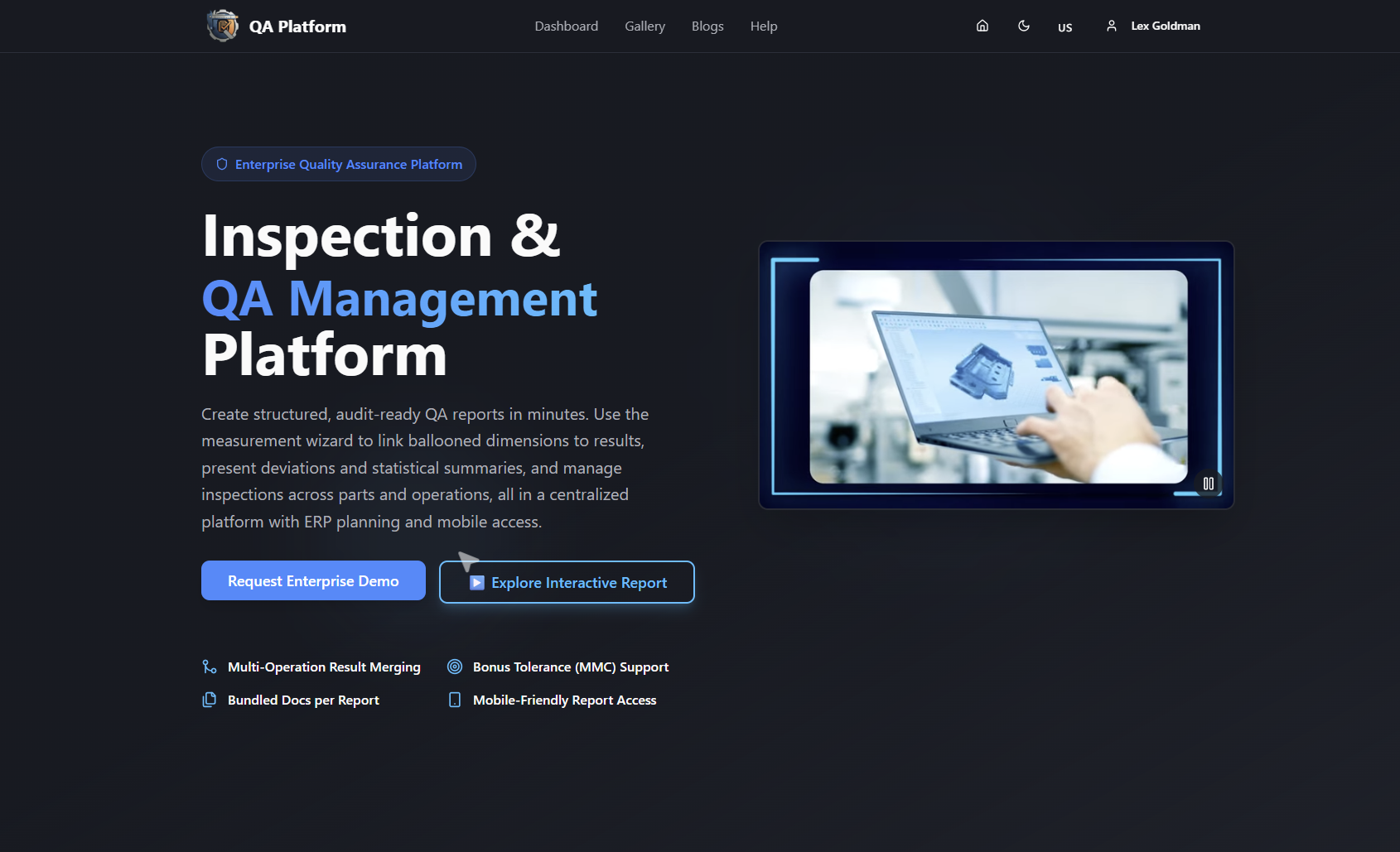
QA-Report is a cloud-based platform that generates audit-ready First Article Inspection reports, dimensional reports, and GD&T inspection summaries that satisfy ISO 9001, AS9100, and PPAP requirements. The measurement wizard links ballooned drawing dimensions to measured results, auto-flags out-of-tolerance deviations, and produces professional PDF reports in minutes. CMM data import, a built-in 3D CAD viewer for STEP and IGES files, and automatic drawing ballooning remove hours of manual work from your inspection process. For teams managing manufacturing quality control across multiple parts and production batches, QA-Report's integrated MES layer adds route cards, kanban planning, and rejection tracking in one centralized platform. Explore QA-Report to see how it fits your quality system.
FAQ
What is PFMEA software used for?
PFMEA software structures the identification, analysis, and prioritization of process failure modes before they cause defects. It generates documentation required for PPAP submissions and IATF 16949 compliance.
What PFMEA standard does the software follow?
Current PFMEA software aligns with the AIAG-VDA FMEA Handbook, which has governed the methodology since 2019 and replaced the legacy Risk Priority Number system with the Action Priority approach.
How does PFMEA software connect to Control Plans?
Integrated FMEA/control plan software propagates changes from the PFMEA directly into the Control Plan in real time, eliminating the version mismatches that cause audit non-conformances.
How often should a PFMEA be reviewed in the software?
Experts recommend reviewing PFMEA at least annually for ongoing production processes, and immediately after any event that reveals a new failure mode, a process change, or a customer complaint.
Can PFMEA software support cross-functional teams?
Yes. Cloud-based platforms provide role-based access so production, maintenance, process engineering, and quality can all contribute to the same PFMEA without creating parallel document versions.