
An 8D report follows eight sequential disciplines, D1 through D8, usually preceded by an optional D0 planning step, and a compliant report captures a specific deliverable at each stage: symptom and urgency (D0), team roster and authority (D1), a quantified problem statement (D2), verified interim containment (D3), root cause for both occurrence and escape (D4), a vetted permanent fix (D5), validated implementation data (D6), updated prevention systems like FMEAs and control plans (D7), and formal sign-off with lessons learned (D8).
Here's the one-line deliverable for each discipline:
- D0: Customer symptom recorded verbatim, urgency assessed, initial containment owner assigned.
- D1: Cross-functional team named, with authority levels and time commitments documented.
- D2: Problem quantified with Is/Is-Not and 5W2H data, not a vague description.
- D3: Interim containment scoped by lot or serial range, with verification evidence.
- D4: Root cause proven for both why the defect occurred and why it escaped detection.
- D5: Permanent corrective action selected, with risk assessment and verification plan.
- D6: Implementation validated against acceptance criteria before containment is lifted.
- D7: Systemic updates made to FMEAs, control plans, SOPs, and training records.
- D8: Team recognized, report signed off, and file archived for audit retrieval.
A minimal audit-ready report needs a header block, a verbatim symptom statement, named owners with dates, objective evidence at each gate, and a documented verification method. Skip any of those and a reviewer will send it back.
Key Takeaways
An audit-ready 8D report requires completing D0 through D8 in sequence, with documented evidence, verified containment, dual root-cause analysis, and formal sign-off at closure.
| Point | Details |
|---|---|
| Follow D0–D8 in order | Skipping or reordering disciplines weakens the corrective action's defensibility during audits. |
| Separate occurrence from escape | D4 must document why the defect happened and why detection missed it, not just one cause. |
| Quantify D2, don't summarize it | Use 5W2H and measured values against targets instead of vague qualitative descriptions. |
| Validate before removing containment | D6 needs a defined monitoring period and acceptance criteria before D3 actions stop. |
| Digitize the evidence trail | Tools like QA-Report link measured CMM data directly to the report, reducing missing-field rejections. |
Where to Find Authoritative 8D Resources and Templates
For deeper reference, consult ASQ's overview of the eight disciplines for canonical step definitions, the SPI RCCA Guidebook for an example form with field-level guidance, and a free downloadable D0–D8 template in Word, Excel, and PDF format. Manufacturing teams building out prevention actions may also find the quality control practices guide useful for shaping D7 control-plan updates.
Table of Contents
- What Is an 8D Report and When Do You Need One?
- How Do You Complete the 8D Report Steps?
- Building a Reusable 8D Report Template
- Why Digitize Your 8D Reporting Workflow?
- What Are the Most Common 8D Report Mistakes?
- Use QA-Report to Manage Digital 8D Records
- Frequently Asked Questions
- Sources
What Is an 8D Report and When Do You Need One?
The 8D methodology is a structured, eight-step corrective action process built around cross-functional teamwork and evidence-based root cause analysis. ASQ describes it as eight sequential disciplines, D1 through D8, often preceded by a D0 planning phase, and stresses that skipping steps or working out of order undermines the corrective action's defensibility.
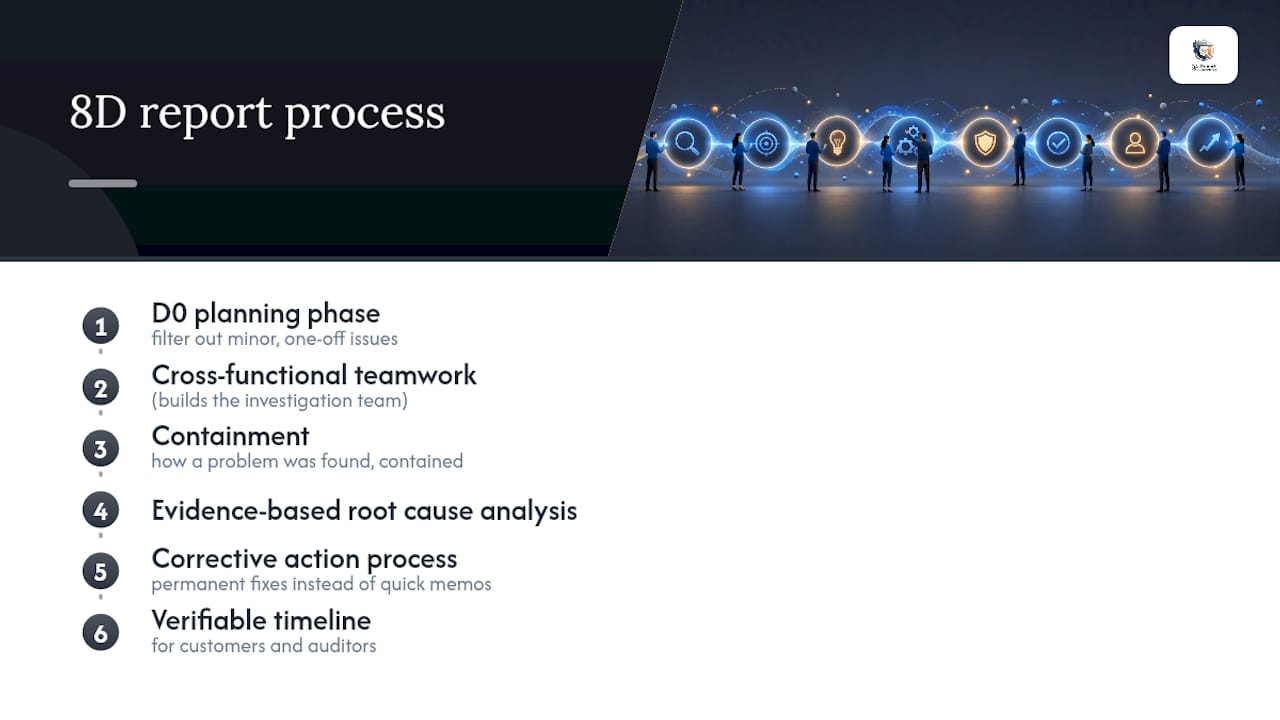
You reach for 8D, not a quick 5 Whys memo, when the situation demands a paper trail: a customer-issued corrective action request, a recurring defect that survived a previous fix, a safety or regulatory escape, or an external audit finding. Toolshero's explainer on the 8D format notes that D0 exists specifically to filter out minor, one-off issues that don't warrant the full process.
The payoff for that overhead is real. Atlassian's analysis found that a properly run 8D becomes a communication tool: it gives customers and auditors a verifiable timeline of exactly how a problem was found, contained, and permanently fixed. Typical use cases include automotive Tier-1 supplier responses to OEM complaints, supplier nonconformance reports, and critical process escapes in aerospace or medical device manufacturing, where a five-minute conversation won't satisfy an AS9100 or ISO 9001 auditor.
How Do You Complete the 8D Report Steps?
Each discipline has a specific job. Treat the sequence below as both a work plan and a field-by-field guide to what goes into the written report.
-
D0: Preparation and emergency response. Record the customer's complaint verbatim, don't paraphrase it into internal jargon. Decide whether the issue truly warrants a full 8D or a lighter fix, and log that decision with a reason. Note urgency level, initial containment owner, and target dates for D1 kickoff.
-
D1: Establish the team. List every member by name and role: champion (sponsor with budget authority), team leader (runs the investigation), and process owners (people who can actually change the line). Document each person's authority level and expected time commitment. A team member who can't authorize a process change is a bottleneck waiting to happen.
-
D2: Describe the problem. This is where vague reports fail. Use Is/Is-Not analysis and 5W2H (who, what, when, where, why, how, how many) to pin down the defect quantitatively. Write the measured value against the target, not "parts were out of spec," but "wall thickness measured 0.048 in. against a 0.052 in. ± 0.003 in. spec on 14 of 200 units." Attach the sample evidence: photos, gauge readings, inspection records.
-
D3: Interim containment action. Document exactly what was done to isolate the problem right now: sorted inventory, quarantined lots, added 100% inspection. Scope it precisely, serial ranges, batch numbers, date codes, so nobody wonders what's covered. Include verification steps proving containment actually works and name the owner responsible for maintaining it.
-
D4: Root cause analysis. This is the technical core of the report, covered in detail below. The short version: you need both a cause of occurrence (why the defect happened) and a cause of escape (why your inspection process didn't catch it).
-
D5: Choose permanent corrective actions. List every candidate fix considered, not just the one you picked. Document the rationale for the final selection, a risk and side-effect assessment (did the fix introduce a new failure mode?), and the verification method planned for D6.
-
D6: Implement and validate. Write the implementation plan with dates, then the measurement plan: what metric proves the fix works, what sample size, over what monitoring period. Automotive guidance commonly cites 30 consecutive days of clean production as a validation window before interim containment gets removed. State the acceptance criteria explicitly so there's no ambiguity about when D3 actions can stop.
-
D7: Prevent recurrence. This is where a good 8D pays for itself long after the immediate fire is out. Update the FMEA to reflect the newly understood failure mode, revise the control plan, rewrite the SOP, retrain affected operators. Assign an owner and a date to each action, and check whether sister parts or similar processes share the same exposure.
-
D8: Recognize the team and close. Summarize lessons learned in plain language, capture formal sign-offs from the champion and customer (if required), record the closure date, and note where the file lives for future audit retrieval.
Pro Tip: Open the 8D file on day one, even before the team is fully formed. A blank template with a report number and date populates instantly, and it forces D0 urgency decisions to happen in writing instead of in someone's head.
A few structural habits separate 8D reports that sail through review from ones that bounce back with red ink:
- Keep one living document instead of scattered emails and sticky notes across departments.
- Attach raw evidence (CMM logs, photos, gauge data) rather than summarizing it in a sentence.
- Assign a named owner and a due date to every action item, no exceptions.
- Separate containment language from correction language so reviewers can't confuse the two.
How Do You Document D4 Root-Cause Analysis Properly?
Fishbone (Ishikawa) diagrams and 5 Whys serve different jobs, and the strongest 8D reports use both. Start with a fishbone to map every plausible cause category, machine, material, method, measurement, environment, and people, so the team doesn't fixate on the first plausible story. Then run 5 Whys on the branch the team votes as most likely, drilling down until you hit a cause that's fixable and testable.

Document the chain literally. Example: defect observed → why? tool wear exceeded limit → why? tool change interval not enforced → why? maintenance schedule based on time, not cycle count → why? no cycle counter installed on that station. Each "why" needs supporting evidence attached, a wear measurement, a maintenance log, an interview note, not just a team's best guess.
5xWhys's D4 guidance is explicit that root cause analysis has to answer two separate questions: why did the defect occur, and why did your detection process fail to catch it before shipment. Reports that only answer the first question get rejected.
Reviewers look for reproducibility. If you can't demonstrate the failure on demand or point to test data, a supplier statement, or a process audit that confirms the mechanism, the root cause is still a theory.
Attach the raw test reports, not a paraphrase of them, and label which evidence supports occurrence versus escape.
Building a Reusable 8D Report Template
A workable 8D template starts with a header block: report number, customer name, part number and revision, date opened, target closure date, champion name, and current status. Every subsequent discipline gets its own section with specific required fields, not a blank text box.
The SPI RCCA Guidebook lays out an example form showing exactly what reviewers expect at each gate, and cross-referencing it against your own template catches gaps before a customer does.
| Discipline | Required fields | Common rejection reason |
|---|---|---|
| D0 | Verbatim symptom, urgency rating, initial owner | Symptom paraphrased instead of quoted |
| D2 | 5W2H data, measured value vs. target | Problem statement stays qualitative |
| D3 | Containment scope (lot/serial), verification method | No proof containment actually works |
| D4 | Occurrence cause, escape cause, raw evidence | Escape cause missing entirely |
| D6 | Validation data, sample size, monitoring period | Acceptance criteria undefined |
Practical advice worth repeating: open the report the day the issue surfaces, not after the team has already met twice. Keep a single living file rather than version-forked copies emailed between departments. And attach the underlying data, gauge readouts, inspection logs, supplier certificates, rather than a summary sentence claiming the work was done. A free downloadable D0–D8 template built around this structure gives most teams a faster starting point than building one from scratch, and pairing it with solid inspection documentation practices keeps the evidence trail consistent from intake through closure.
- Header block: report number, customer, part, dates, champion.
- D0–D3 fields: symptom, urgency, containment scope, verification.
- D4–D6 fields: occurrence cause, escape cause, validation data.
- D7–D8 fields: system updates, owners, sign-off, archive location.
Why Digitize Your 8D Reporting Workflow?
Paper and scattered spreadsheets are where 8D reports go to get rejected. A digital workflow keeps one living file instead of five conflicting versions, and it lets teams attach raw measurement files, CMM logs, calibration certificates, defect photos, directly to the discipline they support, preserving the audit trail a reviewer will eventually trace.
Three measurable advantages show up quickly once teams switch:
- Faster reviewer turnaround because every required field is structured, not buried in prose.
- Fewer rejected 8Ds for missing fields, since the form won't let D4 close without an escape cause.
- Easier cross-checks against FMEAs and control plans when D7 updates are linked, not retyped.
Pro Tip: Link each 8D record to its inspection lot number and route card. When D7 prevention actions are tied directly to the operational work instruction, the fix actually reaches the shop floor instead of living only in a closed file.
For teams managing FAI, dimensional, and CMM data across parts and batches, an integrated inspection platform removes the manual re-entry that causes half of these gaps in the first place, since ballooned drawing data and measured results already live in one system.
What Are the Most Common 8D Report Mistakes?
Missing escape analysis is the single most frequent rejection reason. A close second: verification claims with no attached data, "root cause confirmed" means nothing without a test report or reproducibility evidence behind it. Vague problem statements in D2 round out the top three; "intermittent failure" tells a reviewer nothing a measured value and sample size would.
Watch for these red flags mid-investigation:
- The team lacks authority to implement the fix it's proposing.
- Containment is quietly being treated as the permanent correction.
- D4 gets rushed to hit a deadline, without supporting data.
Best practice: fill D0 through D3 within the first 72 hours, require evidence behind every RCA claim, assign accountable owners with real dates, and make sure D7 actually updates the FMEA and control plan rather than just referencing them.
Pro Tip: Run RCA sessions with a strict rule: no cause gets written down without someone naming how it will be verified. It kills speculation before it eats an hour of meeting time.
A Practitioner's Habit for Faster 8D Closure
Splitting the report into audit-ready chunks speeds everything: a clean header block, a D2–D4 evidence packet (photos, gauge data, 5 Whys chain), and a separate D6 validation package with monitoring data. One living file with pre-assigned evidence owners at kickoff means nobody scrambles for a missing attachment during review. Reviewers expect the validation package alone to answer "how do we know this held."
Use QA-Report to Manage Digital 8D Records
QA-Report gives 8D teams the piece most templates lack: a direct link between measured evidence and the report itself, instead of manual copy-paste between a CMM printout and a Word document.
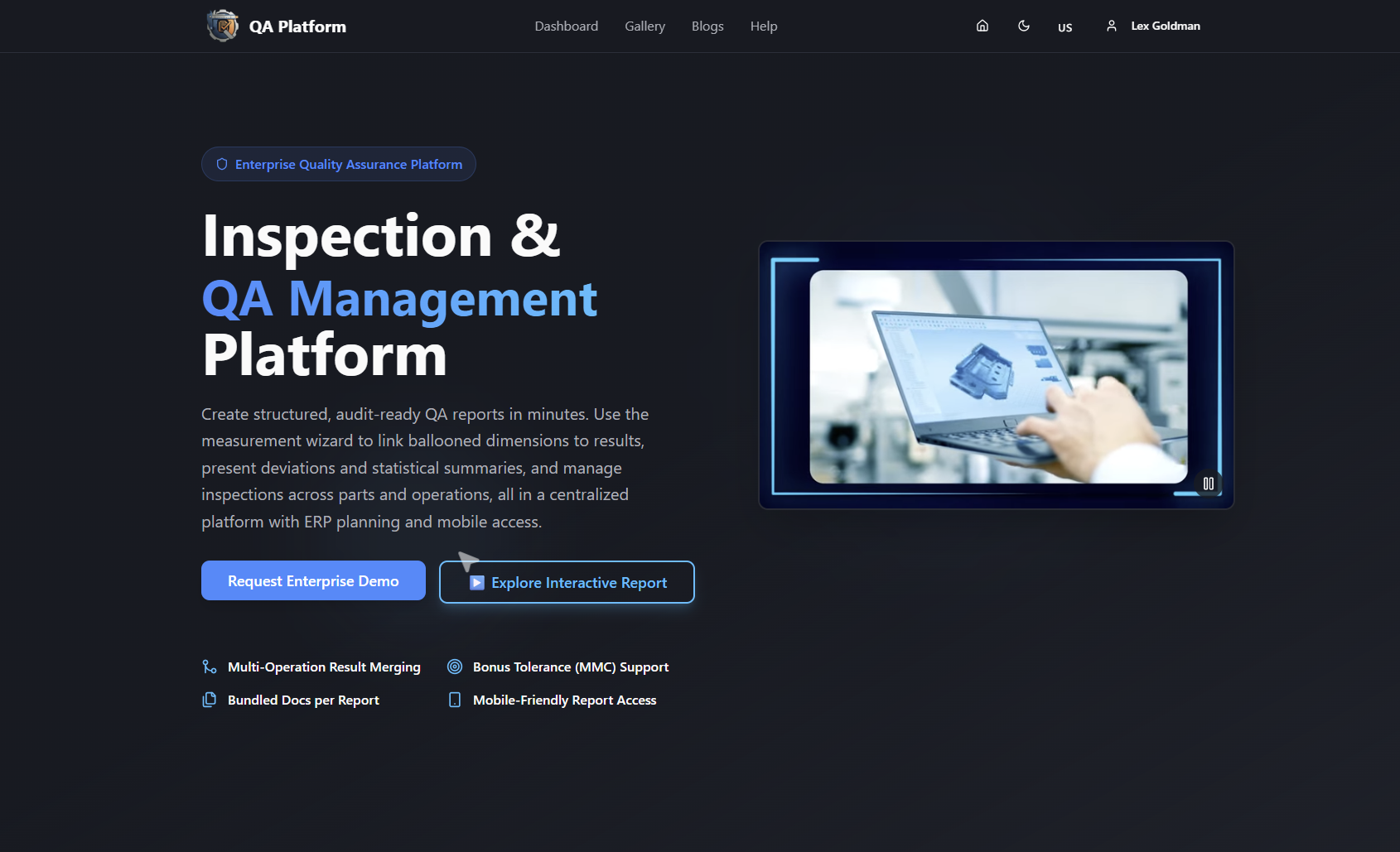
The measurement wizard connects ballooned drawing dimensions to actual measured results and auto-flags out-of-tolerance values, which slots directly into a D2 problem statement or a D6 validation package without retyping numbers. CMM data import pulls measurement files straight in rather than requiring someone to transcribe them, and version control with timestamps means a reviewer can see exactly when each discipline was completed, not just guess from an email thread. Standard report templates generate audit-ready PDFs that satisfy ISO 9001 and AS9100 documentation expectations, and linking records to FMEAs becomes far easier when both live in the same system.
If your team is still assembling 8D reports from disconnected spreadsheets and scanned inspection sheets, a free trial of QA-Report is a practical way to see whether a centralized workflow shortens your next validation cycle. You can also browse the video tutorials to see how attachments, CMM imports, and templates work before committing a team's time to it.
Frequently Asked Questions
What's the difference between 8D vs 5 Whys? 5 Whys is a single root-cause technique, one tool used inside D4. An 8D report is the entire structured process, team formation, containment, dual root-cause analysis, permanent correction, and prevention, that produces an auditable corrective action document.
How long should an 8D report take to complete? D0 through D3 should be filled within the first 72 hours. Full closure through D8 typically depends on the D6 validation window, often around 30 consecutive days of clean production in automotive settings, before containment is lifted.
Do all 8D reports need a D0 step? No. D0 is a common addition, not part of the original Ford methodology, and its job is to decide whether the issue actually warrants a full 8D investigation versus a lighter corrective action.
What causes most 8D reports to get rejected? Missing escape-cause analysis in D4, verification claims without attached test data, and vague D2 problem statements are the three most frequent reasons reviewers send reports back.
Who should lead an 8D investigation? A team leader runs the day-to-day investigation, while a champion, usually someone with budget and process authority, sponsors the effort and ensures corrective actions actually get implemented.
Sources
- What is 8D? Eight Disciplines Problem Solving Process | ASQ
- 8D Problem Solving: Ford's 8 Disciplines, D1–D8 Guide (2026)
- 8D problem solving — Atlassian