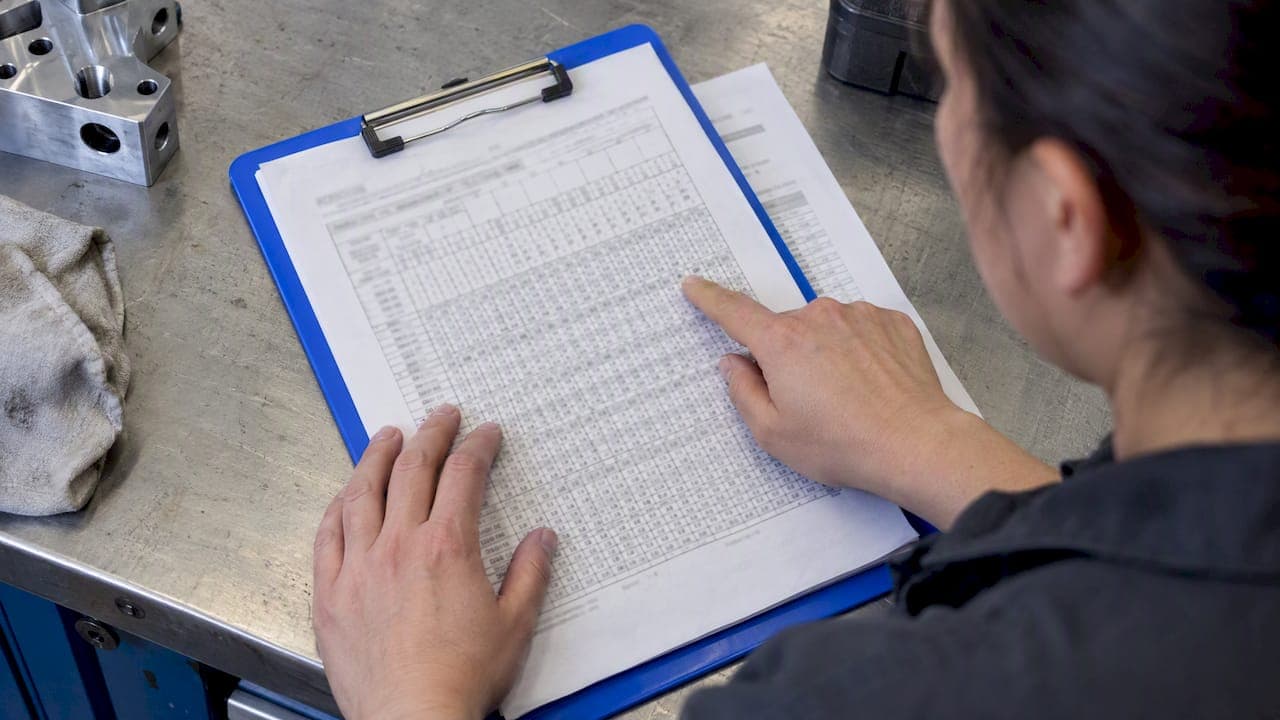
ANSI/ASQ Z1.4 is the AQL-based standard for inspecting lots by attributes: you pull a sample sized by the standard's tables, count defects, and accept or reject the whole lot based on fixed numbers. For most incoming and in-process checks, start at General inspection level II and work through the tables from there.
TL;DR:
- Use general inspection level II unless a customer contract or prior quality history requires another level; choose Z1.9 instead for continuous measurements.
- For a lot of 2,000 at level II, code letter K calls for 125 samples; accept seven defects or fewer and reject eight or more.
- Move to tightened inspection after consecutive rejections, and use reduced inspection only after qualifying accepted lots while production remains stable; record each switch.
- For 3,200 brackets at AQL 2.5 and level II, inspect 200 randomly selected units; accept up to 10 defects and reject at 11.
- Record the lot number, sample size, defect counts by category, applied AQL, and inspector approval; recount independently on a fresh sample near the acceptance limit.
Table of Contents
- What ANSI/ASQ Z1.4 Covers and Why It Exists
- Core Terms: AQL, Defects, and Inspection Levels
- How to Read Z1.4 Tables and Select a Sample Size
- Switching Rules and What OC Curves Tell You
- Worked Example: Running a Z1.4 Inspection Start to Finish
- Practitioner Tips: Software That Keeps Z1.4 Consistent
- A Practitioner's Take on Applying Z1.4 Well
- Run Z1.4 Inspections Without the Spreadsheet Guesswork
- FAQ
- Sources
What ANSI/ASQ Z1.4 Covers and Why It Exists
We rely on ANSI/ASQ Z1.4 because it gives a standardized, auditable way to judge whole lots from a sample rather than inspecting every unit, a key concept in packaging quality control. The current edition, ANSI/ASQ Z1.4-2003 (R2018), provides sampling procedures and tables for inspection by attributes, with tightened, normal, and reduced plans built around percent nonconforming or nonconformities per 100 units.
The standard traces its lineage to MIL-STD-105E: when the Department of Defense stopped supporting that military standard, ANSI/ASQ Z1.4 became the recommended replacement for attributes sampling. We see it applied most often in incoming inspection, lot acceptance at receiving, and in-process checks on production runs where a go/no-go decision on the whole batch is what matters.
When your quality characteristic is continuous, like a dimension or a torque value, variable sampling plans under ANSI/ASQ Z1.9 fit better.

Core Terms: AQL, Defects, and Inspection Levels
The Acceptable Quality Level (AQL) is the maximum percent defective (or defects per hundred units) that we treat as acceptable for routine acceptance. A common reference value is a low single-digit percent, often applied to major defects, though the right AQL always depends on the risk a nonconformity actually poses to form, fit, or function.
Getting the vocabulary right changes how you count. ASQ's sampling resources draw a clear line between a defect, which affects how a unit functions or looks, and a nonconformity, which is any failure to meet a stated specification regardless of functional impact. Mixing the two up skews your defect counts and, eventually, your AQL decisions.
Classifications typically break into three tiers:
- Critical: could cause injury or a hazardous condition; these are almost never acceptable under sampling.
- Major: likely to result in failure or materially reduce usability.
- Minor: a departure from specification unlikely to affect function.
Inspection levels I, II, and III (plus four special levels, S-1 through S-4) set how much discriminating power your sample size carries. General inspection level II is the default most teams use unless a customer contract or prior history calls for something tighter or looser.
How to Read Z1.4 Tables and Select a Sample Size
Reading the tables is mechanical once you know the sequence. Follow it in order and you will land on the correct sample size and acceptance numbers every time.
- Define the unit of inspection and lot size. Count the units that make up the lot you are judging, whether that is a shipment, a production batch, or a single order.
- Choose the inspection level and find the code letter. Cross-reference your lot size against the general inspection level (usually II) in the sample-size code letter table to get a single letter, such as "H" or "K."
- Pull the sample size and acceptance numbers from the single-sampling table. Match the code letter against your chosen AQL column to read off the sample size, the acceptance number (Ac), and the rejection number (Re).
- Check whether switching rules change the picture. If recent lots have failed or a run of clean lots has accumulated, normal inspection may need to shift to tightened or reduced, which changes the applicable table.
Pro Tip: Keep a running log of consecutive lot results next to your Z1.4 worksheet. You will need it the moment switching rules call for a change.
A short example: a lot of 2,000 units, general level II, gives code letter K. At a typical AQL, the single-sampling table calls for a moderate sample size and associated acceptance and rejection numbers. Count defects in the sample of 125; seven or fewer and the lot passes, eight or more and it does not. Our complete walkthrough of the AQL sampling table covers more lot-size and AQL combinations if you want to practice the lookup.

Switching Rules and What OC Curves Tell You
Z1.4 is not a static lookup. It is a scheme, and the switching rules between normal, tightened, and reduced inspection are what make that scheme defensible over time. Tightened inspection kicks in after a run of rejected lots under normal inspection; reduced inspection becomes available after a string of clean lots, provided production is stable.
Operating characteristic (OC) curves describe the probability that a lot of a given true quality level gets accepted under a specific plan. They are how we talk about producer's risk (a good lot wrongly rejected) and consumer's risk (a bad lot wrongly accepted) in the same breath.
Switching rules describe a worst-case scheme performance. ASQ/ANSI Z1.4-2003 (R2018) notes that ignoring switching rules and selecting individual plans without reviewing their OC curves undercuts the protection the scheme is built to provide.
A quick checklist for inspection-level changes:
- Move to tightened inspection after consecutive lot rejections under normal inspection.
- Move to reduced inspection only after a qualifying run of accepted lots with stable production.
- Document every switch with the lot numbers, dates, and the rule that triggered it, so an auditor can retrace the decision.
Worked Example: Running a Z1.4 Inspection Start to Finish
Picture a lot of 3,200 machined brackets arriving from a supplier. You set AQL 2.5 and general inspection level II, consistent with your incoming inspection procedure.
- Look up the code letter. A lot size of 3,200 under general level II gives code letter L.
- Pull the sample size and acceptance numbers. At AQL 2.5, code letter L calls for a sample size of 200, acceptance number 10, rejection number 11.
- Draw and inspect the sample. Pull 200 brackets at random and classify each defect found against your major and minor criteria.
- Record the decision. Nine defects means acceptance; twelve means rejection and a disposition decision on the full lot.
For documentation, capture the lot number, sample size, defect count by category, the AQL applied, and the inspector's sign-off. When a result lands right at the acceptance number, a second independent count on a fresh sample is often the more defensible move before committing to a decision. Our notes on incoming inspection best practices cover the recordkeeping side in more depth.
Practitioner Tips: Software That Keeps Z1.4 Consistent
Manual table lookups invite transcription errors, especially under deadline pressure. We build QA-Report's inspection workflow around automated ballooning and CMM data import so that measured results, defect counts, and sample-size calculations live in one record instead of scattered spreadsheets.
Structured checklists tied to each lot keep attribute counts consistent across inspectors and shifts, which matters when switching rules depend on an accurate history of consecutive results. The same structured data feeds directly into FAI and PPAP-ready PDF reports, so the evidence an auditor wants is already assembled rather than reconstructed after the fact.
A Practitioner's Take on Applying Z1.4 Well
The standard rewards consistency more than cleverness. Teams that document every switching-rule decision and revisit their AQLs against real defect data outperform teams that treat the tables as a one-time lookup. Review your AQLs on a schedule, not just when a customer complains.
— Michael Chen
Run Z1.4 Inspections Without the Spreadsheet Guesswork
We built our software to take the manual work out of attribute inspections: automatic drawing ballooning, CMM data import, out-of-tolerance flagging, and audit-ready PDF reports that satisfy ISO 9001 and AS9100 documentation needs.
Plans start with a Free tier, with Basic at $49.99 per month and PRO at $149.99 per month for teams running higher inspection volumes. Check our pricing page or book a demo to see how a Z1.4 workflow looks inside QA-Report.
FAQ
What Is 2.5 AQL Inspection?
It is a commonly referenced value for major defects under ANSI/ASQ Z1.4, though the appropriate AQL always depends on the risk a specific defect poses.
What Are the ANSI Standards?
ANSI, the American National Standards Institute, coordinates voluntary consensus standards across industries in the United States rather than writing every standard itself. ANSI/ASQ Z1.4 is one such standard, developed with ASQ, covering sampling procedures and tables for inspection by attributes.
What Is the ISO Standard for Sampling Plans?
ISO 2859 is the international counterpart to ANSI/ASQ Z1.4, covering attribute sampling plans indexed by AQL in a structure closely aligned with the ANSI version. Teams working with international customers sometimes need to confirm which standard a contract specifies, since the two are similar but not identical in table structure.
What Is the Difference Between ANSI Z1.4 and Z1.9?
ANSI/ASQ Z1.4 covers attribute sampling, where each unit is simply judged conforming or not. ANSI/ASQ Z1.9 covers variable sampling, which measures a continuous characteristic and requires sampling and analysis per characteristic, making it more involved to implement than Z1.4.
Sources
- ASQ/ANSI Z1.4–2003 (R2018)
- Attribute Sampling Plans - Inspection by Variables & Attributes Z1.4 & Z1.9 | ASQ
- Z1.4 Sample Size - ASQ - Ask the Standards Experts