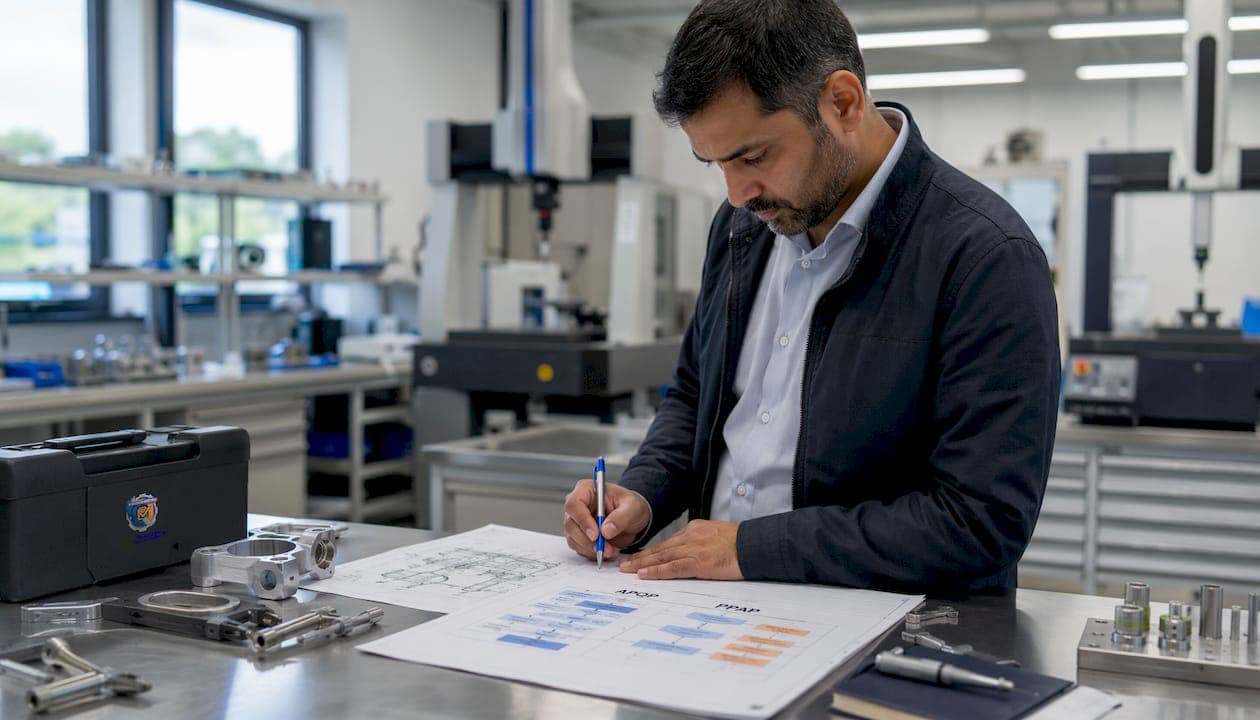
Which APQP and PPAP software solutions lead the market?
The strongest APQP and PPAP software platforms available in the U.S. today combine project tracking, document control, supplier collaboration, and compliance support for AIAG and AS9145 aerospace standards in a single system. The table below maps each platform to its primary use case, key capabilities, and deployment model.
| Product | Best For | Key Features | Compliance Support | Cloud/Web | Customer Type |
|---|---|---|---|---|---|
| Net-Inspect | Workflow automation | Project and document management automation | AIAG, AS9145 | Web-based | OEMs, contract mfrs |
| SoftExpert APQP-PPAP | Large enterprise supplier connectivity | Supplier portal, workflow customization | AIAG, IATF 16949 | Cloud | Large OEMs |
| Omnex APQP/PPAP Manager | Project-centric planning | Resource and document control, time tracking | AIAG, AS9145 | Web | Project managers |
| DELMIAworks | ERP-integrated quality | All APQP phases, electronic submission | AIAG, IATF 16949 | Cloud/on-site | Mid-large mfrs |
| PPAPXpress | Rapid PPAP documentation | PPAP file automation, audit readiness | AIAG | Web | Contract mfrs |
| Discus PPM | Ease of use, fast deployment | Configurable workflows, intuitive UI | AIAG | Cloud | SMB manufacturers |
| APQPXpress | Product launch timelines | Phase-based APQP, automated process flow | AIAG | Web | Contract mfrs |
| Plex Quality Management | Cloud scalability | Integrated QMS, compliance features | AIAG, IATF 16949 | Cloud | Mid-large mfrs |
| Relyence APQP | Risk and compliance | FMEA, control plans, analytics | AIAG, AS9145 | Cloud | Quality engineers |
| Palstat | Custom workflows | AIAG and AS9145 configuration | AIAG, AS9145 | Web | Aerospace, auto |
| EtQ Reliance | Enterprise scalability | Audit trails, advanced reporting | AIAG, IATF 16949 | Cloud | Large enterprises |
| MasterControl | Regulated industries | Document control, audit management, training | ISO, IATF 16949 | Cloud | Regulated mfrs |
| Minitab Engage | Analytics-driven quality | Process improvement, project management | AIAG | Cloud | Quality analysts |
Core features and automation benefits worth comparing closely
PPAP documentation consists of 18 required elements across five submission levels, and managing them manually across multiple suppliers is where most quality teams lose time. The best platforms automate element tracking, flag missing items, and route approvals without manual follow-up.
Key capabilities to evaluate:
- Document control with electronic signatures: Platforms like MasterControl and EtQ Reliance provide full audit trails and e-signature workflows that satisfy IATF 16949 and FDA requirements.
- Supplier collaboration portals: SoftExpert and Omnex offer dedicated portals where suppliers upload documents directly, receive automated notifications, and track approval status in real time.
- Multi-stage approvals and interim expiration: Production part approval workflows benefit from conditional approvals tied to production milestones, a capability found in Relyence APQP and DELMIAworks but absent from simpler document-centric tools.
- FMEA and control plan integration: Relyence APQP links FMEA outputs directly to control plans and PPAP packages, reducing the risk of disconnected records.
- Automation of PPAP file generation: PPAPXpress and APQPXpress focus specifically on accelerating PPAP file creation, cutting preparation time considerably.
Pro Tip: Before requesting a demo, ask the vendor specifically how their platform handles interim approvals and conditional PPAP submissions. Many tools support standard Level 3 submissions cleanly but struggle with pilot-run versus full-production approval distinctions.
Manufacturers who have adopted cloud-based APQP platforms report shorter approval cycle times thanks to automated notifications and supplier portals. Demos, webinars, and case studies are available from most vendors listed here, and requesting a live walkthrough of the supplier portal is the fastest way to assess real-world usability.

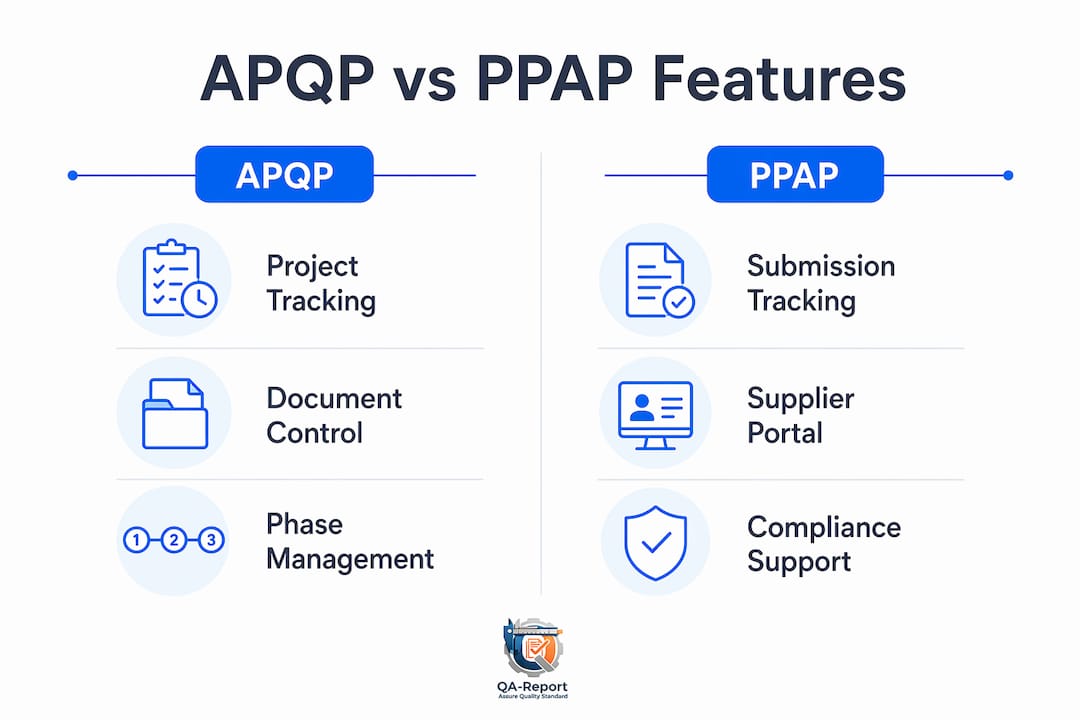
How to choose the right APQP and PPAP software for your operation
The right platform depends on three factors: your industry standard, your deployment preference, and how deeply the tool needs to connect with your existing systems.

Compliance standard first. Automotive manufacturers working under IATF 16949 should prioritize platforms with native AIAG core tools support. Aerospace suppliers governed by AS9145 need a platform like Palstat or Relyence APQP that explicitly supports that standard's documentation requirements.
Deployment and scalability. Cloud platforms like Plex Quality Management and EtQ Reliance suit manufacturers who need multi-site access and IT-light deployment. On-site or hybrid options from DELMIAworks work better when data sovereignty or ERP proximity is a constraint.
Integration depth. A platform that cannot exchange data with your ERP or PLM creates a parallel record-keeping burden. Evaluate:
- Native ERP connectors (SAP, Oracle, DELMIAworks natively)
- REST API availability for custom integrations
- PLM linkage for design change notifications
- QMS synchronization for CAPA and audit trail continuity
Vendor support and training. Omnex and MasterControl both offer structured onboarding programs and user communities. Thin vendor support is the most common complaint in post-implementation reviews, so ask for references from manufacturers of similar size.
Total cost of ownership. Per-user subscription pricing suits smaller teams; enterprise licensing with unlimited users fits high-volume contract manufacturers. Factor in implementation, training, and annual maintenance when comparing bids.
Understanding the APQP and PPAP process phases software must support
APQP consists of five defined phases, from planning through feedback and corrective action. PPAP is triggered in Phase 4 as the validation output, not a separate event.
| APQP Phase | Key Activities | Software Support Needed |
|---|---|---|
| Phase 1: Planning | Customer requirements, feasibility | Requirements capture, risk register |
| Phase 2: Product Design | DFMEA, design verification | FMEA module, DVP&R tracking |
| Phase 3: Process Design | PFMEA, control plan, process flow | PFMEA, control plan builder |
| Phase 4: Product/Process Validation | PPAP submission, MSA, SPC | PPAP file generation, MSA, SPC |
| — | Lessons learned, CAPA | CAPA module, lessons-learned library |
Without software linking these phases, PPAP becomes a paper exercise that fails to surface process risks early. The most capable platforms treat PPAP documentation as a living record, with conditional approvals and revision management tied to production milestones rather than a one-time submission.
Key documentation requirements per AIAG and AS9145:
- Design records and engineering change documents
- Process flow diagrams and control plans
- Measurement system analysis (MSA) results
- Initial process capability studies
- Part submission warrant (PSW) with customer sign-off
How leading platforms handle varying industry and customer requirements
Automotive OEMs, aerospace primes, and medical device manufacturers each impose different documentation levels and approval workflows. Palstat stands out for its configuration depth across AIAG and AS9145 simultaneously. SoftExpert handles multi-customer requirement sets through its workflow engine, letting suppliers maintain separate PPAP packages per customer without duplicating records. For teams supplying both Tier 1 automotive and aerospace customers, a platform that manages customer-specific submission levels in parallel is not optional.
How software supports new product introduction lifecycle stages
New product introduction (NPI) requires quality gates at every phase transition. APQPXpress and Discus PPM both structure their workflows around phase-based gates, blocking advancement until required deliverables are approved. This prevents the common failure mode where a team reaches Phase 4 with incomplete Phase 2 FMEA records. Cloud-based platforms with Gantt and kanban views, such as Plex Quality Management, give program managers visibility across multiple NPI projects simultaneously.
Benefits for OEMs and contract manufacturers differ significantly
OEMs typically need supplier-facing portals, multi-tier PPAP visibility, and integration with PLM systems. SoftExpert and DELMIAworks address this directly. Contract manufacturers, by contrast, need to respond quickly to customer-specific PPAP requirements with minimal setup time. PPAPXpress and APQPXpress are built for exactly that scenario, prioritizing fast file generation over deep configurability. Discus PPM occupies the middle ground, offering configurable workflows without the implementation overhead of an enterprise platform.
Cloud and web deployment options across the market
Every platform in this comparison offers cloud or web-based access, but the architecture varies. Plex Quality Management runs on a true multi-tenant cloud with automatic updates. EtQ Reliance and MasterControl offer private cloud options for manufacturers with data residency requirements. Net-Inspect operates as a web application accessible from any browser, which suits distributed supplier networks without requiring client software installation.
What U.S.-based manufacturers report from real-world use
Manufacturers who have moved from spreadsheet-based PPAP tracking to dedicated platforms consistently report faster approval cycles and fewer audit findings. Integrated APQP platforms reduce quality costs by maintaining traceable, audit-ready PPAP elements that survive personnel changes and customer audits. The most cited pain point before adoption is the same across industries: a PPAP package assembled from disconnected files in multiple systems, with no single owner and no automated expiration tracking.
QA-Report brings audit-ready inspection into your quality workflow
If the platforms above handle APQP project management and PPAP documentation well, the gap many quality teams still face is the inspection report itself. Generating a compliant First Article Inspection report from CMM data, with ballooned drawings and GD&T validation, typically takes hours in a spreadsheet.
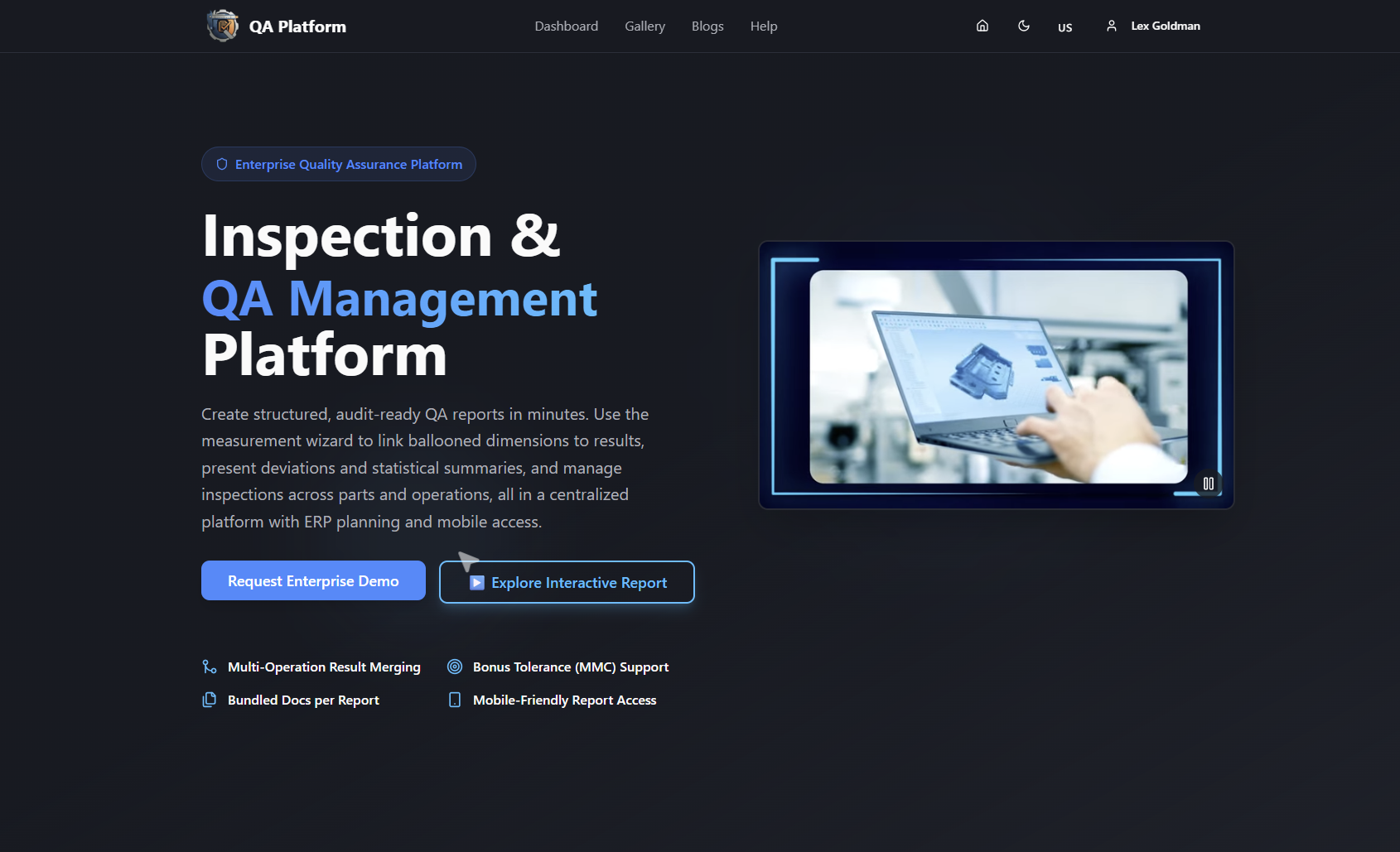
QA-Report closes that gap. The platform imports CMM data directly, auto-balloons PDF drawings with AI-driven numbering, flags out-of-tolerance deviations automatically, and generates audit-ready PDF reports that satisfy ISO 9001, AS9100, and PPAP requirements in minutes. An integrated MES layer adds route cards, kanban and Gantt planning, and role-based shop-floor access. For quality engineers who need PPAP-compliant inspection records without the manual assembly work, QA-Report offers a free trial and tiered subscription pricing, with enterprise options for larger operations. See the full platform at qa-report.com.
Key Takeaways
The strongest APQP and PPAP software platforms combine phase-based project tracking, automated document control, and supplier collaboration in a single system aligned to AIAG or AS9145 standards.
| Point | Details |
|---|---|
| Standards alignment is the first filter | Choose platforms explicitly supporting AIAG for automotive or AS9145 for aerospace before evaluating any other feature. |
| Multi-stage approvals separate capable tools | Platforms like Relyence APQP and DELMIAworks support conditional and interim PPAP approvals; simpler tools do not. |
| Cloud deployment reduces IT burden | Plex, EtQ Reliance, and MasterControl offer cloud or private cloud options suited to multi-site manufacturers. |
| PPAP as a living record improves risk detection | Software that links PPAP documentation to production milestones surfaces process risks earlier than one-time submission tools. |
| QA-Report covers the inspection report gap | For PPAP-compliant FAI reports with CMM data import and auto-ballooning, QA-Report offers a free trial with tiered pricing. |