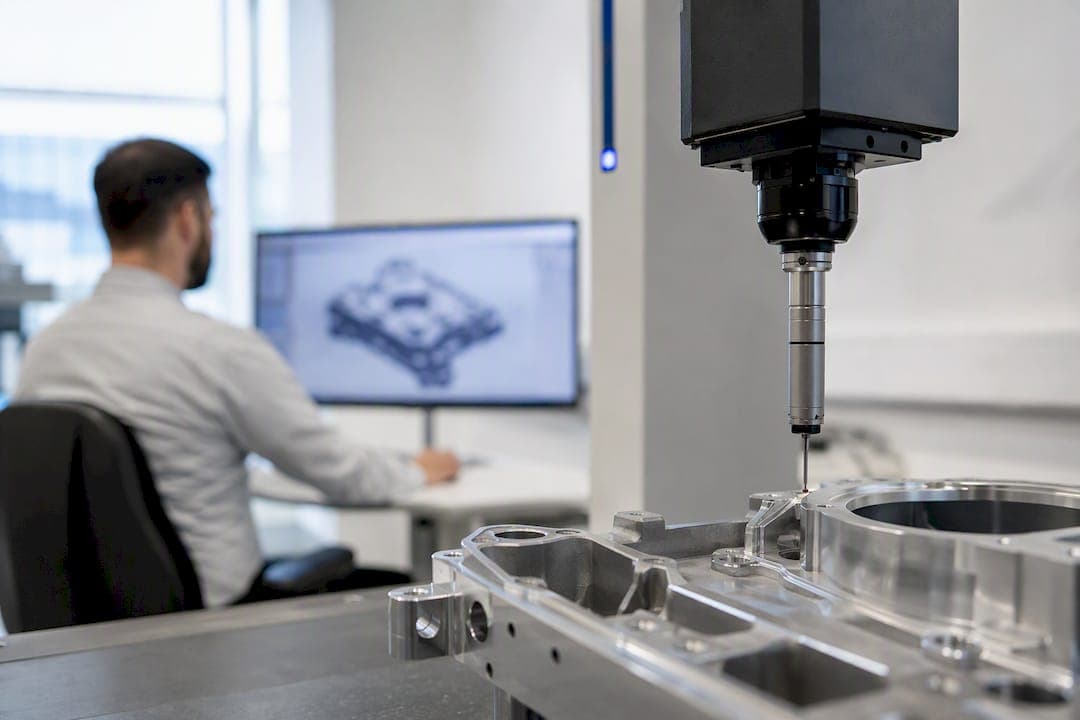
A quality digital thread is the connected chain of lifecycle data, from design intent through inspection results, that lets a quality team trace any defect back to its root cause in minutes instead of days. Its single biggest payoff is moving quality checks upstream: instead of catching problems on the CMM report, you catch them when the model-based definition (MBD) is still on screen. That shift depends on three enablers working together: MBD/PMI, a PLM or MES backbone, and machine-readable inspection formats like QIF.
TL;DR:
- A digital thread enables rapid root-cause analysis by linking design, inspection, and manufacturing data through bidirectional flow and machine-readable formats like QIF.
- Successful implementation depends on proper data governance, semantic interoperability, and a well-mapped technology stack including PLM, CAD, MES, and ERP systems.
- Most digital thread failures stem from system mismatches, stale data, or lack of process mapping rather than technical flaws, highlighting the need for careful planning and pilot testing.
- Pilots should focus on a single stable part family with clear success metrics such as defect escape rate and root-cause time, before scaling to wider production.
- Inspecting software that automates ballooning and CMM data import can significantly reduce manual errors and streamline integration within a quality-driven digital thread.
Table of Contents
- Digital thread quality starts with a clear definition, not a buzzword
- How digital thread quality reduces defects and shortens root-cause time
- The technology stack behind a reliable digital thread
- Where digital thread implementations actually stall
- A step-by-step plan to pilot a quality-focused digital thread
- How inspection software fits into the quality digital thread
- Where digital thread quality shows up differently by industry
- Why quality has to own the thread, not just consume it
- Sources
Digital thread quality starts with a clear definition, not a buzzword
A digital thread is a bidirectional, interconnected information system linking data, processes, and workflows across the entire product lifecycle, from initial requirements through design, manufacturing, service, and end-of-life, according to the Digital Twin Consortium. Bidirectional is the operative word. Data doesn't just flow forward from engineering to the shop floor. A CMM measurement that reveals a tolerance is consistently tight should flow backward into the design record, informing the next revision.
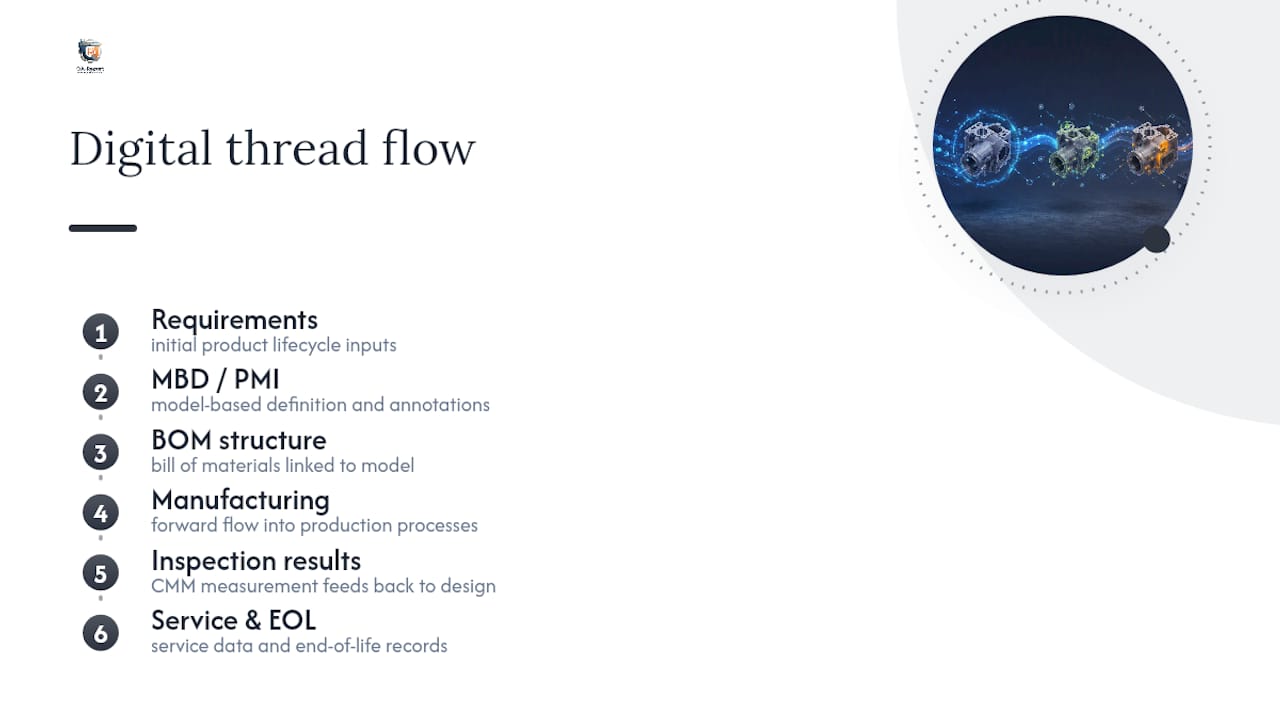
That two-way flow is what makes the thread a single source of truth rather than a folder of exported PDFs. A requirements document, a bill of materials, a ballooned drawing, and an inspection result all reference the same underlying model instead of four disconnected copies that drift apart over time.
This is also where digital thread quality gets confused with digital twin, and the distinction matters for how you sequence a project. A digital twin is a live, simulated representation of a specific physical asset. A digital thread is the data backbone that feeds it. You cannot build a trustworthy twin on top of a broken or incomplete thread, which is why practitioners increasingly argue for building the thread before the twin rather than the reverse. For a quality engineer, the practical takeaway is simpler: focus first on linking requirements, MBD/PMI, BOM structure, and inspection results. The twin, if you need one, comes later.
How digital thread quality reduces defects and shortens root-cause time
The mechanism is straightforward: digital threads move quality assurance from reactive downstream inspection to upstream confirmation using model-based definition and product manufacturing information, according to Quality Magazine. Instead of an inspector reverse-engineering tolerances from a flat 2D drawing after a part is already machined, the characteristics, GD&T callouts, and datums live directly in the 3D model where engineering defined them.
That single change eliminates a category of error that quality teams rarely name explicitly: transcription mismatch. A drawing dimension gets misread, a tolerance zone gets misapplied, or a revision doesn't make it to the floor in time. When PMI is embedded in the model and extracted automatically, that translation step disappears.
Traceability compounds the benefit. When every inspection record links to a specific part number, batch, and serial, a non-conformance stops being an isolated event and becomes a data point you can trace back through the BOM to a specific supplier lot, machine, or operator shift.
Three outcomes quality teams consistently target once a thread is in place:
- Faster time-to-root-cause, because deviations link directly to the design characteristic and process step that produced them
- Fewer transcription-driven out-of-tolerance escapes, since inspectors work from the same ballooned characteristics engineering defined
- Tighter audit cycles, because inspection evidence already carries its chain of custody back to the drawing revision
NIST's digital thread roadmap identifies traceability, data freshness, semantic interoperability, and governance as the central levers that determine whether these gains materialize, warning that a thread built on stale or inconsistent data delivers weaker returns than one built on governed, current information.
Pro Tip: Before chasing new software, audit how many of your current non-conformance reports actually cite a drawing revision number. If most don't, that's your semantic interoperability gap, not a tooling gap.
The technology stack behind a reliable digital thread
No single system carries a digital thread end to end. It's assembled from a stack where each layer contributes a specific type of data, and the failure mode most teams hit isn't missing software, it's disconnected software.
- PLM holds the master model, revision history, and requirements traceability matrix.
- CAD with embedded MBD/PMI carries dimensional and geometric tolerancing directly on the 3D model rather than a separate flat drawing.
- MES captures the "as-built" reality: which operator ran which operation, on which machine, at what time.
- ERP ties parts and work orders to purchase orders, suppliers, and cost.
- IIoT sensors stream machine condition and process parameters that correlate with quality outcomes.
Standards are what keep this stack from turning into a translation nightmare. The Quality Information Framework (QIF) is the leading machine-readable format for inspection data, purpose-built to carry characteristics, measurement plans, and results without manual re-entry, as Chalmers research on machine-readable inspection linkage documents. STEP and IGES remain the workhorse geometry exchange formats, though STEP's richer support for PMI makes it the better long-term choice; the tradeoffs are worth understanding in more depth if your shop still argues about which CAD format to standardize on. ISO 23247-5 now formalizes the principles for connecting digital twins to lifecycle data through a digital thread, giving manufacturers a reference architecture rather than a proprietary one, per ISO's published standard.
Semantic interoperability, meaning two systems agreeing on what a "characteristic" or "deviation" actually means, matters more than raw connectivity. Two systems can be technically integrated via API and still miscommunicate quality data if their underlying data models don't map cleanly, an issue NIST's own digital thread manufacturing program traces to unresolved geometric and topological representation differences at the model level.
Where digital thread implementations actually stall
Most digital thread initiatives don't fail on technology. They fail on the assumptions teams make about how quickly disparate systems will start speaking the same language.
- Semantic mismatch between systems. A "characteristic" in your CAD tool may not map cleanly to a "feature" in your MES. Standardizing on QIF for inspection data and building explicit canonical mappings between systems closes most of this gap.
- Quality treated as a downstream consumer, not a co-owner. When quality only sees the model after design releases it, upstream confirmation never happens. Model-based quality succeeds when quality engineers get write access to PMI definitions during design review, not just read access after release.
- Data governance gaps. Stale revisions, unclear ownership, and inconsistent role-based access erode trust in the thread faster than any technical failure. Every user needs to know which record is current and who is authorized to change it.
- The "buy a tool" fallacy. Software doesn't fix a process that was never mapped. Teams that skip process mapping and jump straight to procurement end up with a expensive system layered on top of the same manual reconciliation they had before.
Pro Tip: Run your first pilot on a part family that already has a stable BOM and a documented inspection history. A moving target makes it impossible to tell whether the thread improved quality or the part just changed.
A step-by-step plan to pilot a quality-focused digital thread
Start narrow. A digital thread pilot that tries to connect every system at once collects every integration headache at once, too.
- Define scope and success metrics first. Pick two or three numbers you can actually measure before you touch software: defect escape rate, mean time to root cause (MTTR), and audit prep time. Without a baseline, you can't prove the thread worked.
- Select one pilot part or product family. Choose something with a stable design and enough production volume to generate real inspection data within weeks, not quarters.
- Map the touchpoints explicitly. Trace the actual data path: CAD model with embedded MBD, PMI extraction, MES work order execution, inspection event capture, and CAPA closure. Draw this on a whiteboard before you write a single integration script.
- Build the integration checklist. At minimum you need PMI extraction from your CAD system, QIF export and import between design and inspection tools, MES event hooks that timestamp production steps, and IIoT telemetry ingestion if process parameters matter to your failure modes.
- Run the pilot on a build, validate, measure, iterate cadence. Build the connections, validate that data actually flows both directions, measure against your baseline metrics, then iterate before you scale to a second part family.
First article inspection is frequently the best entry point for a pilot precisely because it already couples engineering intent with a formal inspection output, creating an auditable record that regulatory reviewers and internal process-improvement teams both want, a pattern documented in a recent systematic review of digital thread frameworks. If your organization already runs FAI on new part introductions, you're piloting on top of a process that already generates the exact evidence a digital thread needs to capture.
Scaling comes only after the pilot proves the metrics moved. Trying to roll a thread out plant-wide before validating it on one part family is the single most common way these initiatives lose executive support.
How inspection software fits into the quality digital thread
The gap between "we have a digital thread strategy" and "our inspectors are actually using it" is usually a tooling gap, not a strategy gap. This is where a platform like QA-Report fits directly into the mechanics described above rather than sitting alongside them.
Automatic drawing ballooning extracts characteristics directly from PDF or CAD drawings, cutting the manual step where an inspector re-numbers a drawing by hand before measurement even starts. A 3D viewer supporting common CAD formats lets inspectors reference the model geometry rather than a flattened export. CMM data import maps measured results against ballooned dimensions, and tolerance validation flags out-of-tolerance deviations the moment they're recorded rather than after a report gets compiled later.
- Auto-ballooning removes the transcription step that introduces the mismatch errors upstream MBD is meant to prevent
- CMM import and tolerance validation close the loop between measured results and the original characteristic definition
- Generated FAI, dimensional, and GD&T reports satisfy documentation requirements without manual assembly
- Batch and serial tracking preserve the linkage a non-conformance needs to trace back through the BOM
| Capability | Digital thread function it supports |
|---|---|
| Auto drawing ballooning | Eliminates manual transcription between MBD and inspection plan |
| CMM data import | Links measured results directly to characteristic definitions |
| Tolerance validation | Flags deviations at the point of measurement, not after reporting |
| FAI/PPAP report generation | Produces audit-ready traceability documentation |
Role-based shop-floor access supports data governance by controlling what inspectors and reviewers see during quality checks. Deeper detail on connecting CMM output to automated documentation is worth reviewing if manual inspection paperwork is still your team's biggest bottleneck.
Where digital thread quality shows up differently by industry
The mechanics stay consistent across sectors. What changes is which piece of the thread carries the most regulatory or commercial weight.
- Aerospace leans hardest on first article inspection, serial-level traceability, and audit trails that satisfy AS9100 and customer-specific requirements; a broken thread here shows up as a failed supplier audit, not just a quality escape.
- Automotive cares most about ramp-up quality: how fast a new program hits right-first-time rates without a long tail of early-production defects tracing back to tooling or fixture issues.
- Medical device manufacturers need traceable inspection records as regulatory evidence, since a design change or non-conformance has to be demonstrably linked back to validated requirements for FDA or notified-body review.
Success indicators track closely with the metrics from the pilot roadmap: fewer defect escapes, shorter audit prep windows, and non-conformance records that resolve in hours instead of the multi-day scramble that happens when traceability lives in someone's email inbox instead of the thread itself.
Why quality has to own the thread, not just consume it
The conventional advice on digital threads treats quality as a downstream beneficiary: get the PLM and MES connected, and quality data will simply flow better. That framing undersells what actually moves the needle. The research consistently points to something more specific: quality improves fastest when the quality function co-owns the model itself, not when it just receives a cleaner feed at the end of the pipeline, a distinction Siemens researchers have made explicit in describing model-based quality as a co-ownership problem rather than an integration problem.
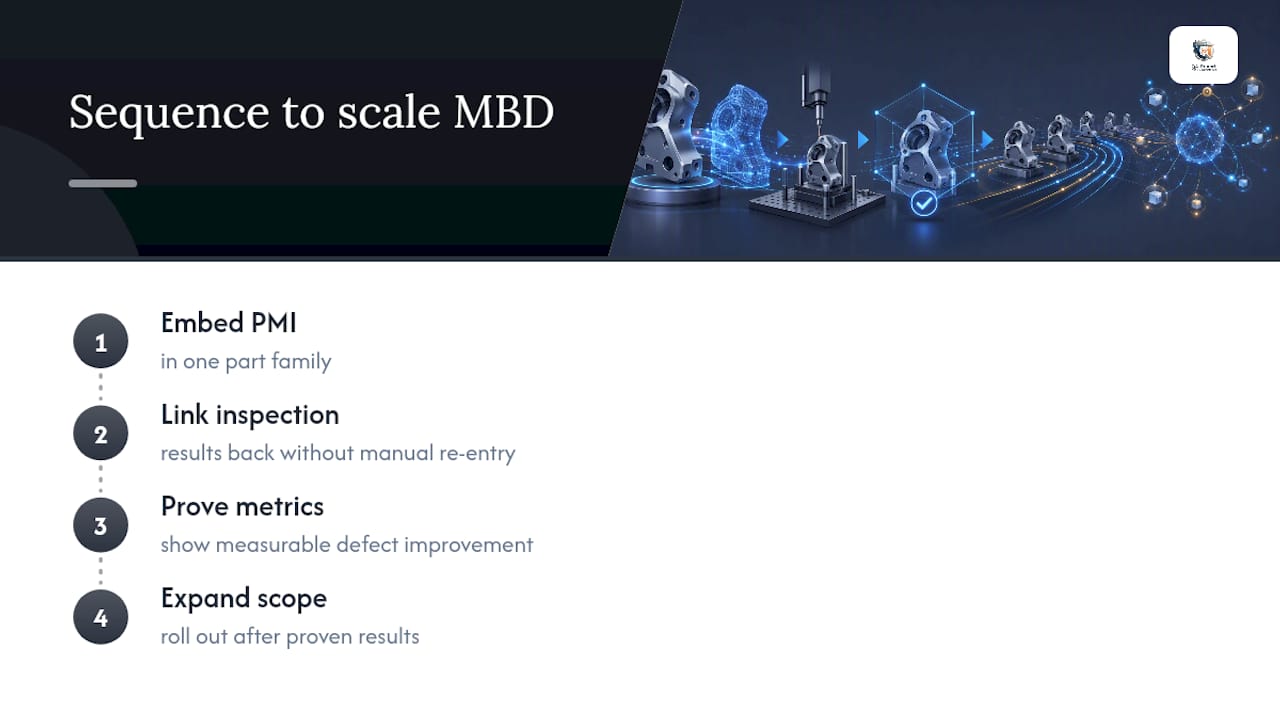
Where most guidance falls short is in sequencing. Teams get told to "connect everything," and they end up with a dozen half-integrated systems and no measurable improvement in defect rates. The better path is narrower and less exciting: get PMI embedded correctly in one part family, get inspection results linking back to that model without manual re-entry, and prove the metrics move before expanding scope.
If you take one thing from this, prioritize the MBD-to-inspection link before anything else. Everything downstream, traceability, audit readiness, root-cause speed, depends on that link being clean first.
— Michael Chen
Ready to see how automated ballooning and CMM import work together in practice? QA-Report's inspection and production planning platform puts the MBD-to-inspection link at the center of the workflow, generating audit-ready FAI, dimensional, and GD&T reports without the manual reconciliation that breaks most digital thread pilots before they scale.
Sources
- The definition of digital thread | Digital Twin Consortium
- What happens when quality co-owns the digital thread | Quality Magazine
- Digital Thread Technology Roadmap | NIST (2024)
- ISO 23247-5:2026 — Digital thread for digital twin
- Machine-readable inspection and linkage research | Chalmers