
Revision control manufacturing systems work by tying every drawing, BOM, and routing to one authoritative, current record instead of scattered copies on shared drives. The single most important action a quality team can take right now is to centralize that record and enforce effectivity dates so ERP and MES systems can never execute an obsolete revision. Standards like ASME Y14.35 and platforms like QA-Report exist precisely to make that enforcement automatic rather than hopeful.
TL;DR:
- Centralizing revision records and enforcing effectivity dates prevent production from using obsolete drawings and ensure all systems are synchronized.
- Using automated revision numbering, immutable audit logs, and visual diffs significantly reduces manual errors and interpretation mistakes.
- Integration of PLM, ERP, MES, and BOM systems ensures real-time updates across manufacturing processes, minimizing drift and rework.
- Rolling out revision control should start with a pilot, involving proper training, defined rules, and deliberate expansion to avoid production delays.
- QA-Report links revisions directly to inspection results, enabling audit-ready documentation and reducing time spent on First Article Inspections.
Table of Contents
- What is revision control and why does it matter in manufacturing?
- Revision vs. version: terms and numbering rules to standardize
- How do you build a revision-control workflow that sticks?
- Best practices that prevent revision-control failures
- What features should you require from a revision-control tool?
- How do you roll out revision control without stalling production?
- Quick checklist and templates you can use today
- What most teams get wrong about the speed versus governance trade-off
- How QA-Report closes the gap between drawing revisions and shop-floor execution
- Sources
What is revision control and why does it matter in manufacturing?
Revision control is the structured process of creating, reviewing, approving, and tracking changes to item masters, BOMs, routings, and quality plans so that downstream systems execute the current, correct version every time. It is not the same as version control, which tracks work-in-progress drafts before anything gets released to production. A revision, by contrast, is a formally approved state that the shop floor is authorized to build against.
The distinction sounds academic until you watch it fail. A machine shop that lets an engineer email a "final" PDF instead of releasing it through a controlled system risks building an entire batch against a superseded print. The scope of what needs governance is wider than most teams assume:
- Engineering drawings and 3D models
- Bills of materials and routings
- Quality plans and inspection instructions
- FAI, CMM, and dimensional reports tied to a specific revision
When that scope gets ignored, the costs show up downstream as rework, scrap, failed audits, and shipments held at the dock while someone tries to figure out which print is actually correct.
Revision vs. version: terms and numbering rules to standardize
Before touching any software, a team has to agree on vocabulary. "Revision" refers to a formally released, production-authorized state of a document. "Version" refers to an in-progress draft still moving through design review. Mixing the two terms in conversation is how a machinist ends up running a part off a version that was never meant to leave engineering. Change control governs the approval decision, while revision control is the tactical record of what changed and when, so the two work together rather than as substitutes for each other.
Numbering conventions need to be decided once and documented, not improvised per project. Common practice, aligned with ASME guidance, uses alpha revisions (A, B, C) during design development and switches to numeric revisions once a part is released for production.
Fast fact: Under this convention, the letters I, O, Q, S, X, and Z are routinely skipped because they're too easily confused with the numerals 1, 0, and 2, or with each other, on a scanned or low-resolution print.
Every revision record, alpha or numeric, needs four pieces of metadata attached without exception:
- Who made the change and who approved it
- When it was approved
- Why it was made (the reason code or ECO reference)
- The effectivity date that determines when it takes hold
How do you build a revision-control workflow that sticks?
A workflow only works if the shop floor cannot physically access the wrong revision. That means the process has to run through a defined sequence, not through informal sign-offs in a hallway.
- Change request. Someone logs a request with a reason code, affected parts, and supporting evidence, whether that is a customer complaint, a nonconformance report, or a design improvement.
- Review and approval. A defined approval matrix, typically engineering, quality, and production, signs off. Skipping a signatory here is the fastest way to get an audit finding.
- Release. The new revision gets a number, an effectivity date, and a formal release record. This is the moment it becomes authoritative.
- Distribution. Transmittals go out to everyone touching the part: purchasing, production, quality, and any outside suppliers.
The hard part is what happens between release and distribution. Manufacturing ERP systems have to enforce effectivity dates, update the BOM and routing automatically, and decide whether open work orders finish on the old revision or cut over immediately. That decision needs a documented rule, not a judgment call made on the fly by whoever is on shift.
Pro Tip: Write your effectivity rule for in-flight work orders into the ECO template itself. If the rule lives only in someone's memory, the third shift will build the wrong revision the first time that person is on vacation.
Best practices that prevent revision-control failures
The teams that avoid trouble share a handful of habits, and the teams that don't tend to fail in the same handful of ways.
- Maintain a single source of truth. A shared drive with folders named "Rev C_final_v2" is not a system, it's a liability.
- Use automatic numbering so no two people can accidentally issue the same revision letter.
- Keep title blocks synchronized with the released record so the drawing and the database never disagree.
- Require an immutable audit log. Every change, approval, and distribution event should be timestamped and unchangeable.
- Mandate visual diffs or overlays before anyone signs off on a released drawing change.
That last point deserves emphasis. Overlay and side-by-side visual comparison catches interpretation errors that a text-only change log or a hand-drawn revision cloud routinely misses, especially on dense GD&T callouts.
The most common failure mode is straightforward: engineering, procurement, and production drift out of sync because nobody linked the drawing change to the BOM update. BOM version control is what keeps procurement, production, and inventory aligned with the approved revision, particularly on complex, multi-supplier assemblies where a missed update means the wrong connector ships on ten thousand units.
Pro Tip: If your team still relies on spreadsheets for revision tracking, treat that as a finding waiting to happen, not a workaround. Regulated industries can't sustain manual tracking once part counts and supplier counts grow past a handful.
What features should you require from a revision-control tool?
Evaluate any system by capability, not by brand name. The following capabilities separate tools that hold up under an AS9100 or ISO 9001 audit from tools that merely look organized.
- Automatic revision numbering that eliminates manual entry errors and enforces the alpha-to-numeric convention your team chose.
- Immutable audit trails that log every approval, edit, and distribution event with a timestamp nobody can quietly alter.
- Visual overlay comparison so reviewers can see exactly what changed between revisions instead of hunting through a text description.
- PLM, ERP, MES, and BOM synchronization, so a released revision updates routings and work orders without a manual re-entry step.
- CMM data import that ties measured results directly to the correct revision's ballooned dimensions.
- API or webhook notifications that alert planners and suppliers the moment a new revision goes live.
- Offline access for shop-floor devices, because a tablet with no signal still needs the current print.
- Role-based access control and encryption, so only authorized approvers can release a revision in the first place.
Synchronization gaps between engineering, procurement, and production remain the single biggest risk quality teams report, and modern QA platforms address this by flagging inspection plans and BOMs automatically the moment a drawing updates.
How do you roll out revision control without stalling production?
Rolling out a new system works best in phases, not as a single flag-day cutover that catches half the shop floor off guard.
- Governance first. Define your numbering scheme, approval matrix, and effectivity rules before touching software.
- Pilot on one product line. Pick a moderate-complexity assembly, not your highest-risk aerospace part and not your simplest bracket.
- Integrate PLM, ERP, and MES. Confirm that a released revision actually updates the BOM, routing, and open work orders as designed.
- Train the floor. Operators need to know how to pull the current revision and what to do if a print looks stale.
- Audit the trail. Run a mock audit against your own records before an external auditor does it for you.
- Expand deliberately. Add product lines once the pilot's metrics hold steady.
QA-Report's inspection layer maps directly onto this rollout. Its measurement wizard links ballooned drawing dimensions to CMM-imported results, so a revision change flags out-of-tolerance deviations tied to the correct print automatically:
- Drawing ballooning locks inspection reports to a specific revision, closing the gap between engineering and the quality floor.
- Audit-ready FAI and PPAP reports generate the immutable record auditors expect to see.
- The MES layer synchronizes route cards and work orders so production never runs against a superseded revision.
Track rework rate, first-pass yield, and time-to-release as your core KPIs. A falling rework rate is usually the first sign the new workflow is actually holding.
Quick checklist and templates you can use today
Before releasing any revision, confirm this short list against your own records:
- Change request logged with a reason code and affected part numbers
- Approval matrix signatures captured (engineering, quality, production)
- Revision number assigned per your alpha or numeric convention
- Effectivity date set and communicated to ERP/MES
- Transmittal sent to purchasing, production, quality, and suppliers
- Prior revision archived, not deleted, in an immutable log
Red flag to watch for: any released drawing missing an effectivity date or an approval signature. That gap is where obsolete-build errors start.
What most teams get wrong about the speed versus governance trade-off
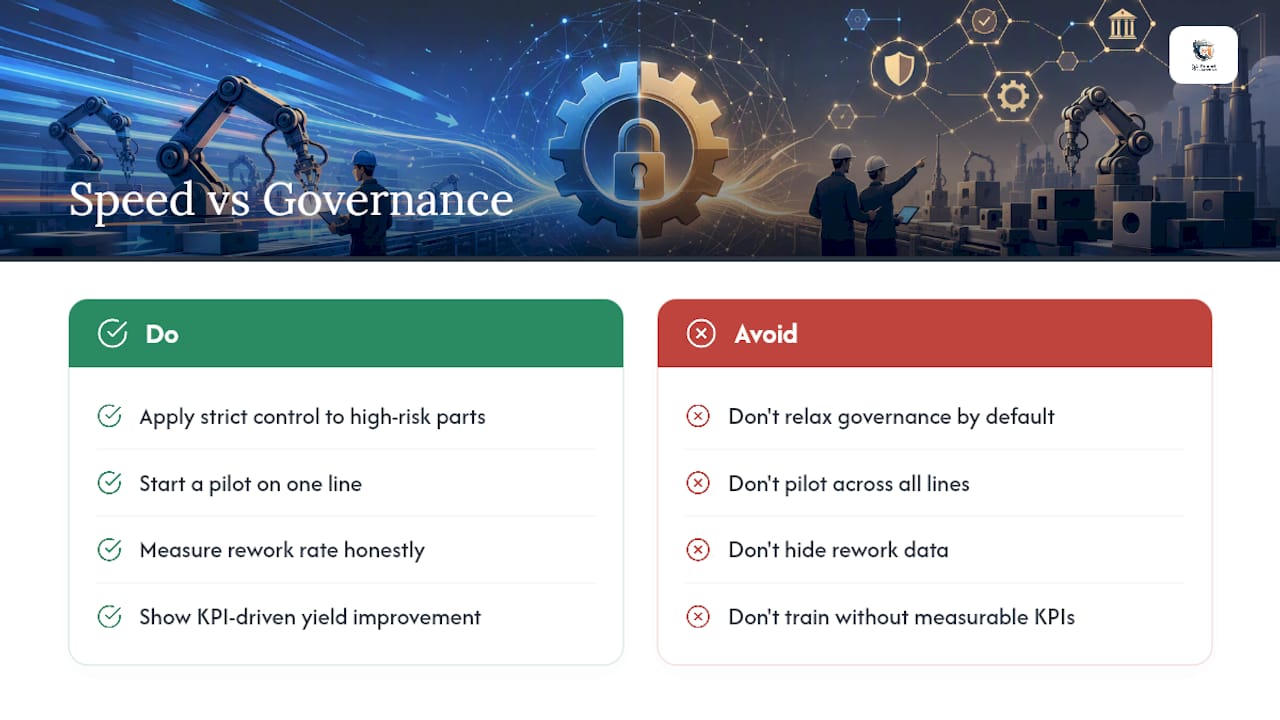
The instinct to loosen governance on low-risk parts to move faster is reasonable, but it's usually applied backward. High-risk product families, tight tolerances, safety-critical assemblies, multi-supplier BOMs, deserve the strictest revision discipline precisely because a missed effectivity date there costs the most to unwind.
Start a pilot on one line, measure rework rate honestly, and let that number do the persuading. Teams adopt new discipline faster when they can see first-pass yield move, and training sticks better when operators watch a KPI improve because of a process they now own.
— Michael Chen
How QA-Report closes the gap between drawing revisions and shop-floor execution
There are other ways to patch this problem, a shared drive with strict folder discipline, a standalone PLM module bolted onto an old ERP, but most of them still leave a manual handoff between the released drawing and the inspection record. QA-Report closes that specific gap: its measurement wizard links ballooned drawing dimensions directly to CMM-imported results, so an out-of-tolerance flag always points back to the exact revision that was in effect.
The platform generates audit-ready FAI, dimensional, and GD&T reports in minutes rather than hours, satisfying ISO 9001, AS9100, and PPAP requirements without a separate formatting step. Its built-in 3D CAD viewer, automatic ballooning, and MES layer with route cards and rejection tracking mean a revision change updates inspection criteria and shop-floor routing in the same motion. If your team is still reconciling drawing revisions against inspection reports by hand, start a trial of QA-Report and run your next First Article Inspection against a revision-locked report instead of a spreadsheet.
Sources
For deeper implementation detail, consult the ASME-aligned numbering guidance covering alpha and numeric schemes, the breakdown of document version control versus revision control, and the explanation of BOM version control's role in complex assemblies. Teams weighing physical shop-floor controls alongside document governance may also find value in this overview of ambient dust control practices for manufacturing plants.