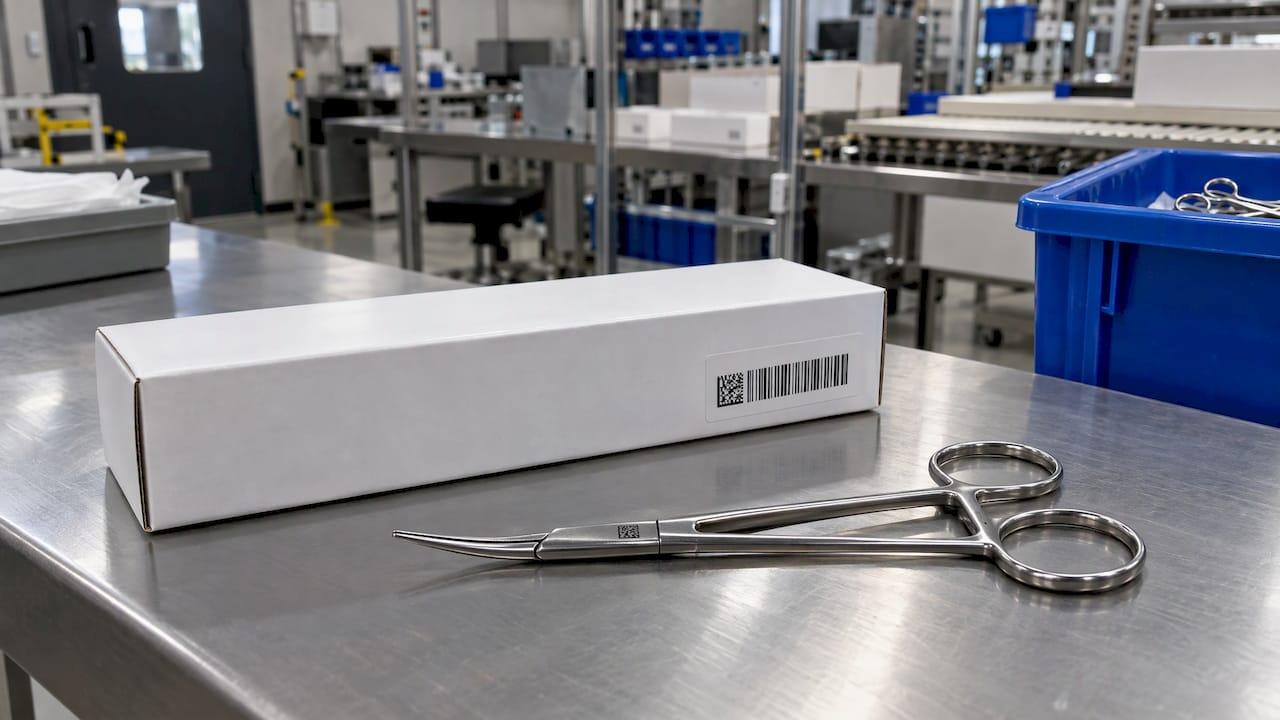
UDI compliance comes down to four obligations: assign a unique device identifier (UDI) under an FDA-accredited system, put it on every label and device package in plain text and machine-readable form, mark it directly on reusable devices that are reprocessed, and submit the device data to FDA's GUDID database. The harder part is keeping that identifier consistent with your lot, serial and device history records for the life of the product. This guide covers the U.S. rule in the order a quality team works through it. It also settles the question of UDI vs GTIN. If your batch, serial and inspection data already live in one system, such as the QA-Report platform, the UDI becomes one more traceable attribute rather than a separate spreadsheet.
The rule here is the U.S. FDA UDI system. The EU, the UK and Canada run their own device identification requirements. Check each regulator's current text before you assume a U.S. label satisfies it.
TL;DR
- A UDI has two parts: a fixed Device Identifier (DI) for the labeler and model, and a variable Production Identifier (PI) for lot, serial, expiration or manufacturing date when those appear on the label.
- A GTIN is not the same thing as a UDI. In the GS1 system, the GTIN serves as the DI portion of the UDI.
- Under 21 CFR 801.20, every device label and device package must carry a UDI unless an exception or alternative applies. Reusable devices that are reprocessed before each use need a permanent direct mark.
- Device data goes to FDA's GUDID database, so your label, your records and your GUDID entries must agree.
- Most UDI trouble is a records problem: the identifier on the label does not match what the device history shows.
Table of Contents
- What a UDI is and what it contains
- UDI vs GTIN: how they relate
- Which devices and packages need a UDI
- Assigning and placing the UDI
- Direct marking of reusable devices
- Submitting to GUDID
- The records that prove compliance
- A worked example
- Where QA-Report fits
- Our perspective
- FAQ
- Sources
What a UDI is and what it contains
FDA defines a UDI as a unique numeric or alphanumeric code with two parts, according to its UDI Basics page:
- Device Identifier (DI): mandatory and fixed. It identifies the labeler and the specific version or model of the device.
- Production Identifier (PI): conditional and variable. It carries the lot or batch number, serial number, expiration date, manufacturing date, or, for human cells, tissues and cellular and tissue-based products, the distinct identification code. It is included only when that information appears on the label.
The PI rule is the one teams most often misread. You do not choose whether to include a PI. If an expiration date or lot number is printed anywhere on the label or package, that element must be in the UDI. A label with a lot number in the human-readable text but no lot in the barcode is out of step with the rule, even if the DI is perfect.
The labeler must present the UDI in two forms: easily readable plain text and automatic identification and data capture (AIDC) form, which in practice means a barcode. FDA specifies that dates on device labels and packages use the YYYY-MM-DD format. The labeler is normally the manufacturer, although the party that causes a label to be applied to a device for distribution can also hold that role.

Why does the system exist at all? Jay Crowley, then a senior FDA patient safety adviser, described pre-UDI identification at a 2009 FDA workshop as a mess in which different manufacturers used different standards, so devices could not be found when something went wrong. That quote appears in the GS1 UDI Guide. UDI is the uniform answer.
UDI vs GTIN: how they relate
The two terms are often used as if they were interchangeable. They are not.
A GTIN (Global Trade Item Number) is the GS1 key for any trade item that may be priced, ordered or invoiced. The brand owner assigns it, and it is unique at each packaging level, as the GS1 standards guidance for assigning DIs describes. A UDI is a regulatory construct defined by FDA. It can be built from several identifier systems, provided the system is run by an FDA-accredited issuing agency. GS1 is one such agency.
When you use GS1, the relationship is direct. The GS1 FAQ on the FDA UDI rule states that the DI segment is always required and that, in the GS1 system, the DI is a GTIN. The PI is required only if PI information appears on the label or package.
| GTIN | UDI | |
|---|---|---|
| What it is | A GS1 identifier for a trade item | An FDA-defined identifier made of a DI and, when applicable, a PI |
| Who sets the rules | GS1 standards | FDA (21 CFR Parts 801, 806, 830), with issuing agencies operating the code systems |
| Identifies | Product at a packaging level | Labeler and model (DI), plus lot, serial or dates (PI) |
| Relationship | Can serve as the DI | Needs a DI; a GTIN is one way to supply it |
| Where it goes in GUDID | Entered as the DI | The record the DI opens |
In short: a GTIN can be your DI, but a GTIN alone is not a complete UDI whenever the label carries lot, serial or date information. Each packaging level that is a trade item needs its own DI, while logistics units are exempt, per the GS1 UDI Guide.
One format point follows from this. The UDI must be issued under an FDA-accredited agency's system, conform to the ISO/IEC 15459 standards incorporated in 21 CFR 830.10, and use only characters from the ISO/IEC 646 invariant set, according to FDA's Form and Content guidance. Do not improvise an internal numbering scheme and call it a UDI.
Which devices and packages need a UDI
The starting point is 21 CFR 801.20: the label of every medical device and every device package must bear a UDI unless an exception or alternative applies. The regulation lists several routes out:
- General exceptions in section 801.30. Shipping containers do not need a UDI.
- Class I devices do not need a PI in the UDI.
- A class I device that bears a Universal Product Code (UPC) on its label and device packages is deemed to meet the subpart B requirements.
- Exceptions tied to direct marking in section 801.45.
- A request process under section 801.55.
The request process lets a labeler ask FDA for an exception or alternative for a specified device or type of device. FDA may grant it when the standard requirements are not technologically feasible, or when an alternative would improve identification or better ensure safety or effectiveness. FDA publishes its decisions on its UDI exceptions and alternatives page, so check there before you assume your product type has been decided.
FDA has also set enforcement policies for particular groups. For example, FDA's July 2022 Federal Register notice says FDA does not intend to enforce GUDID submission for class I devices that are consumer health products. The policies change, so read FDA's UDI compliance policies page for the current position before you rely on one. The same page notes that FDA does not intend to enforce direct-mark requirements for certain finished devices already in inventory when the UDI can be derived from another mark on the device.
For a label-by-label walk-through of what belongs where, see our guide to UDI labeling requirements.
Assigning and placing the UDI
The sequence that avoids rework is straightforward.
- Choose an issuing agency. Your UDI has to come from a system operated by an FDA-accredited issuing agency. If you use GS1, your GTIN becomes the DI.
- Assign a DI to every version or model and every packaging level. A change that creates a new version or model needs a new DI. The GS1 UDI Guide notes that each designated trade-item packaging level carries its own DI.
- Decide which production data appears on the label. Lot, serial, expiration and manufacturing date each trigger a PI element when they are printed. Decide before label design, not after.
- Encode both forms. FDA's Form and Content guidance has plain text order the DI before the PI, with non-UDI elements after the PI. The GS1 system uses Application Identifiers to mark which element is which. The right barcode symbology depends on whether the code is read at retail and whether it must encode only the DI or both DI and PI, per the GS1 implementation guideline.
- Apply it to every applicable level. The code must appear in both forms from the unit of use up to the highest package level, with logistics units exempt.
- Verify what was printed. Compare the printed barcode against the intended data. An illegible or mismatched code is a nonconformance, not a cosmetic issue.
Direct marking of reusable devices
A device intended for more than one use and reprocessed before each use must carry a permanent UDI on the device itself. Under 21 CFR 801.45:
- The direct-marked UDI may be identical to or different from the label UDI.
- It may be plain text, AIDC, or both, or an on-demand alternative technology.
- Exceptions apply if marking would interfere with safety or effectiveness, is not technologically feasible, the device is single-use but subjected to additional processing for one more use, or it was previously marked.
- The labeler must document the basis for any exception in the design and development files.
That last requirement is easy to overlook. A claimed exception without a documented rationale in the design file will not hold up in an audit. Marking also introduces a process question: if you laser-mark a part, the mark's legibility and durability are part of your validation story. Verifying the mark at inspection, against the identifier in your records, closes the loop.
Submitting to GUDID
The Global Unique Device Identification Database (GUDID) is the FDA-administered database that holds the identifying information for each device. The UDI rule requires labelers to submit device information to it, per FDA's UDI Basics page. The GUDID record is keyed on the DI. It holds labeler details, device description and attributes, and regulatory data, none of which includes the PI values for individual lots.
Three practical points:
- Treat GUDID as a controlled record. Every attribute should trace to a controlled source in your design and regulatory files, not to whoever last typed it in.
- Watch the vocabularies. GUDID accepts specific values for several fields. Free-text approximations are the usual reason a submission is returned.
- Re-read the guidance when it changes. FDA issued updated final GUDID guidance in December 2024, replacing the 2014 version. Read the current version on FDA's UDI pages before your next submission or update, instead of working from an older internal procedure.
The records that prove compliance
A UDI on a label is the visible part. The evidence that you comply sits in your quality system. Build these links deliberately:
- Labeling specifications. The label drawing or specification should state the UDI format, the data elements encoded and the symbology.
- Device history record (DHR). The DHR should show which UDI, lot or serial was applied to which production unit and where the UDI sits on the device or package. Our device history record guide lists the fields to include.
- Serial and lot traceability. If the PI carries a serial number, your serial genealogy must resolve from the printed code to the build record. See serial number tracking in manufacturing.
- Process validation for label application. If a printer or marker applies the UDI, its setup, verification and legibility checks belong in the validated process.
- Complaint and distribution records. A field complaint should capture the UDI so the unit can be traced to its build record. Without it, the return arrives with no history.
- Retention. Keep these records for the periods your quality system and regulation require. Our guide to ISO 13485 record retention maps each record type to its retention logic, and the ISO 13485 documentation guide shows how these records fit the wider system.
If your records are electronic, the controls of 21 CFR Part 11 apply to how they are created, changed and signed.
The common thread is that no single document proves UDI compliance. The proof is that a unit's printed identifier, its GUDID record and its build history all agree, and that you can show it quickly.
A worked example
Take a class II device sold in boxes of ten, with a lot number and an expiration date printed on each box.
- Packaging levels: the single unit pack, the box of ten, and a carton of ten boxes. The unit pack and the box are trade items, so each gets its own GTIN as its DI. The carton counts as a logistics unit only if it is never sold or ordered as a trade item.
- PI content: because lot and expiration appear on the label, both go into the UDI. The date is formatted YYYY-MM-DD in the human-readable text.
- Label check: the barcode on the box must decode to the box's DI plus lot plus expiration. A reader that returns only the GTIN means the PI is missing.
- GUDID: one record per DI, with package quantity and the relationship between the unit and box DIs described.
- Records: the DHR for each lot references the label specification revision and the verification result for that lot's printed codes.
If the expiration date changes next year because of a revised shelf-life claim, the label changes, the specification revision changes, and your records show which lots carried which date. That is a controlled change, not a surprise in an inspection.
Where QA-Report fits
QA-Report is a cloud-based inspection and quality platform for manufacturers in regulated industries. It handles batch and serial tracking, a document vault, role-based team permissions and an MES layer with route cards, so the production and inspection data that your UDI must agree with sits in one place. Teams that want to try it can start on the Free plan at $0 per month. Basic is $49.99 per month and PRO is $149.99 per month, and On-Premise and Enterprise plans are priced on request. Current plan details are on the pricing page.

For shops that track parts across operations, MES software for machine shops links route cards and batch tracking to the same records your UDI process depends on.
Our perspective
Most UDI problems we hear about from quality teams are not label design problems. They are data-agreement problems. The label says one thing, the GUDID record says a second, and the build record, if anyone can find it, says a third.
The fix is structural. When lot and serial numbers are created once, at the point of production, and everything downstream reads from that source, the printed code and the record cannot drift apart. That is the reason we built batch and serial tracking, a document vault and role-based access into one platform rather than as separate tools.
Our positioning is also deliberate on deployment. Some medical device makers have confidentiality requirements for design and production data, so QA-Report is available both in the cloud and on-premise, with enterprise options for larger organizations.
If you take one thing from UDI, take this: treat the identifier as part of traceability, not as a labeling task that happens at the end of the line. A broken chain of custody is easy to miss until a complaint or an audit pulls on it.
Michael Chen
FAQ
Is a GTIN the same as a UDI?
No. A GTIN is a GS1 identifier for a trade item. A UDI is an FDA-defined identifier made of a DI and, when the label carries production data, a PI. In the GS1 system the GTIN serves as the DI, so it is one part of the UDI, not the whole.
Do all medical devices need a UDI in the United States?
Under 21 CFR 801.20, every device label and package must bear a UDI unless an exception or alternative applies. Shipping containers are excepted, class I devices do not need a PI, and a class I device with a UPC on its label and packages is deemed compliant. FDA can also grant exceptions on request under section 801.55.
Does the UDI have to be on the device itself?
Only for devices intended for more than one use and reprocessed before each use. Those need a permanent direct mark under 21 CFR 801.45, unless an exception applies, such as marking being technologically infeasible. The basis for any exception must be documented in the design and development files.
What is the difference between the DI and the PI?
The DI is the fixed part that identifies the labeler and the device version or model. The PI is the variable part that carries lot, serial, expiration or manufacturing date. The PI appears only when that information is printed on the label or package.
Does a U.S. UDI satisfy EU, UK or Canadian requirements?
Not automatically. Each of those markets has its own device identification and registration rules. A U.S.-compliant identifier can often be reused as part of the data, but confirm the current requirements with the relevant regulator before you ship.
Sources
- UDI Basics | FDA
- 21 CFR Part 801 Subpart B, eCFR
- 21 CFR 801.45, eCFR
- UDI Exceptions and Alternatives | FDA
- UDI Compliance Policies and UDI Rule Compliance Dates | FDA
- Unique Device Identification System: Form and Content of the UDI | FDA
- Federal Register notice, July 25, 2022, UDI compliance dates policy
- GS1 UDI Guide (2017)
- GS1 US FDA UDI Rule FAQ
- GS1 standards guidance for assigning DIs
- GS1 implementation guideline for FDA UDI requirements