
Controlled documents tell your team what to do; records prove what your team actually did. The distinction sounds simple, but ISO 9001:2015 folds both into a single term, "documented information," which is exactly why so many quality systems blur the line between them. Get the classification wrong at the point of creation, and you inherit version-control chaos on one side and audit gaps on the other.
TL;DR:
- Controlled documents require approval, version control, and restricted distribution to stay current and prevent obsolescence.
- Records are generated during activities, must be unique, time-stamped, protected from alteration, and retained according to schedule.
- Misclassifications often occur when documents are edited post-approval or records are treated as editable, increasing audit risks.
- Automating capture and linking document revisions to records can eliminate most manual errors and improve audit readiness.
- Establishing clear classification rules, a document register, a retention schedule, and approval workflows is crucial for effective control.
Table of Contents
- Controlled Documents vs Records: Defining the Difference
- What Counts as a Record in a Quality System
- Key Differences at a Glance
- How to Classify an Item When It's Not Obvious
- Lifecycle Controls: Approval, Versioning, and Retention
- Why the Distinction Drives Audit Outcomes
- Linking Controlled Documents to Immutable Records Through Automation
- Building a Document and Records Control Checklist
- A Practitioner's View on Where Systems Actually Break
- A Faster Path to Compliant Documents and Records
- Where to Go Deeper on Documented Information
- Sources
Controlled Documents vs Records: Defining the Difference
A controlled document is prescriptive and alive. It tells operators, inspectors, and engineers how a task should be performed, and it keeps changing as processes improve, regulations shift, or a customer requests a revision. Think of it as a living instruction set: it needs updates whenever practices change to stay current and useful.
The controls that separate a genuinely controlled document from an uncontrolled one are specific. You need:
- A formal approval workflow before release, with a named approver and effective date.
- Version history that shows exactly what changed, when, and why.
- Controlled distribution so obsolete copies don't circulate on the shop floor.
- Access restrictions that limit editing rights to the document owner or a change-control board.
Typical examples include standard operating procedures, work instructions, engineering specifications, inspection plans, and the change-control forms used to authorize revisions. Controlled documents in the workplace commonly fall into these categories in regulated manufacturing, where an SOP might govern daily operations while a specification defines acceptance criteria for a part.
Format matters less than most teams assume. A controlled document can live as a paper master, a PDF, a Word file, or a CAD drawing. What matters is that only one version is "current" at any moment, and everyone working from it knows it hasn't quietly gone stale.
What Counts as a Record in a Quality System
A record is evidence. It's generated the moment an activity happens: an inspector measures a part, an operator completes a batch step, a technician calibrates a gauge. Once that activity is documented, the record becomes a fixed account of what occurred. Unlike a controlled document, it doesn't get revised. If the information turns out to be wrong, you correct it through a documented deviation or amendment, never by editing the original.
National Archives guidance frames records as items created or received in the course of business and preserved for evidential or informational value. That preservation requirement drives the specific controls records need:
- A unique identifier tying the record to a specific part, batch, or event.
- A timestamp capturing when the activity happened, not when someone got around to filing it.
- Protection against alteration, whether through access controls, checksums, or electronic signatures.
- A defined retention period, after which the record is either archived or destroyed according to schedule.
Regulated industries generate many types of records such as inspection reports, batch records, training logs, calibration certificates, and deviation investigations. Each one answers the same question an auditor will eventually ask: can you prove this happened?
Copies complicate the picture slightly. A photocopy of a signed inspection report can still function as a record if it is the version relied on for a decision or shared as proof of conformance. Status depends on how the copy is used and controlled, not simply on which one came off the printer first.

Key Differences at a Glance
Classification decisions get easier once you map the same item across five axes instead of arguing definitions in the abstract. A blank inspection form and the completed report it produces look similar on a shelf, but they behave completely differently once you ask who created them, whether they get revised, and what they're retained for.
| Axis | Controlled Document | Record |
|---|---|---|
| Who creates it | Document owner or engineering/quality team | Operator, inspector, or system at point of activity |
| Approval before use | Required before release (approver, effective date) | Not applicable; approval happens during the activity itself |
| Can it be revised | Yes, through formal change control | No; corrections require an amendment, not an edit |
| Retention basis | Current version only; superseded versions archived or voided | Retention schedule tied to regulatory or contractual requirement |
| What it proves | What the process requires | What actually happened |
The practical rule is to decide classification at the moment an item is created, not retroactively during audits. A blank First Article Inspection template is a controlled document. The same template, filled in with actual measurements and signed off, becomes a record the instant it's completed. Treat that filled form as editable, and you've just turned evidence into a liability.
How to Classify an Item When It's Not Obvious
Most classification calls are easy once you apply the template test: if it's blank and reusable, it's a document; if it's completed and tied to a specific event, it's a record. The harder cases show up when a form does double duty or a register keeps growing.
- Ask who created it and why. If quality or engineering authored it to standardize future work, it's a document. If it was generated as a byproduct of doing the work, it's a record.
- Check whether it required approval before use or after completion. Pre-use approval signals a document; post-activity sign-off signals a record.
- Ask what it proves. A document proves a process exists. A record proves that process was followed on a specific occasion.
- Test for evidentiary purpose. If a customer, auditor, or regulator would ask for it as proof an action occurred, treat it as a record regardless of its format.
Gray areas cluster around a few recurring items. A training matrix that's continuously updated behaves like a controlled document; the individual training completion entries within it are records. A logbook or register is trickier: the blank register template is a document, but each completed line entry is a record the moment it's signed and dated.
Pro Tip: If your team debates whether something is a document or a record for more than a few minutes, split it. Keep the reusable template as a controlled document, and let the output of each use stand alone as its own record. Trying to force one artifact to serve both roles is what causes version-control nightmares during audits.
Lifecycle Controls: Approval, Versioning, and Retention
Documents and records don't just differ in what they are. They move through entirely different lifecycles, and applying record-style controls to a document (or vice versa) is where most quality systems quietly break down.
A controlled document's lifecycle runs through review, approval, release, and periodic revision. Every step needs a control attached:
- Scheduled or triggered review (annually, or upon process change).
- Documented approval with a named approver and effective date.
- Controlled release that removes obsolete versions from active use.
- A revision log that ties each version to the change that caused it.
A record's lifecycle is shorter but less forgiving. It runs through generation, registration, protected storage, and eventual disposal:
- Immediate capture at the point of activity, ideally time-stamped automatically.
- Registration with a unique ID linking it to the batch, part, or event.
- Storage that prevents alteration, often enforced through electronic signatures or restricted permissions.
- Disposition on a fixed retention schedule, with legal holds overriding that schedule when litigation or investigation requires it.
Under ISO 45001 and ISO 9001, several clauses explicitly require documented information to be both "maintained" and "retained." That's not redundant phrasing. "Maintained" points to keeping the current version accurate and accessible. "Retained" points to preserving a fixed record of what happened, unaltered. Confusing the two terms in your procedure is a fast way to fail a clause-by-clause audit review.
Why the Distinction Drives Audit Outcomes
ISO 9001:2015 collapsed separate document-control and record-control clauses into one: clause 7.5, documented information. That simplification helped writing procedures, but it didn't simplify what auditors actually check. They still expect the current version of a document to be in use on the floor, and they still expect records to exist as proof that the documented process was actually followed.
Auditors treat records as the primary evidence trail. A beautifully written SOP means nothing if there's no calibration certificate, no completed inspection report, or no training record showing the operator was qualified to perform the task described in that SOP.
The findings that recur most often trace back to a handful of failures:
- An operator working from a superseded procedure because obsolete copies weren't pulled from circulation.
- A batch record with gaps, corrections made without a documented deviation, or missing signatures.
- A training record that can't be located when an auditor asks who was qualified to run a specific operation.
- A retention schedule that either destroys records too early or has no defined end date at all.
Retention decisions aren't purely a quality-system choice. NARA's records management guidance makes clear that disposition depends on how a record is used, distributed, and controlled, and in many regulated industries, statutory or contractual retention periods override whatever your internal procedure says. Check the regulatory requirement for your industry before finalizing a retention schedule, not after.
Linking Controlled Documents to Immutable Records Through Automation
Most document-and-record failures aren't classification mistakes. They're workflow failures: an inspector working from a printed drawing that's two revisions old, or a batch record edited after the fact because nobody locked it down. Manual systems make both mistakes easy to commit and hard to catch until an auditor finds them.
Modern inspection and quality platforms close that gap by tying access and generation together instead of managing them as separate problems. Practical mechanisms include:
- Restricting shop-floor access to the current approved revision of a drawing or specification, so operators can't accidentally reference a superseded version.
- Auto-timestamping and locking a report the moment it's generated, turning it into an immutable record instead of an editable file.
- Linking every generated record back to the exact document revision that governed the work, so the traceability chain never breaks.
QA-Report's measurement wizard links ballooned drawing dimensions to measured results and generates locked, audit-ready PDF reports that satisfy ISO 9001 and AS9100 evidence requirements without manual reformatting. The CMM data import workflow pulls measured values directly into the report structure, cutting out the manual transcription step where alteration risk and human error both creep in.
Pro Tip: If your team still hand-carries paper travelers between workstations, that's usually where version drift starts. The fix isn't more training. It's removing the option to reference anything but the current controlled document in the first place.
Building a Document and Records Control Checklist
You don't need a system overhaul to close most gaps. You need four decisions made deliberately and written into a governing procedure, rather than left to whoever happens to be filling out the form that week.
- Write a classification rule into your document control procedure: templates and instructions are documents; completed outputs tied to a specific activity are records.
- Build a document register listing every controlled document, its owner, current revision, and review date.
- Build a records retention schedule separately, assigning an owner, a retention period, and a disposition method for each record type.
- Implement approval workflows and version control for documents, and immutable, time-stamped capture for records.
- Test retrieval, not just storage. Pull a record from three years ago and time how long it takes. That number tells you more about audit readiness than any procedure document will.
Deciding these four things at the point of implementation, rather than retrofitting them after an audit finding, is the single highest-leverage move a quality manager can make. For a deeper walkthrough of the classification rule specifically, MSI's primer is worth a close read.
A Practitioner's View on Where Systems Actually Break
Teams don't usually fail this because they misunderstand the definitions. They fail because a template and its completed output get treated as the same artifact throughout its life, so someone eventually "corrects" a signed inspection report the way they'd revise an SOP. That single habit accounts for a disproportionate share of the version-control findings I see in audit reports.
The fix isn't more procedure. It's designing systems where records get captured automatically as a byproduct of doing the work, rather than reconstructed afterward from memory or a spreadsheet. Classify at creation, automate capture, and most of the recurring audit findings disappear on their own.
— Michael Chen
A Faster Path to Compliant Documents and Records
Manually managing revision control on one side and immutable record capture on the other eats hours every week, especially across multiple inspectors and shifts. QA-Report closes that gap by combining both functions in one platform: inspectors always work from the current approved drawing revision, and every generated inspection report locks automatically into an audit-ready record the moment it's created.
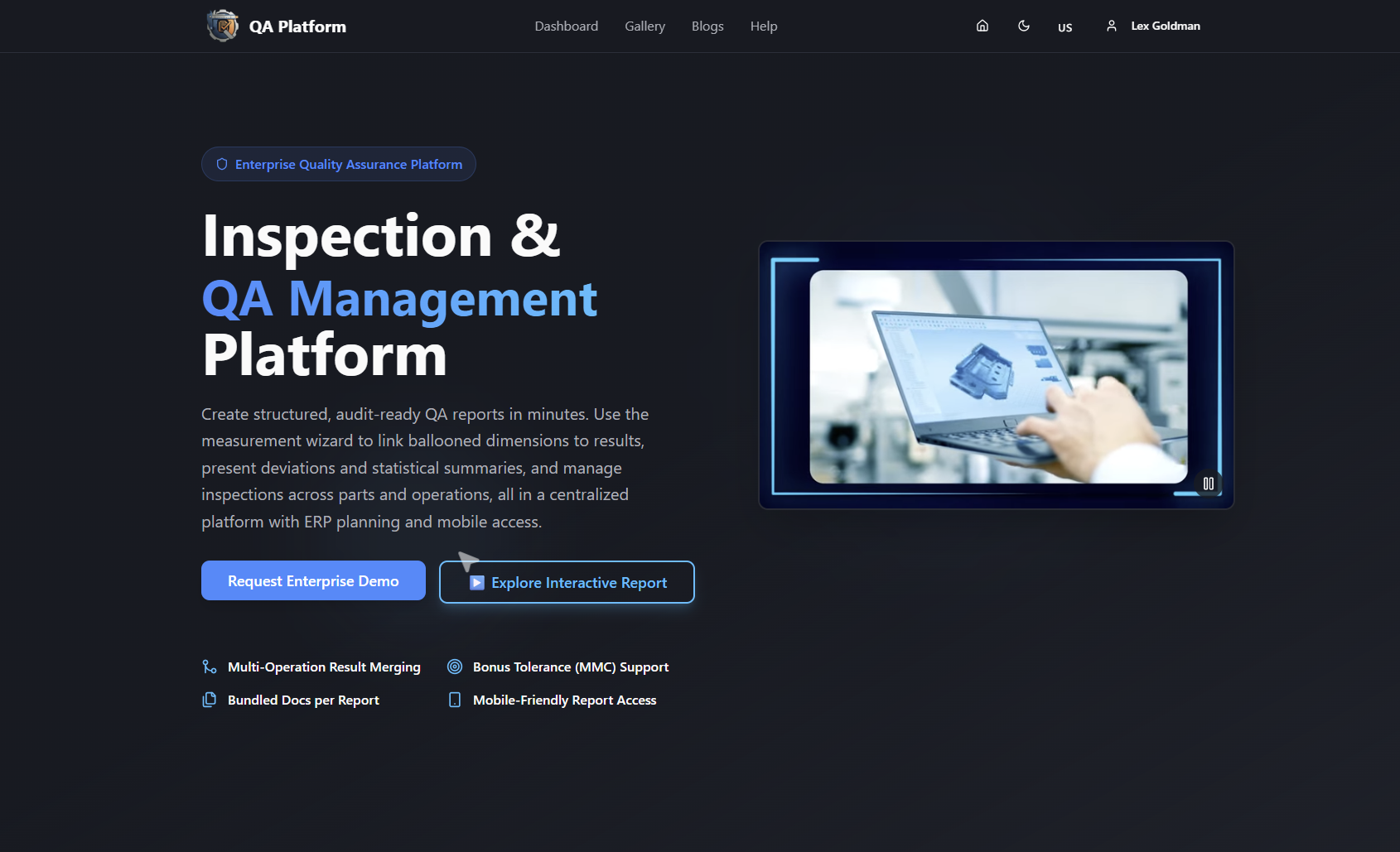
The measurement wizard links ballooned drawing dimensions directly to measured results, auto-flags out-of-tolerance deviations, and produces PDF reports built to satisfy ISO 9001, AS9100, and PPAP requirements without extra formatting work. For manufacturers working with certified suppliers, understanding ISO-certified supplier expectations alongside your own document controls rounds out the compliance picture on both sides of the relationship.
If you're still stitching together spreadsheets, PDFs, and paper travelers to keep documents and records straight, try QA-Report's free drawing ballooning tool on your next inspection and see how much manual work disappears from a single report cycle.
Where to Go Deeper on Documented Information
For the standards language behind "documented information" and how it splits into maintained versus retained requirements, ISO's own guidance document is the primary source. NARA's records management basics page covers disposition schedules and legal status in plain terms, useful even outside government contexts. For a practical primer on setting up the underlying procedure, MSI's document and records control guide walks through the four foundational decisions every quality manager needs to make before writing a single SOP. AIIM's comparison of document management versus records management is worth reading if you're building or buying a system to handle both functions at once.
Sources
- Document and Records Control: The Proven Place to Start | MSI
- Controlled documents in the workplace | Biotility (UF research site)
- Records management basics | National Archives (NARA)
- Iso
- Document Management vs. Records Management | AIIM