
IATF 16949 requires a site-specific quality management system built on top of ISO 9001:2015, with mandatory customer-specific requirement tracking, the five core tools (APQP, PPAP/FAI, FMEA, MSA, SPC), documented supplier controls, and audit-ready evidence for every clause from 4 through 10. Certification runs on a recurring multi-year cycle: your certification body issues the certificate after a successful stage 2 audit, then returns regularly for surveillance audits to confirm the system still works. Every audit is conducted by an IATF-recognized certification body, subject to witness auditing and IATF oversight.
If you're starting from zero or shoring up a system that's drifted, here's where to put your first week:
- Decide your certification scope. Identify which sites, product lines, and support functions fall inside the certified boundary and which are excluded.
- Build a customer-specific requirements matrix. List every OEM you supply, the clauses their CSRs touch, and who owns each requirement.
- Inventory your documented information. Pull together your quality manual, control plans, PPAP packages, and internal audit records so you know what's missing before an auditor tells you.
- Confirm your certification body is operating under IATF Rules 6th Edition, effective January 1, 2025.
- Schedule a gap analysis against clauses 4 through 10.
- Assign clause owners across leadership, quality, engineering, and production.
Key Takeaways
Meeting IATF 16949 requirements comes down to disciplined clause-by-clause documentation, an accurate CSR matrix, and traceable evidence connecting every drawing dimension to its measured result.
| Point | Details |
|---|---|
| One week | Define your certified site scope, list applicable customer-specific requirements, and select a certification body. |
| One month | Close your top three documentation gaps and update control plans and FMEAs tied to special characteristics. |
| Three months | Complete internal audits, hold a management review, and finalize PPAP/FAI packages before your certification audit. |
| Confirm Rules 6th Edition | Verify your certification body operates under Rules 6th Edition, effective since January 1, 2025. |
| Reduce paperwork friction | Tools like QA-Report link ballooned drawing dimensions to CMM results automatically, cutting the manual work behind audit-ready PPAP and FAI evidence. |
Where to verify the official rules and OEM requirements
Treat the primary sources as the final word whenever a consultant, template, or blog post disagrees with them.
- IATF Global Oversight publishes the current Rules edition, FAQs, and sanctioned interpretations directly.
- The IATF customer-specific requirements portal hosts official OEM CSR documents, including updates from GM, Ford, Stellantis, BMW Group, and Volkswagen Group.
- AIAG offers training and implementation guidance for the core tools and auditor expectations.
- Certification body sites, such as TÜV and NSF, describe their own audit stages and process timelines in practical detail.
What is the difference between IATF 16949 and ISO 9001? ISO 9001 is a general quality management standard usable in any industry, while IATF 16949 is an automotive-specific supplement built on top of it. You implement them together rather than choosing one, and IATF 16949 adds requirements around customer-specific requirements, core tools, and production part approval that ISO 9001 doesn't address.
How long does it take to get IATF 16949 certified? Most organizations need three to six months of implementation and internal audit work after an initial gap analysis, followed by a stage 1 and stage 2 audit with a certification body. Total time from starting a gap analysis to certificate issuance commonly runs six to nine months, depending on how mature your existing quality system is.
Does every facility in a company need separate IATF 16949 certification? Certification is site-specific, so each manufacturing location generally needs its own certificate. Support functions like a shared design office or corporate procurement team get audited as part of a certified site's system but typically don't hold independent certificates.
What happens during an IATF 16949 surveillance audit? An IATF-recognized certification body visits annually to confirm your system still conforms, sampling different processes and shifts across the three-year cycle rather than reviewing everything each time. Surveillance audits typically run one to two days, focused on areas of highest risk or recent change.
What are the most common reasons suppliers fail an IATF 16949 audit? Recurring findings include an incomplete or outdated customer-specific requirements matrix, control plans that don't trace back to FMEA findings, corrective actions that don't address root cause, and gaps in supplier statutory or regulatory conformity evidence.
Table of Contents
- What Is IATF 16949 and Where Does It Apply?
- How Do the IATF 16949 Clauses Break Down?
- What Are Customer-Specific Requirements and How Do You Track Them?
- What Documented Information Does IATF 16949 Require?
- Which Core Tools Does IATF 16949 Actually Require?
- What Do Supplier Controls and Statutory Compliance Require?
- How Long Does IATF 16949 Certification Take?
- What Are the Most Common IATF 16949 Nonconformities?
- What Should a CSR Matrix and PPAP Index Look Like?
- Does Digital Inspection Software Actually Reduce Audit Effort?
- A Practical Way to Cut Audit Prep Time
- Sources
What Is IATF 16949 and Where Does It Apply?
IATF 16949 is not a stand-alone standard. It's a sector-specific supplement that layers automotive-specific requirements onto ISO 9001:2015, and you cannot certify to it independently of ISO 9001. When an auditor evaluates your quality management system, they're checking both documents simultaneously: the general clauses from ISO 9001 and the automotive-specific additions IATF 16949 bolts onto nearly every one of them.
Certification is site-specific, which trips up a lot of multi-plant organizations the first time they map their scope. The rule of thumb: manufacturing and production value-added sites are the primary scope of certification, while corporate functions like a shared finance department or an off-site design office get audited as support functions but don't earn their own certificate.
A few concrete examples make this clearer:
- In scope: stamping lines, machining cells, heat treatment, painting and coating operations, final assembly.
- Support functions (audited, not independently certified): a design engineering office in a different city, a centralized purchasing group, corporate IT.
- Typically out of scope entirely: unrelated business units that don't produce automotive parts or provide services to automotive production sites.
Pro Tip: Don't assume every remote engineering or sales office needs its own certificate. Confirm with your certification body how they'll audit support functions remotely tied to your certified site, since getting this wrong either overextends your audit scope or leaves a gap an auditor will catch later.
For the authoritative word on scope questions, IATF Global Oversight and AIAG publish the rules and training materials that certification bodies themselves rely on. When your internal team disagrees on a scope question, those two sources settle it faster than a guess.
How Do the IATF 16949 Clauses Break Down?
Clauses 4 through 10 form the operational skeleton of the standard, and each one has a distinct set of evidence an auditor will ask to see. Walking through them in order gives you a practical map of what to prepare.
-
Clause 4, context of the organization. Document your interested parties (customers, regulators, employees) and write a scope statement that names your certified sites, product categories, and any process exclusions. Auditors check that this scope matches what they physically observe on the floor.
-
Clause 5, leadership. Top management must show visible ownership of the quality policy, not just sign it. Expect auditors to ask plant managers and shift supervisors whether they know the quality objectives and how their work ties to them. Objectives need measurable targets, not aspirational language.
-
Clause 6, planning. This is where risk-based thinking becomes tangible. You need a documented approach to identifying risks and opportunities, plus contingency and business continuity plans for the automotive-specific risks: utility loss, labor unrest, key supplier disruption, IT outages. When you change a process, you also need a documented plan for managing that change without introducing defects.
-
Clause 7, support. Competence records for every role that affects product quality, a controlled system for documented information, and engineering change records that show who approved what and when. This clause is also where organizational knowledge lives, meaning you need a way to capture know-how before an experienced operator retires or leaves.
-
Clause 8, operation. The largest clause by volume. It covers product realization, design and development controls where you do design work, production process controls, and the release of product. This is where PPAP or FAI evidence lives, and it's usually the clause auditors spend the most time on.
-
Clause 9, performance evaluation. Your internal audit program, management review process, and the metrics you actually track (scrap rate, first-pass yield, customer complaints, on-time delivery). Auditors want to see that management review produces decisions, not just meeting minutes.
-
Clause 10, improvement. How you handle nonconformities, whether corrective actions actually address root cause instead of symptoms, and evidence of continual improvement beyond firefighting.
For each clause, the pattern auditors follow is consistent: they ask for a document, then ask to see it in practice, then ask a floor-level employee whether the practice matches the document. If those three things disagree, you get a finding.
What Are Customer-Specific Requirements and How Do You Track Them?
Customer-specific requirements, commonly shortened to CSRs, are additional quality system rules that individual OEMs layer on top of IATF 16949's baseline requirements, and they are contractually binding the moment you sign on as a supplier to that customer. IATF's own FAQs state plainly that organizations must document their direct customers and applicable CSRs in a controlled quality manual document, whether that's a table, a list, or a matrix, under clause 7.5.1.1 d). Skipping this is one of the fastest ways to draw a nonconformity, because it's an explicit, checkable requirement rather than a matter of interpretation.

Major OEMs each publish their own CSR documents, and they don't overlap perfectly:
| OEM | Typical CSR Focus Areas |
|---|---|
| General Motors | Supplier quality manual requirements, error-proofing verification, specific PPAP submission levels |
| Ford Motor Company | Control plan requirements, appearance approval, additional FMEA guidance |
| Stellantis | Supplier assessment scoring, launch readiness reviews, packaging specifications |
| BMW Group | Special characteristic identification, engineering change management protocols |
| Volkswagen Group | Formel Q requirements, capability study thresholds, supplier self-assessment |
Building a working CSR matrix doesn't require complicated software. A spreadsheet with four columns does the job: customer name, clause reference the CSR touches, evidence location and owner, and current status. What matters is keeping it current, because OEMs revise their CSRs regularly and an outdated matrix is worse than no matrix at all since it gives you false confidence.
A few practical notes on managing CSRs:
- Tier 2 suppliers must flow down any customer requirements their direct customer passes along, even when that customer isn't an OEM itself.
- When a customer hasn't clearly communicated a destination-country statutory requirement, keep written evidence (emails, meeting notes) showing you tried to obtain it. Auditors expect to see that effort documented, not just an absence of information.
- Find official OEM CSR documents through the IATF customer-specific requirements portal, and always record the source document version and effective date next to each requirement in your matrix, since CSRs change without much warning.
What Documented Information Does IATF 16949 Require?
Clause 7.5.1.1 spells out documentation requirements more specifically than base ISO 9001 does, and auditors treat this list as close to non-negotiable. Missing or outdated documentation is consistently one of the most common findings in IATF audits, so it's worth building a documentation map before your gap analysis rather than after.
| Document or Record | Typical Evidence Auditors Expect |
|---|---|
| Quality manual with customer/CSR table | List of direct customers, applicable CSRs, and reference to where full CSR text lives |
| Control plans | Special characteristics identified, inspection method, frequency, reaction plan |
| PPAP or FAI records | Complete submission package matching the required level for that customer |
| Internal audit records | Audit schedule covering all clauses and shifts across the certification cycle |
| Management review minutes | Inputs reviewed, decisions made, actions assigned with owners and dates |
| Supplier evidence records | Approval status, performance scores, statutory/regulatory conformity proof |
The practical challenge most suppliers hit isn't producing any single document. It's connecting them into a traceable chain: a drawing gets ballooned, each ballooned dimension links to a measured result, that measured result feeds a statistical summary, and the whole package becomes your inspection report. Break one link in that chain and you've broken traceability entirely, which is exactly the kind of gap an experienced auditor spots within minutes of asking for a sample record.
A few habits prevent the most common documentation nonconformities:
- Version control every controlled document, including control plans and FMEAs, so a superseded revision can't accidentally surface during an audit.
- Set a retention schedule that meets or exceeds your longest customer requirement, since OEM retention periods vary and the strictest one governs.
- Keep a single source of truth for PPAP and FAI records rather than scattering them across shared drives, email threads, and individual laptops.
Our guide on inspection documentation best practices walks through how to structure this traceability chain in more detail.
Which Core Tools Does IATF 16949 Actually Require?
IATF 16949 expects five core tools to be embedded in your quality system, not treated as one-time exercises you run before a launch and never touch again. Each has a specific role in preventing defects rather than just detecting them after the fact.
- APQP (Advanced Product Quality Planning): a structured framework for planning new products or process changes before production starts, reducing the odds of surprises during launch.
- PPAP/FAI (Production Part Approval Process / First Article Inspection): the formal submission proving your process can consistently make parts to print. Aerospace suppliers dual-certified to AS9100 often run FAI in an AS9102-style format alongside PPAP.
- FMEA (Failure Mode and Effects Analysis): the AIAG/VDA-aligned method for identifying what could go wrong in a design or process and prioritizing fixes before failures happen.
- MSA (Measurement Systems Analysis): confirms your gauges and inspection methods produce results you can trust, since a bad measurement system hides real defects or flags good parts as bad.
- SPC (Statistical Process Control): ongoing monitoring of process variation so you catch drift before parts go out of tolerance.
For each tool, auditors look for specific evidence, and it's rarely the tool output alone. They want control plans that trace back to FMEA findings, capability studies that back up your process capability claims, gauge R&R studies that support your MSA conclusions, and complete PPAP submission packages matching the level your customer required.
Pro Tip: When you're short on time or budget, prioritize core tool implementation around special characteristics first. A part with a safety-critical dimension needs a tighter FMEA, a more rigorous control plan, and more frequent SPC sampling than a cosmetic feature. Auditors know which characteristics carry the most risk, and they'll spend their time there too.
AIAG's implementation resources remain the standard reference for how these tools are supposed to work together, and their training materials are what most certification body auditors themselves trained on.
What Do Supplier Controls and Statutory Compliance Require?
Clause 8.4 puts real teeth into how you manage your own supply base, and auditors treat weak supplier controls as a direct reflection of your overall system maturity. If you can't show how you selected, monitor, and hold your suppliers accountable, an auditor reasonably questions whether you're managing your own processes any better.
What auditors typically inspect:
- Supplier selection criteria and evidence that you applied them consistently, not just for your largest suppliers.
- Ongoing performance metrics: on-time delivery, quality escapes, corrective action responsiveness.
- Flow-down of applicable customer-specific requirements to your own supply chain, including Tier 2 and beyond.
- Evidence that supplier products meet statutory and regulatory requirements for both the country of manufacture and the destination country where the final vehicle ships.
Statutory and regulatory conformity is a spot where suppliers often assume their customer bears full responsibility. In practice, you need documented evidence of your own effort to identify and meet those requirements, even when the customer hasn't handed you a complete list. Written correspondence asking a customer to clarify a destination-country requirement, kept on file, is often the difference between a clean audit and a finding.
A practical statutory/regulatory verification checklist:
- Identify every destination market your parts ship to, not just where your direct customer is headquartered.
- Request written statutory and regulatory requirements from customers for each destination market, and retain that correspondence.
- Build supplier audits around confirming they're doing the same thing one tier down.
- Document your approval process for new suppliers, including how you verify their own regulatory conformity evidence.
Pro Tip: Schedule supplier evidence reviews quarterly instead of once a year. A once-a-year check almost always lands right before your own surveillance audit, leaving no time to fix gaps you find. Quarterly reviews catch problems while you still have runway to correct them.
Our supplier quality management system guide covers KPI selection and audit cadence in more depth, and the manufacturing QA checklist from Machining Technologies offers a useful operational counterpart for shop-floor teams building out these controls.
How Long Does IATF 16949 Certification Take?
Certification runs on a predictable rhythm once you understand the milestones, though the path to your first certificate varies more than the maintenance cycle that follows it. Choosing your certification body matters more than most suppliers expect going in. You need one that's IATF-recognized, and it's worth confirming they've fully adopted Rules 6th Edition, effective since January 1, 2025, since any certification body still operating under the obsolete 5th Edition rules or relying on outdated sanctioned interpretations puts your certificate at risk.
| Milestone | Typical Duration | What Happens |
|---|---|---|
| Gap analysis | 2 to 4 weeks | Compare current system against clauses 4 to 10 and CSR requirements |
| Implementation and internal audit | 3 to 6 months | Close gaps, run internal audits, complete a management review |
| Stage 1 audit | 1 to 2 days | CB reviews documentation readiness and confirms scope |
| Stage 2 (certification) audit | 2 to 4 days depending on site size | CB verifies system implementation on the floor, interviews staff, samples records |
| Certificate issuance | Weeks after successful stage 2 | Certificate valid for three years from issuance |
| Annual surveillance audits | 1 to 2 days | Confirms ongoing conformance and samples different processes and shifts |
| Recertification audit | Before the 3-year certificate expires | Full reassessment similar in scope to the original stage 2 audit |
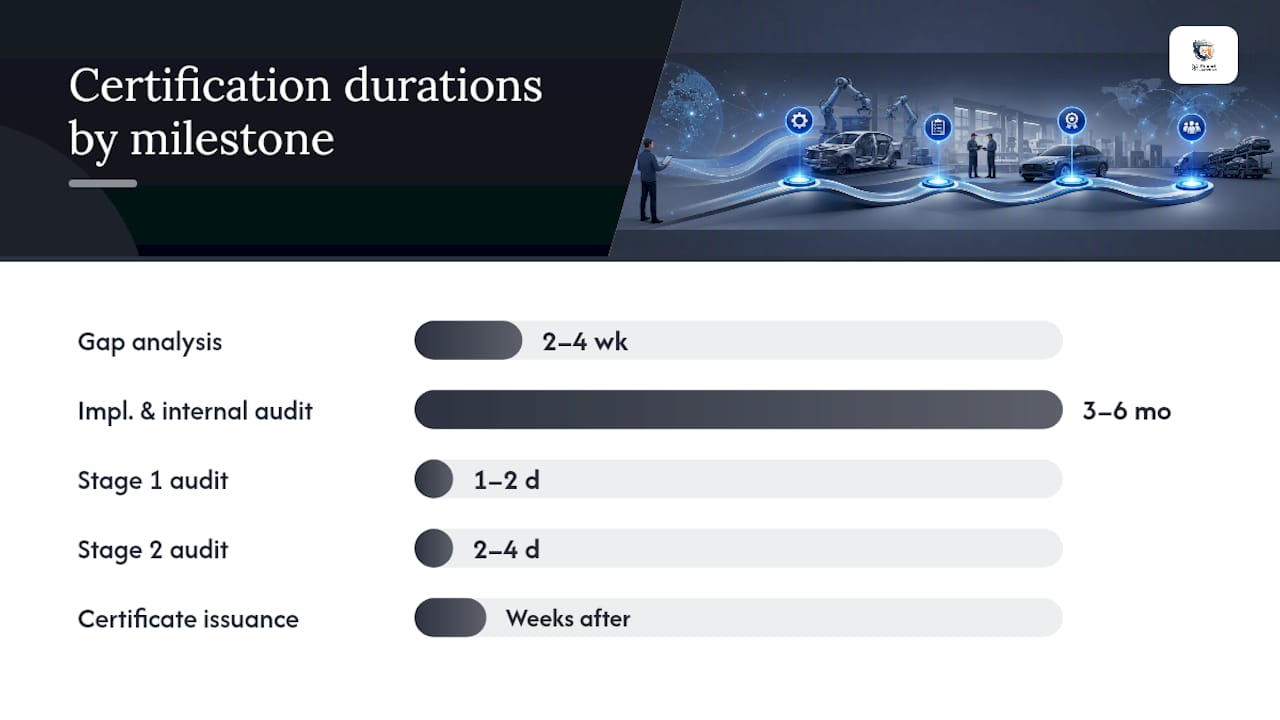
Your certification stays valid for three years, with annual surveillance audits required to maintain it, a rule every IATF-recognized certification body follows without exception. Auditors don't need to cover every process and every shift in a single visit. IATF guidance allows certification bodies to sample different shifts and processes across the three-year cycle, scheduling more frequent or targeted sampling when risk, performance issues, or process changes warrant it. That's worth knowing if you run a night shift you suspect gets less scrutiny than days. It probably will, eventually.
Witness auditing is part of how IATF maintains scheme integrity: IATF oversight bodies occasionally observe certification body auditors during a live audit to confirm they're applying the rules consistently. If your audit happens to include a witness auditor, it's not a sign anything is wrong. It's routine oversight of the certification body, not an escalation of scrutiny on you. Registrar process descriptions, like the one NSF publishes for IATF 16949, give a useful outside look at how a typical certification body structures these stages.
What Are the Most Common IATF 16949 Nonconformities?
Certain findings show up so often across IATF audits that you can predict most of them before an auditor walks in the door. Knowing the pattern lets you fix the highest-risk gaps first instead of spreading limited time evenly across everything.
- Documentation gaps in the CSR matrix. Missing customers, outdated CSR versions, or no clear owner assigned to a requirement.
- Incomplete FMEA and control plan alignment. A control plan that doesn't trace back to the failure modes identified in the corresponding FMEA.
- Ineffective corrective actions. Root cause analysis that stops at "operator error" instead of digging into why the process allowed that error to happen.
- Weak supplier controls. No documented evidence of supplier performance monitoring or missing statutory/regulatory conformity proof.
- Internal audit program gaps. Audits that don't cover all clauses, all shifts, or all applicable processes across the certification cycle.
- Missing PPAP or FAI evidence. Submissions that are incomplete relative to the required PPAP level or missing entirely for a customer-approved change.
Auditors don't sample randomly. They follow the trail your own records leave: a customer complaint points them to a specific line, a specific shift, a specific part number. If your traceability chain has a gap right where that trail leads, that's exactly where the finding lands. The organizations that pass cleanly are the ones whose records hold up no matter which thread an auditor decides to pull.
A prioritized readiness checklist before any certification or surveillance audit:
- Confirm your CSR matrix is current and every customer requirement has a named owner.
- Cross-check control plans against FMEA outputs for every special characteristic.
- Pull the last three corrective actions and verify they addressed root cause, not symptom.
- Confirm supplier statutory/regulatory evidence is on file for every active supplier shipping to a regulated market.
- Review your internal audit schedule to confirm it covers every clause and shift within the current cycle.
- Assemble PPAP/FAI packages for any recent engineering changes before the auditor asks for them.
For sampling and incoming inspection specifics, our incoming inspection best practices guide covers traceability practices that directly reduce this category of finding.
What Should a CSR Matrix and PPAP Index Look Like?
Templates don't need to be elaborate to satisfy an auditor. They need the right fields, consistently filled in, and easy to pull up on demand during an opening meeting.
Customer-specific requirements matrix fields:
| Field | Purpose |
|---|---|
| Customer name | Identifies which OEM or Tier 1 customer the requirement applies to |
| Clause reference | Links the CSR to the specific IATF or ISO 9001 clause it modifies |
| Requirement summary | Plain-language description of what the CSR demands |
| Evidence location | Where the proof of compliance lives (document ID, system record) |
| Owner | Named individual responsible for maintaining compliance |
| Source document and effective date | CSR document version and the date it took effect |
| Status | Current compliance state, reviewed on a fixed schedule |
PPAP/FAI index, minimal required items:
- Design records and any authorized engineering change documents
- Process flow diagram
- Control plan
- FMEA
- Measurement system analysis studies
- Dimensional results, ballooned to the drawing
- Material and performance test results
- Initial process studies (capability data)
Control plan snippet fields:
| Field | Example Entry |
|---|---|
| Characteristic | Bore diameter (special characteristic) |
| Inspection method | CMM |
| Sample frequency | 1 per hour |
| Acceptance criteria | approximately 25 millimeters |
Our first article inspection report template walks through a complete AS9102-style FAI package you can adapt for automotive PPAP submissions, and it's a faster starting point than building an index from scratch.
Does Digital Inspection Software Actually Reduce Audit Effort?
Assembling audit evidence by hand, chasing down which revision of a drawing matches which inspection report, is where most of the wasted hours in an IATF audit prep cycle disappear. The connection between a ballooned drawing dimension and its measured result is exactly the traceability chain auditors ask to see, and manually maintaining that chain across hundreds of part numbers is where documentation gaps creep in.
Digital tools map fairly directly onto specific pieces of IATF evidence:
- Automatic drawing ballooning produces the traceable link between a drawing dimension and its measured result, which is the backbone of any PPAP or FAI package.
- CMM data import removes manual transcription errors between a coordinate measuring machine's output and your inspection report, closing one of the more common sources of measurement discrepancies auditors catch.
- Centralized document vaults with version history directly answer clause 7.5's control of documented information, since an auditor can ask for any past revision and get it instantly instead of hearing "let us check who has that file."
None of this replaces the underlying quality system work. A tool doesn't build your FMEA or write your control plan. What it does is remove the administrative friction of proving the work happened, which matters because IATF's own guidance confirms auditors sample records across shifts and processes over the full three-year certification cycle rather than reviewing everything in one visit. That means your evidence needs to be organized and retrievable on short notice, indefinitely, not just polished for one scheduled audit day.
Our piece on automating CNC and CMM quality control reports goes deeper into how that data import and reporting flow actually works in practice.
A QA engineer's field notes on getting through audits faster
Three habits separate teams who breeze through an opening meeting from teams who spend the first hour scrambling for documents.
First, prepare a one-page CSR quick reference before the auditor arrives, not during the audit. When an auditor asks which customer requirements apply to a specific part number, pulling up a clean one-pager beats flipping through a 40-tab spreadsheet while everyone waits.
Second, keep a single source of truth for PPAP and FAI records. The moment records live in three places, some slightly outdated, you've created the exact inconsistency auditors are trained to find. Pick one location and enforce it.
Third, in the opening meeting, show the auditor your internal audit schedule and your last management review minutes before they ask. It signals the system is alive and actually used, not assembled the week before certification. Auditors form an impression fast, and a team that leads with organized, current records earns a different kind of scrutiny than one that looks like it's improvising.
A Practical Way to Cut Audit Prep Time
Suppliers spend a disproportionate amount of audit prep time not on quality problems but on paperwork: matching drawing revisions to inspection results, chasing CMM output into a report format an auditor will accept, and hunting down which folder has the current PPAP package. QA-Report was built around exactly that gap. Its measurement wizard links ballooned drawing dimensions directly to measured results, auto-flags anything out of tolerance, and generates the statistical summaries and PDF reports that satisfy ISO 9001, AS9100, and PPAP documentation requirements.
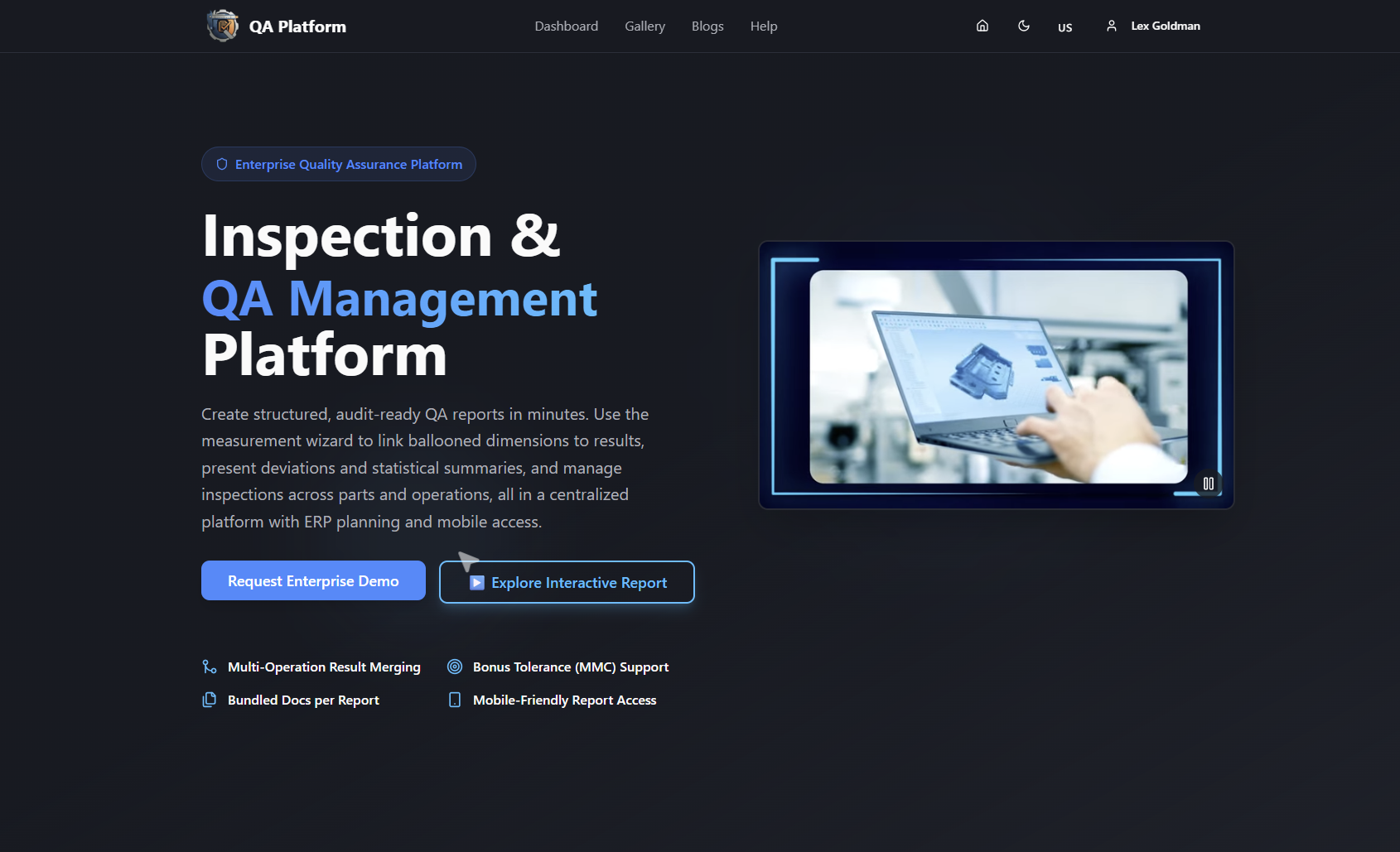
The platform's automatic drawing ballooning, built-in 3D CAD viewer for STEP and IGES files, and direct CMM data import remove the manual re-entry work that eats hours before every surveillance audit. Everything lives in one centralized, multi-language document vault with mobile access, so inspectors on the floor and quality managers preparing for an auditor are working from the same current record, not three different spreadsheets.
If you want to see how the ballooning and CMM import workflow fits into your own PPAP process, the free drawing ballooning tool is a low-friction way to try it on a real drawing today. For a fuller look at the CMM inspection software and automated reporting features, or to talk through a larger multi-site supplier program, start with QA-Report and request a walkthrough suited to your certification timeline.
Sources
- TÜV | Automotive ISO/TS 16949 and IATF 16949 certification
- AIAG – IATF 16949:2016 resources
- IATF – Rules 6th Edition publication notice