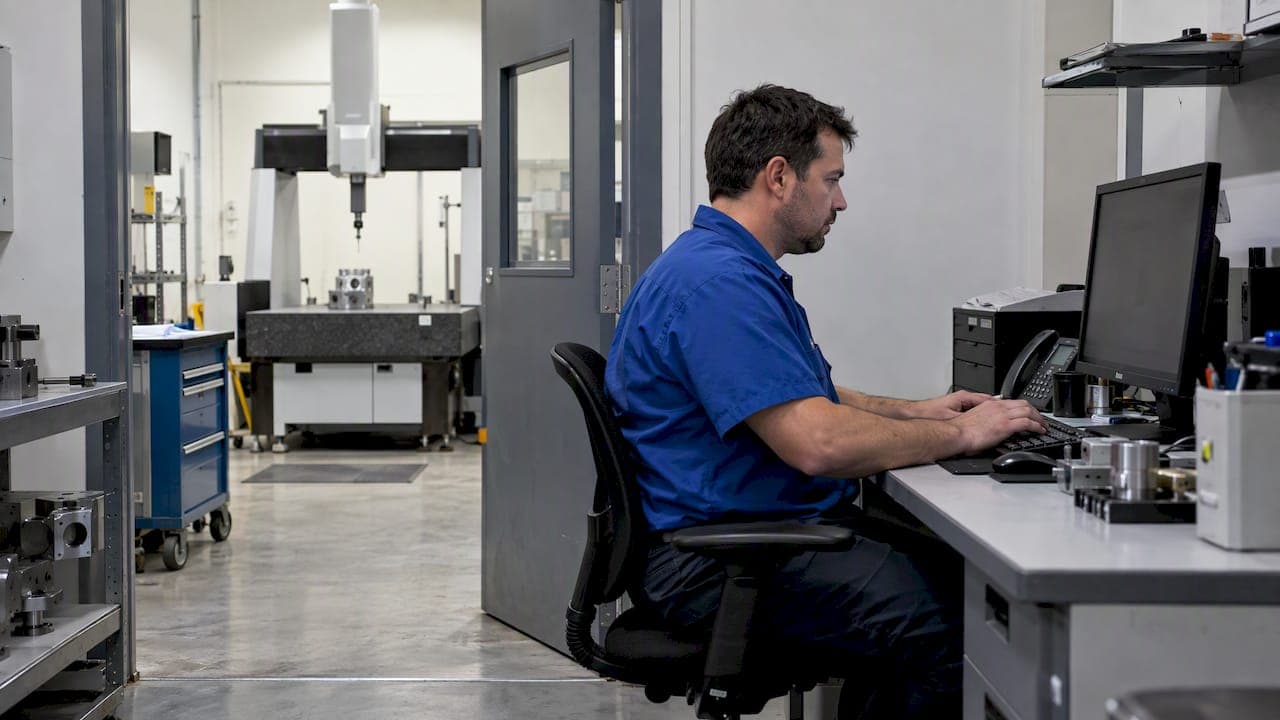
The most reliable way to schedule inspections is to organize bookings by purpose rather than by calendar convenience: First Article Inspection for new or changed parts, sampled checks for process control, and dedicated CMM blocks for audit-critical verification. Each category carries its own cadence, documentation burden, and standard, so scheduling must respect AS9102 and ISO 9001 requirements rather than working around them. Automated, centralized booking makes this approach sustainable at scale.
TL;DR:
- Under AS9102, schedule a full First Article Inspection after any new part, tooling or process change, or site move, leaving one shift before production.
- Reserve dedicated CMM blocks for first article and audit work, and schedule calibration, probe changes, qualified operators, and required soak time before each run.
- Use full CMM programs or dense sampling for first article and audit checks; routine process checks can use evenly distributed points with tighter acceptance margins.
- Record the part revision, inspection trigger, standard, equipment calibration, operator, sampling plan, and evidence location in each booking to preserve traceability during audits.
- Link inspection bookings to production routing, then review inspection timeliness, CMM use, FAI rework, and turnaround weekly to catch conflicts early.
Table of Contents
- Core rules for building an inspection schedule
- Practical cadences and timelines for FAI, CMM FAIs and routine checks
- How to book CMM time, handle calibrations, and schedule qualified staff
- Use sampling strategy to cut inspection time without losing confidence
- How CAD-driven planning and MES integration make scheduling predictable
- A compact booking template and pre-run checklist
- How QA-Report supports this scheduling approach
- Handling rescheduling and delays management protocols
- Communication strategies with suppliers and production teams about inspection schedules
- Contingency planning for equipment downtime or operator unavailability
- Integration of inspection scheduling with quality control documentation and traceability systems
- Weekly checklist and KPIs a quality manager should track
- Try QA-Report for inspection scheduling that holds up to audit
- FAQ
- Sources
Core rules for building an inspection schedule
A defensible schedule starts with three decisions: what triggers an inspection, how often it repeats, and who owns the outcome. Skipping any one of these turns scheduling into guesswork, and guesswork is what auditors notice first.
We recommend organizing every inspection into one of three purpose categories before assigning a date. First Article Inspection applies to new parts, tooling changes, process changes, or a change in manufacturing location, as defined under AS9102. In-process checks verify that a running job stays within tolerance. Final or audit inspections confirm conformance before shipment or customer sign-off.
ISO 9001 frames monitoring and measurement as a risk-based activity, which means higher-risk features or processes with a history of drift earn tighter inspection intervals, while stable, low-risk operations can run on a longer cycle.
- Assign a single scheduling owner per production line who sets booking windows and resolves conflicts.
- Name an approver, often the quality manager, who signs off on any change to a planned FAI or audit inspection.
- Define an escalation path (who gets notified, and within what window) when an inspection slips past its planned date.
Practical cadences and timelines for FAI, CMM FAIs and routine checks
Timing expectations differ sharply by inspection type, and treating them identically is a common source of missed deadlines. AS9102 requires a full First Article Inspection whenever a part is new, or when tooling, process, or manufacturing location changes, which means FAI scheduling has to be triggered by engineering and production change notices, not just a production calendar.
- Flag any engineering change order or new part number as an automatic FAI trigger at the planning stage.
- Book full CMM programs for FAI and audit-critical features, since these runs involve the most dimensions and the longest cycle times.
- Reserve abbreviated, shorter checks for routine in-process sampling where a subset of critical dimensions is enough to confirm stability.
- Build a buffer of at least one shift between a scheduled FAI and the production start date, so rework does not cascade into the next job.
FAI programs run longer than routine checks because they cover the most dimensions and the most probe changes of any inspection type, according to Quality Magazine's analysis of CMM efficiency. Scheduling a shorter abbreviated check back to back with a full FAI on the same machine is one of the fastest ways to blow a production window.
Batching similar parts into a single CMM session cuts setup time, while staggering dissimilar jobs protects throughput when probe configurations differ widely between parts.
How to book CMM time, handle calibrations, and schedule qualified staff
CMM availability is usually the tightest constraint in any inspection schedule, and it gets tighter when calibration, probe qualification, and operator availability are treated as afterthoughts instead of line items.
- Reserve dedicated CMM blocks for FAI and audit-critical work so a routine sampling job cannot bump a customer-facing inspection.
- Build calibration windows directly into the schedule rather than hoping they land on a quiet day.
- Add probe qualification and stylus change time to every run estimate, since these steps are easy to underestimate and routinely push jobs past their booked window.
- Confirm that a qualified operator, not just an available one, is assigned to GD&T-heavy or first article work.
Environmental soak time matters more than most schedules account for. Parts moving from a shop floor into a climate-controlled metrology lab need time to stabilize before measurement, and skipping that step introduces thermal error that no amount of careful programming can fix. Document the temperature controls and soak period for any inspection where dimensional tolerances are tight enough to be affected by thermal expansion.
Pro Tip: Block CMM calendars in fixed-length increments (30 or 60 minutes) rather than open-ended windows; it makes conflicts visible immediately instead of after the fact.
Use sampling strategy to cut inspection time without losing confidence
Sampling strategy is not a detail to leave to the inspector's judgment at the machine. Research from NIST on CMM measurement uncertainty found that the number and distribution of sample points can change measurement uncertainty by orders of magnitude, which means a scheduling decision to run an abbreviated sample instead of a full program is also a decision about how much uncertainty the result carries.
For most process-control checks, a smaller, well-distributed set of points is enough to catch drift early. For FAI and audit-critical conformance, a denser sampling plan or a full program is the safer default, since the NIST findings show that under-sampling a feature can understate real variation.
- Reserve full CMM programs for first article and customer-facing audit checks where sampling error has the highest consequence.
- Use shorter, targeted point sets for routine in-process monitoring where early drift detection matters more than exhaustive coverage.
- Add guard bands or tighter acceptance margins when sampling is reduced, so a borderline result does not pass on uncertainty alone.
Program efficiency techniques, like minimizing probe changes and optimizing probe travel paths, also shorten cycle time without touching sample density, which is often the easier lever to pull first.
How CAD-driven planning and MES integration make scheduling predictable
Automating the path from drawing to measurement plan removes a surprising amount of friction from scheduling. Model-based inspection planning that moves directly from CAD and PMI data to a CMM program can cut programming time from hours to minutes, according to Quality Magazine's coverage of model-to-measurement workflows. That time savings compounds across every FAI and audit inspection a shop runs in a year.
- Generate measurement plans automatically from ballooned drawings instead of reprogramming each part by hand.
- Synchronize inspection bookings with production routing through MES tools like route cards, kanban boards, and Gantt views, so a late production step automatically flags a downstream inspection conflict.
- Keep audit-ready reporting attached to each inspection record, which reduces the scramble to reconstruct evidence when an auditor asks for it.
A shop running inspection scheduling and production planning on separate systems tends to discover conflicts only after they have already caused a delay. Linking the two closes that gap, and our own CMM inspection software is built around exactly this workflow, pairing automated plan generation with MES-level production visibility.
A compact booking template and pre-run checklist
A good inspection booking carries enough context that anyone, not just the person who scheduled it, can run and defend the result.
- Part number, revision, and the specific trigger (new part, process change, routine sample) driving the inspection.
- Inspection type (FAI, in-process, final) and the applicable standard, such as AS9102 or a customer-specific PPAP requirement.
- Assigned equipment, operator, and calibration status at the time of booking.
- Required soak time, sampling plan, and acceptance criteria.
- Evidence storage location, so the report, ballooned drawing, and raw data are retrievable together during an audit.
Our AS9102 report template guide and FAI template walkthrough cover the documentation side of this checklist in more detail.
How QA-Report supports this scheduling approach
We built QA-Report around the same purpose-driven, metrology-aware logic this guide describes. Automatic drawing ballooning and a built-in 3D CAD viewer for STEP and IGES files let a team generate a measurement plan directly from a drawing, while CMM data import and tolerance validation flag out-of-tolerance results as soon as data lands.
- Automatic ballooning and 3D CAD viewing remove manual plan setup before an inspection is even booked.
- CMM data import and tolerance validation auto-flag deviations against the measurement plan.
- MES features including route cards, kanban, and Gantt planning keep production and inspection schedules visible in one place.
- Audit-ready AS9102 and PPAP reporting means evidence is attached to the booking from the start, not assembled afterward.
A shop using a single platform for ballooning, CMM import, and MES planning typically shortens the gap between a scheduled inspection and an audit-ready report, since the evidence chain never leaves the system.
Handling rescheduling and delays management protocols
Delays happen in every production environment, so a schedule that cannot absorb a slip is a fragile schedule. The fix is not avoiding delays altogether, it is defining in advance how a delay gets handled and communicated.
Start with a clear rule for what counts as a reportable delay. A CMM running ten minutes behind on a routine sample check matters less than a first article inspection slipping past its booked window, so set thresholds that match inspection type and risk category, not a single blanket rule for everything.
When a delay happens, the scheduling owner should update the booking immediately rather than letting production discover the slip on its own. A rescheduled FAI needs re-approval from whoever signed off on the original window, since moving a first article check can affect a production release date downstream.
Keep a simple log of why inspections get rescheduled. Recurring causes, like a specific CMM being double-booked or a particular operator consistently unavailable, point to a structural scheduling problem rather than a one-off issue, and that pattern is worth fixing at the root instead of absorbing it week after week.
Build in a standard buffer for high-risk inspections. A first article or audit-critical check scheduled with zero slack time will cause a cascading delay the moment anything goes wrong, while the same check scheduled with even a half-shift buffer absorbs small problems without touching the production line.
Finally, treat a rescheduled inspection as a scheduling event in its own right, with its own record of who moved it, why, and what approval it received, so the audit trail stays intact even when the original plan changes.
Communication strategies with suppliers and production teams about inspection schedules
Inspection schedules fail quietly when the people who depend on them do not know what to expect. Production supervisors need advance notice of when a machine or operator will be unavailable for inspection, and suppliers need visibility into when incoming material will be checked before it clears for use.
A weekly booking summary, shared with production leads and relevant suppliers, solves most of this with minimal overhead. It does not need to be elaborate: a short list of what is scheduled, when, and on which equipment is usually enough to prevent a supervisor from pulling a machine mid-inspection or a supplier assuming material has cleared before it has.
For supplier-facing inspections, set expectations early about lead time. A supplier who knows that incoming material typically clears within a defined window can plan shipments accordingly, while a supplier left guessing tends to either overslip buffer stock or get blindsided by a hold.
Production teams benefit most from knowing which inspections are flexible and which are not. A routine in-process check can often move by an hour or two without consequence, but a first article inspection tied to a customer release date usually cannot, and making that distinction clear up front avoids unnecessary friction when a schedule needs to shift.
Centralizing this information in one shared system, rather than relaying it through email threads or verbal updates, keeps everyone working from the same version of the schedule. When production, quality, and suppliers all see the same booking calendar, fewer inspections get missed simply because someone was not copied on the right message.
Contingency planning for equipment downtime or operator unavailability
Every inspection schedule eventually runs into a CMM going down for unplanned maintenance or a qualified operator calling out. Planning for that in advance is what separates a minor disruption from a missed customer deadline.

Start by identifying which inspections absolutely require a specific machine or operator, and which can flex. A CMM programmed for a particular probe configuration may not have an easy substitute, but a manual dimensional check against a calibrated gauge often can run on backup equipment without much loss of confidence.
Cross-training matters here. A shop with only one person qualified to run GD&T-heavy CMM programs has a single point of failure built into its schedule, and that risk shows up at the worst possible time, usually during a customer audit or a tight production window.
Keep a short list of contingency options ready before they are needed: a secondary CMM, a qualified backup operator, or an outside metrology lab for overflow work. Having these options identified in advance means a disruption triggers a decision, not a scramble.
When a CMM goes down mid-schedule, prioritize reassigning audit-critical and first article work first, since those inspections carry the highest consequence for delay. Routine in-process checks can often absorb a short wait without affecting the broader production timeline.
Document every contingency decision the same way a normal booking gets documented, including what equipment or operator substitution was made and why. An auditor reviewing a schedule later should be able to see not just what happened, but that the substitution was deliberate and controlled, not improvised.
Integration of inspection scheduling with quality control documentation and traceability systems
A schedule that lives apart from quality documentation creates a gap that shows up exactly when it matters most, during an audit or a customer complaint investigation. Every scheduled inspection should connect directly to the report, raw data, and traceability record it produces.

This starts with treating the booking itself as part of the quality record. A booking that captures part number, revision, inspection type, and the standard it satisfies becomes the first entry in a traceability chain, rather than a calendar note that gets discarded once the inspection is complete.
ISO 9001's monitoring and measurement guidance expects organizations to show that measurement resources are suitable and controlled, which means the link between a scheduled inspection and its equipment calibration record needs to be retrievable, not reconstructed after the fact.
Batch and serial tracking tie this together on the production side. When an inspection is scheduled against a specific batch or serial number, the resulting report, deviations, and disposition decisions stay connected to that exact unit, which matters enormously when a customer asks for traceability on a specific part years later.
A document vault or centralized evidence store removes the single biggest cause of audit friction: time spent hunting for the report, drawing, or raw data tied to a given inspection. When scheduling, documentation, and traceability sit in one system, pulling a complete audit trail becomes a lookup rather than a reconstruction project.
Weekly checklist and KPIs a quality manager should track
A handful of numbers tell you whether a schedule is healthy: on-time inspection rate, CMM utilization, FAI rework rate, and average inspection turnaround. Review them weekly alongside three habits: confirm next week's bookings, clear any blocked resources, and verify upcoming calibration windows before they lapse.
— Michael Chen
Try QA-Report for inspection scheduling that holds up to audit
Everything in this guide, purpose-driven cadences, CMM booking discipline, and sampling strategy tied to measurement uncertainty, works best when it lives in one system instead of across spreadsheets, email, and a separate MES tool. We built QA-Report to handle exactly that, linking automatic drawing ballooning, CMM data import, and MES-level production planning so a scheduled inspection, its measurement plan, and its audit evidence stay in one place.
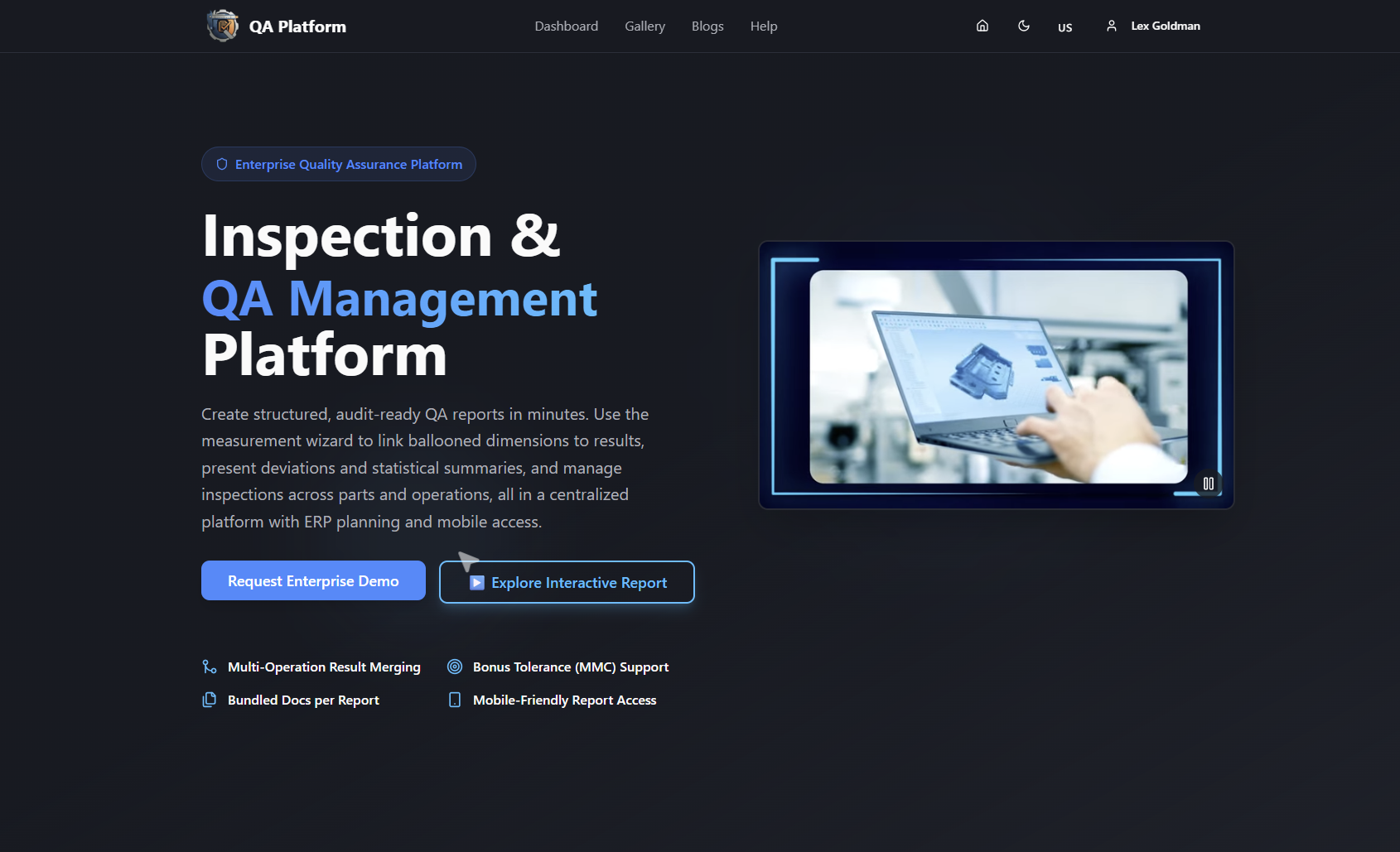
If your current drawings still need ballooning before you can plan inspections at all, our free drawing ballooning tool is a quick way to prepare them. When you are ready to see the full scheduling and reporting workflow, our pricing page lists the Free, Basic, PRO, On-Premise, and Enterprise Solutions options, including the Basic plan at $49.99 per month and PRO at $149.99 per month.
FAQ
How often should FAI inspections be scheduled?
A First Article Inspection is triggered by a specific event, not a calendar interval: a new part number, a tooling change, a process change, or a change in manufacturing location all require one under AS9102. Routine production without any of those changes does not require a repeat FAI.
What is the difference between inspection scheduling and MES production scheduling?
Inspection scheduling plans when and how a part gets measured against a quality standard, while MES production scheduling plans the manufacturing steps themselves, including routing, batching, and operator assignment. Integrating the two, through route cards, kanban, or Gantt planning, keeps a production delay from silently causing a missed inspection window.
How does measurement uncertainty affect how I should schedule CMM inspections?
Sampling strategy, meaning how many points you measure and how they are distributed, can change measurement uncertainty by orders of magnitude according to NIST research. That means audit-critical and first article inspections generally need denser sampling or a full CMM program, while routine process checks can use a lighter, well-distributed sample without losing confidence.
What should an inspection booking record include for audit readiness?
An audit-ready booking should include the part number and revision, the inspection trigger and applicable standard, the assigned equipment and operator, calibration status, and the location where evidence will be stored. Missing any of these fields tends to slow down an audit even when the inspection itself was done correctly.
Can QA-Report help reduce CMM programming time for first article inspections?
Yes, our platform generates measurement plans directly from ballooned drawings and CAD data, which shortens the manual programming step that typically consumes the most time in a first article inspection. Automated model-based planning of this kind has been shown to cut programming time from hours to minutes.
Sources
- What is AS9102 (First Article Inspection) — AS9100Store
- The estimation of measurement uncertainty of small circular features measured by CMMs — NIST IR 5698
- ISO 9001 monitoring and measurement guidance — ECESIS