
RBAC in manufacturing means assigning system and machine permissions to defined job roles, not to individual employees, so an operator, a quality engineer, and a plant manager each get exactly the access their job requires. The right model layers a physical site scope onto every role, known as site-aware RBAC, and pairs it with least privilege and ongoing governance. Done well, it produces clearer accountability, fewer accidental line stoppages, and a straighter path to ISO 9001, AS9100, and PPAP audits.
TL;DR:
- Properly scoped site-aware RBAC ensures roles are limited to specific plants, preventing accidental cross-plant approvals and reducing operational errors.
- Implementing RBAC requires detailed role mapping aligned with actual job duties, with phased testing to avoid disrupting production.
- Regular entitlement reviews and automated role adjustments tied to HR events help prevent permission decay and maintain security over time.
- RBAC must account for operational constraints by centralizing high-level controls while localizing site-specific permissions for real-time systems.
- Clear separation of duties in RBAC supports audit compliance and improves inspection workflows by assigning distinct roles for recording, reviewing, and approving quality data.
Table of Contents
- What Does RBAC Look Like on a Manufacturing Floor?
- Why Does RBAC Matter for Manufacturing Cybersecurity and Compliance?
- How Does Site Scope Change RBAC for Multi-Plant Operations?
- How Do You Roll Out RBAC Without Stopping Production?
- How Do You Keep RBAC From Decaying Over Time?
- How Does RBAC Fit Into IT and OT Architecture?
- How Does Role-Based Access Support Inspection and Quality Workflows?
- Get Started With RBAC That Fits Your Plant, Not a Template
- A Practical Take on Rolling Out RBAC
- Sources
What Does RBAC Look Like on a Manufacturing Floor?
The NIST glossary defines role-based access control around three rules: role assignment (a user must hold a role to get permissions), role authorization (a user's active role must be authorized for them), and permission authorization (a role can exercise only permissions it's been granted). On a shop floor, that translates into roles most managers already recognize informally, now made explicit in a system.
A typical role map looks like this:
- Operator: records production counts, logs downtime, views work instructions. No edit rights on specifications.
- Maintenance technician: accesses equipment logs and work orders, cannot alter quality records.
- Quality engineer: views and edits nonconformances, enters inspection data, cannot finalize disposition alone.
- Shift lead: approves shift-level exceptions and reassigns operators within a line.
- Plant manager: sees full-plant dashboards and reports, generally cannot override quality holds.
- Multi-site admin: manages user accounts and role templates across facilities, rarely touches production data directly.
WorkOS documents a similar structure, adding document control as a distinct role that manages revisions without touching production or inspection data. The "must not have" side matters as much as the grants. An operator who can edit a tolerance spec, or a technician who can close a nonconformance, breaks the separation of duties auditors look for.
Why Does RBAC Matter for Manufacturing Cybersecurity and Compliance?
Shared logins and permission sprawl are the quiet cause behind a lot of production incidents that get blamed on "human error." When five operators log in under one shared account, a bad parameter change or a skipped inspection step has no clear owner, and troubleshooting turns into guesswork. Insider risk grows the same way: broad, unaudited access means one disgruntled or careless credential can touch far more than its holder's actual job.
NIST SP 1800-10 lists user authentication, authorization, and change control among the core protections for industrial control system integrity, and RBAC is how those protections get enforced day to day. IEC 62443 and, in medical device or pharma contexts, 21 CFR Part 11, both expect documented control over who can create, modify, or approve records. RBAC is the mechanism that satisfies that expectation without manual sign-off sheets.
RBAC also supports broader governance goals. The NIST Manufacturing Profile for the Cybersecurity Framework ties access control directly to risk management activities manufacturers already report against. The operational payoff shows up fast: provisioning a new hire's access takes minutes instead of a chain of emails, and when an auditor asks who approved a deviation last quarter, the answer is a query, not a search through paper logs.
How Does Site Scope Change RBAC for Multi-Plant Operations?
A role by itself answers "what can this person do." It doesn't answer "where." That's the gap traditional IT-style RBAC leaves open in manufacturing, and it's why Cisco's site-based RBAC guidance recommends combining role, permission, and site scope into a single access group. Think of scope as a nested hierarchy: Plant, then Area, then Line, then Cell. A quality engineer role scoped to "Plant B, Line 3" can approve nonconformances there and nowhere else, even though the same role template exists at four other plants.
That distinction prevents a common and costly mistake: an engineer at one site accidentally approving a hold release on equipment at a different plant they've never walked the floor of. Site scoping keeps the authority local while the role definition stays consistent across the company.
A few design habits keep this manageable as the organization grows:
- Name scopes consistently across every site (Plant > Area > Line > Cell, always in that order) so reports and audits read the same everywhere.
- Avoid nesting more than four or five levels deep. Extra granularity mostly adds administrative overhead without meaningfully reducing risk.
- Separate global actions from site-scoped ones early, and document which is which before assigning a single permission.
Pro Tip: Build your scope hierarchy on paper before touching any software. If your team can't agree on where "Area" ends and "Line" begins during that conversation, your access groups will inherit the same confusion once they go live.
How Do You Roll Out RBAC Without Stopping Production?
Implementation success tends to hinge on how well job duties get mapped to permissions, not on the technical configuration itself, according to IBM's implementation guidance. A rushed technical rollout on a poorly mapped role structure just automates the confusion that already existed.
- Plan. Map every job function's real duties and flag the critical transactions (closing a nonconformance, releasing a hold, editing a spec). Group these into broad initial role templates rather than dozens of narrow ones.
- Model. Define roles, their permissions, and their site scopes together. Enforce least privilege by default and build in separation of duties so no single role can both create and approve the same critical record.
- Pilot. Test the model on one line or one plant first. Have actual OT users, not just IT staff, validate that the workflows and scope boundaries match how they really work.
- Roll out. Deploy in phases, integrating with existing IAM or single sign-on where it exists, and feed access logs into SIEM or monitoring tools so unusual activity gets flagged, not buried.
- Maintain. Schedule automated entitlement reviews, wire role changes into onboarding and offboarding processes, and map roles into incident response playbooks so responders know who can do what during a live event.
Pro Tip: Start with broad role categories, administrators, specialists, and end users, then refine. Oloid's implementation research found this approach causes far less disruption than trying to design granular roles from day one, when nobody yet knows which edge cases actually matter.
How Do You Keep RBAC From Decaying Over Time?
RBAC isn't a project with an end date. It's a governance habit, and role definitions need the same lifecycle discipline as any other control: request, approve, assign, certify, modify, and eventually retire.
- Run entitlement reviews on a fixed schedule, quarterly for high-risk roles like quality approvals, annually for lower-risk ones, and require managers to formally attest that each access grant still makes sense.
- Tie role changes to HR events automatically. A transfer, a promotion, or a termination should trigger an access review the same day, not whenever someone remembers.
- Watch for role explosion. When teams create a new role for every minor exception instead of adjusting scope, the system becomes unmanageable fast, and refining scope boundaries usually solves the problem better than adding roles.
Permission decay, where access quietly outlives its justification, is one of the most underappreciated failure modes in access control. Treat it as an ongoing governance line item, not a box checked once at launch.
How Does RBAC Fit Into IT and OT Architecture?
IT systems tolerate brief downtime for security patches. OT systems on a running line often can't, which means access controls need to respect real-time and availability constraints that a typical IT security policy ignores. RBAC has to flex around that reality rather than fight it.
- Keep certain actions under centralized IT control regardless of site: user provisioning, role template creation, and system-wide configuration changes.
- Scope operational actions, machine parameter adjustments, inspection approvals, work order closures, to the specific site or line where they happen.
- Reference NIST SP 1800-10 for ICS-specific access architecture, IEC 62443 for industrial security zoning, and the NIST Manufacturing Profile for tying access control into broader cybersecurity governance reporting.
Getting this split right is what separates RBAC that actually holds up during an incident from RBAC that looks good in a policy document and fails the first time a line goes down at 2 a.m.
How Does Role-Based Access Support Inspection and Quality Workflows?
Access control decisions show up directly in inspection quality. When an operator can record a measurement but not approve it, and a quality engineer can approve a nonconformance but not close the batch alone, the separation of duties that auditors expect becomes structural rather than procedural.
Role-based permissions determine who can balloon a drawing, who enters CMM results, and who signs off on a first article inspection or Material Review Board disposition. That structure produces audit-ready reports aligned with ISO 9001, AS9100, and PPAP requirements without relying on someone remembering the approval chain from memory.
- Inspection recording, review, and approval stay assigned to distinct roles, mirroring the separation IEC 62443 and NIST guidance recommend.
- MRB and FAI sign-offs trace back to a specific role and person, not a shared login.
For more on how document control roles intersect with inspection records, see this breakdown of controlled documents versus records.
Get Started With RBAC That Fits Your Plant, Not a Template
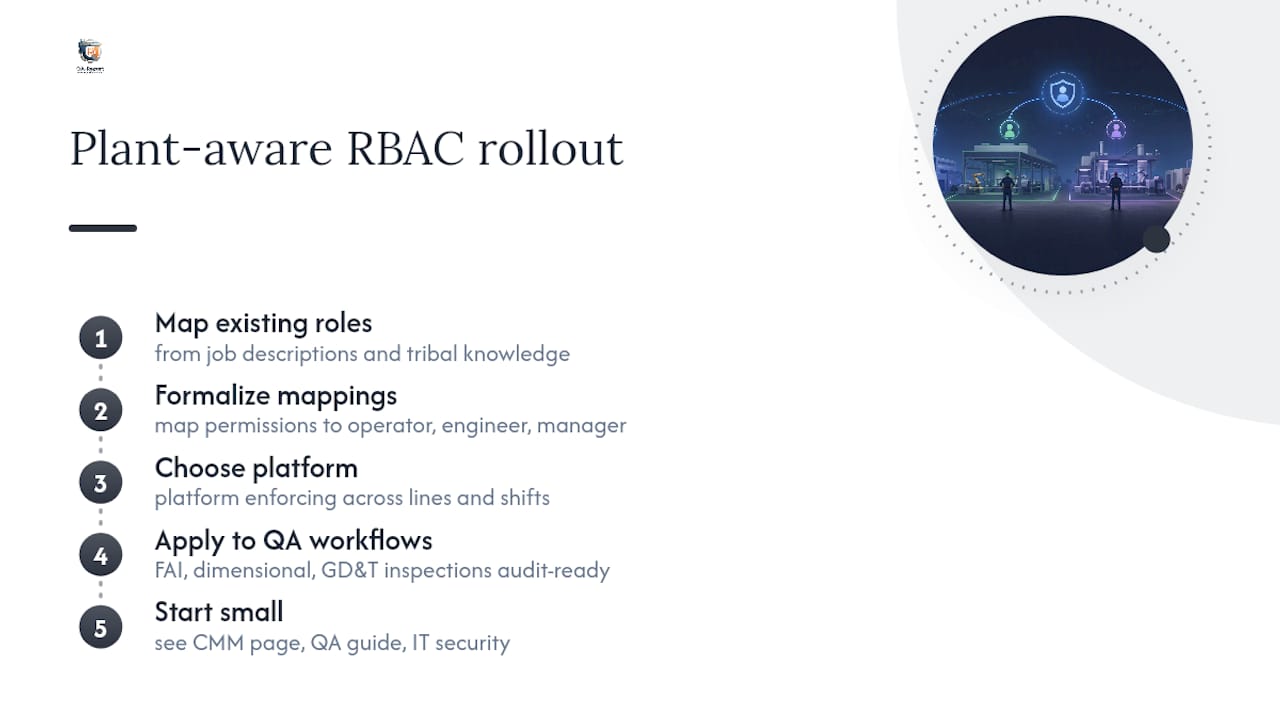
Most manufacturers already have the role structure they need; it's just living in job descriptions and tribal knowledge instead of a system. Formalizing that structure into site-aware RBAC is less about buying new software and more about doing the mapping work described above, then choosing a platform that enforces it consistently across every line and shift.
QA-Report's role-based shop-floor access applies this exact model to inspection and quality reporting. Permissions map to roles like operator, quality engineer, and quality manager, so FAI reports, dimensional data, and GD&T inspections stay audit-ready without manual chasing of sign-offs. If your team is planning a rollout, the CMM inspection software page walks through how measurement data flows into that same role structure. For a broader look at where access control fits into your quality system overall, the manufacturing QA guide is a useful next stop. Smaller shops evaluating where to start should also read this manufacturing IT security guidance for smaller manufacturers, which covers lean approaches to the same problem.
A Practical Take on Rolling Out RBAC
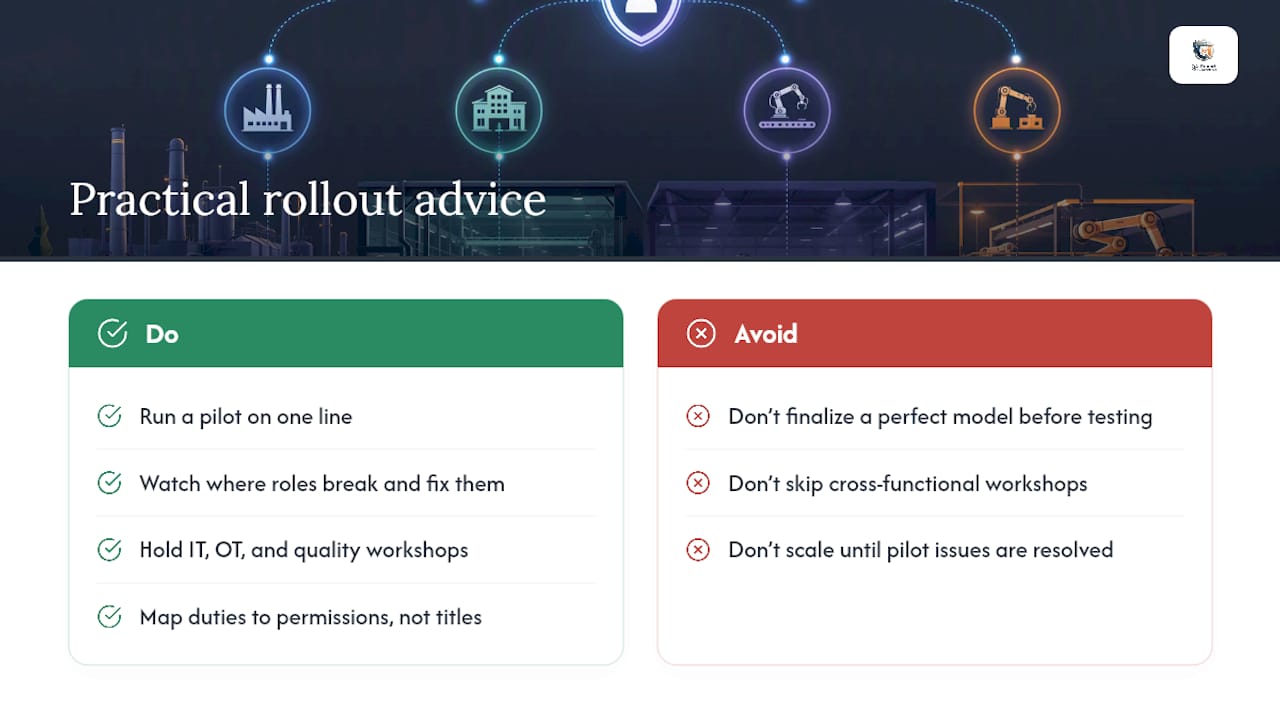
The honest trade-off is speed versus control, and most manufacturers try to resolve it backward, locking down a perfect role model before anyone has tested it against real shop-floor behavior. Pilots beat perfection every time. Run one line, watch where the model breaks, then fix it before scaling.
The workshops matter more than the software. Get IT, OT, and quality in the same room to map actual duties, not job titles, to permissions. Skip that step and you'll spend the next two years fighting role explosion instead of preventing it.
— Michael Chen
Sources
- NIST glossary — Role based access control
- Cisco — Site-Based RBAC for industrial environments
- NIST SP 1800-10 — Protecting information and system integrity in ICS environments
- WorkOS blog — Role-based access control examples