
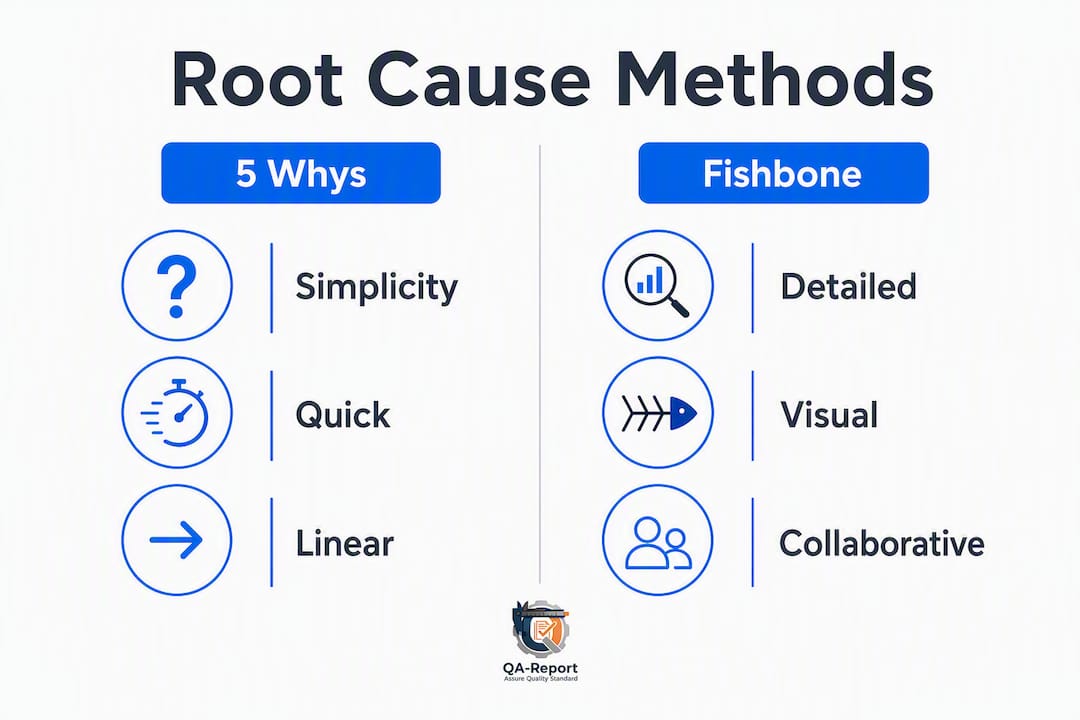
For most manufacturing defects, start with 5 Whys for a quick single-cause issue, Fishbone/Ishikawa when multiple process variables are involved, and 8D when the problem is recurring, customer-reported, or requires formal corrective action documentation. Standards including IEC 62740:2015, ISO 9001, and AS9100 all expect a systematic, evidence-based approach to root cause identification, not a blame exercise.
- Single linear cause, low recurrence risk: 5 Whys with one facilitator, informal record
- Multi-causal or complex process failure: Fishbone/Ishikawa with cross-functional team, structured worksheet
- Recurring, customer-reported, or safety-related defect: 8D with full corrective action record, audit-ready
Table of Contents
- Which root cause analysis method fits your problem?
- How to run 5 Whys, Fishbone, and 8D step by step
- How to combine Fishbone and 5 Whys in one workflow
- What auditors actually check in regulated industries
- Collecting and attaching inspection data to your RCA record
- Templates and tools that support audit-ready RCA records
- How do you verify that a corrective action actually worked?
- Key Takeaways
- The pitfall most RCA teams don't see coming
- QA-Report cuts RCA documentation time for regulated manufacturers
- Useful sources and standards for further reading
Which root cause analysis method fits your problem?
Method selection depends on problem complexity, recurrence risk, and the documentation level your auditors expect. Use the matrix below to match your situation to the right technique.
| Dimension | 5 Whys | Fishbone/Ishikawa | 8D | Fault Tree / DMAIC |
|---|---|---|---|---|
| Problem complexity | Low, linear | Medium, multi-causal | High, systemic | High, probabilistic or data-driven |
| Recurrence risk | Low | Medium | High | High |
| Customer impact | Internal only | Internal/supplier | Customer-reported | Safety or regulatory |
| Time available | 15–30 min | 30–90 min | Days to weeks | Weeks |
| Documentation level | Informal log | Structured worksheet | Full audit record | Formal report with data |
| Cross-functional team | Optional | Recommended | Required | Required |
Who to include: Operator and technician for process knowledge, process owner for accountability, QA engineer for compliance framing, and engineering when design is implicated. For FDA-adjacent or AS9100 audits, loop in your compliance lead before the investigation closes.
Red flags that require formal RCA immediately:
- A regulatory finding or customer corrective action request (CAR) has been issued
- The defect involves a safety-critical characteristic or flight-critical part
- The same failure mode has recurred within the last 12 months
- A nonconformance affects a full production lot or batch
ASQ notes that group-based analyses consistently outperform single-person efforts, which is why cross-functional teams are the standard expectation in regulated environments.
How to run 5 Whys, Fishbone, and 8D step by step
5 Whys process
- Write a precise problem statement: "[Part number] failed [characteristic] at [operation/station] on [date], affecting [quantity] units." Vague statements produce vague causes.
- Ask "Why did this occur?" and record the answer as a factual observation, not an assumption.
- Repeat for each answer. Stop when you reach a cause that, if corrected, would prevent recurrence.
- Avoid restating the nonconformity as the root cause. "The dimension was out of tolerance because the dimension was out of tolerance" is a closed loop, not an answer.
- Document: problem statement, each why/answer pair, identified root cause, proposed corrective action, owner, and target date.
Pro Tip: If your fifth Why points to a person ("the operator didn't check"), keep asking. The real root cause is almost always a missing process control, unclear work instruction, or inadequate fixture — not the individual.
Fishbone/Ishikawa process
The facilitator draws the diagram, writes the problem statement at the fish head, and assigns branches across the six standard categories: Methods, Machines, Materials, Manpower, Measurement, Environment. Before brainstorming, require that every cause placed on the top two or three branches has supporting evidence — a measurement record, machine log, or direct observation. Sessions that skip this step produce "idea soup": a diagram full of plausible guesses with no evidentiary basis.

Document: diagram image or digital file, evidence attached to each major branch, team members present, date, and the two or three branches selected for deeper analysis.
8D process
8D is the industry-standard format for formal, audit-ready corrective action, as explained in this guide on How Advanced Manufacturing Shapes Wheel Performance. Auditors under ISO 9001 and AS9100 will check each section.
- D0: Define the symptom and confirm the problem warrants 8D (safety, regulatory, or customer impact).
- D1: Assemble the cross-functional team with defined roles.
- D2: Describe the problem with measurable data (part, characteristic, quantity, detection point).
- D3: Implement and verify interim containment actions to protect the customer.
- D4: Identify and verify root cause(s) using 5 Whys, Fishbone, or FTA.
- D5: Choose and verify permanent corrective actions against the root cause.
- D6: Implement and validate the permanent fix; update control plans, FMEAs, and work instructions.
- D7: Prevent recurrence by updating similar processes and sharing lessons learned.
- D8: Recognize the team and formally close the record.
Short notes on FTA, DMAIC, and Pareto: Fault Tree Analysis works best when a failure has multiple contributing causes and you need to prioritize the highest-risk path. DMAIC fits data-rich environments where you need statistical evidence of improvement. Pareto charts help triage which defect categories to investigate first. All three require more setup time and data than 5 Whys or Fishbone, so reserve them for systemic or high-volume problems.
How to combine Fishbone and 5 Whys in one workflow
The most reliable approach pairs Fishbone for breadth with 5 Whys for depth. Combining the two prevents single-cause bias and produces a more defensible record.
| Stage | Activity | Owner | Typical Duration |
|---|---|---|---|
| Fact collection | Gather CMM data, MES logs, inspection records | QA engineer | several hours |
| Fishbone brainstorm | Map all potential causes across six categories | Facilitator + team | moderate duration |
| Evidence gating | Confirm data support for top branches | QA + process owner | short duration |
| 5 Whys drill-down | Apply 5 Whys to each gated branch | Team | short duration per branch |
| Corrective action selection | Assign owner, verification metric | QA manager | short duration |
| Escalation check | If recurring or customer-reported, open 8D | Compliance lead | Immediate |
Audit document checklist for this workflow:
- Fact log with timestamps and data sources
- Interview notes (anonymized where appropriate)
- Fishbone diagram with evidence annotations
- 5 Whys worksheets for each gated branch
- Corrective action record: owner, due date, acceptance criteria
- Verification measurement results
- Retention location and document number
What auditors actually check in regulated industries
IEC 62740:2015 is explicit: RCA techniques are not designed to assign responsibility or liability. The investigation must focus on systemic factors, not individual blame. Auditors trained on this standard will flag any RCA record that names an operator as the root cause without identifying the underlying process or system failure that allowed the error.
Under ISO 9001 and AS9100, auditors commonly verify:
- A documented sequence of events with dates and evidence references
- Fact-finding records (measurement data, machine logs, interview summaries)
- Cross-functional team participation with names and roles recorded
- Defined corrective actions with measurable outcomes and assigned owners
- A verification plan showing how effectiveness will be confirmed
- A retention policy stating how long RCA records are kept (typically aligned with your customer contract or regulatory requirement, often 10 years for aerospace)
Anti-blame language: Frame interview questions around the process, not the person. "Walk me through the steps you followed at that station" produces facts. "Why did you miss that?" produces defensiveness and shuts down honest reporting. The VA's RCA guidance recommends building a sequence of events from facts gathered in interviews and record reviews before drawing any conclusions about cause.
Collecting and attaching inspection data to your RCA record
Credible evidence is what separates a defensible RCA from a paperwork exercise. Practical sources for manufacturing RCA include CMM output files, first-article inspection (FAI) records, SPC charts, MES event logs, machine error codes, and calibrated instrument logs.
| Evidence type | Preferred format | Minimum metadata |
|---|---|---|
| CMM measurement report | PDF (summary) + native file | Part number, revision, date, operator, machine ID |
| FAI / dimensional record | Drawing revision, balloon numbers, measured values | |
| SPC chart | PDF or PNG export | Characteristic, date range, Cpk value |
| MES event log | CSV | Timestamp, operation, machine ID, batch/serial |
| Calibration record | Instrument ID, calibration date, next due date |
File naming convention: [PartNumber]_[NCR-Number]_[EvidenceType]_[YYYYMMDD]. This format makes retrieval fast during an audit and links each attachment unambiguously to the nonconformance record.
Templates and tools that support audit-ready RCA records
A structured template set removes the guesswork from documentation. At minimum, your RCA toolkit should include:
- Problem statement template: Part, characteristic, quantity, detection point, date, customer impact (yes/no)
- Event timeline template: Date/time, event description, data source, verified by
- Fishbone worksheet: Six-category diagram with evidence fields per branch
- 5 Whys worksheet: Problem statement, five why/answer rows, root cause statement, corrective action
- 8D form: D0–D8 sections with required evidence fields and sign-off blocks
- Verification plan template: KPI, measurement method, frequency, acceptance threshold, responsible party
For tool types, your team will typically use document templates (Word or PDF), SPC software for statistical evidence, MES logs for production traceability, and a corrective-action tracking system to manage open items.
QA-Report maps directly to the audit-ready record requirements above. CMM data imports automatically into inspection reports, drawing ballooning links balloon numbers to measured results, and PDF evidence packages are generated in minutes rather than hours. Out-of-tolerance deviations are auto-flagged, so the fact-finding stage of your RCA starts with clean, verified data rather than manually compiled spreadsheets.
How do you verify that a corrective action actually worked?
A corrective action is not complete until its effectiveness is measured. Every action in your RCA record needs at least one measurable outcome and a defined verification plan.
Practical KPIs for manufacturing RCA:
- Percent defective (before vs. after corrective action, same operation)
- Cpk improvement on the affected characteristic
- Repeat incident count over a defined monitoring window (e.g., 90 days)
- Time-to-detection change (did the control plan catch the issue earlier)
Verification plan structure
| Element | What to define |
|---|---|
| KPI | Specific metric with unit and baseline value |
| Measurement method | Instrument, sample size, frequency |
| Acceptance threshold | Pass/fail criterion (e.g., zero repeat incidents in 90 days) |
| Data source | CMM report, SPC chart, MES log |
| Responsible party | Named individual, not a department |
| Reporting cadence | Weekly, monthly, or per-lot |
Closure criteria: Evidence of implementation (updated work instruction, control plan revision), short-term verification data meeting the acceptance threshold, a long-term monitoring plan (minimum 90 days for most regulated industries), and documented management concurrence.
Key Takeaways
Choosing the right RCA method and verifying corrective-action effectiveness with measurable data are the two requirements that determine whether your record will satisfy an ISO 9001, AS9100, or FDA-adjacent audit.
| Point | Details |
|---|---|
| Match method to complexity | Use 5 Whys (15–30 min) for linear issues, Fishbone (30–90 min) for multi-causal, and 8D for recurring or customer-reported defects. |
| Combine for depth and breadth | Run Fishbone first to map all potential causes, then apply 5 Whys to the top 2–3 evidence-gated branches. |
| IEC 62740 anti-blame framing | Frame every RCA around systemic factors, not individuals; auditors will flag records that name a person as the root cause. |
| Verify every corrective action | Each action needs a measurable KPI, acceptance threshold, and a minimum 90-day monitoring window before closure. |
| QA-Report for audit-ready records | QA-Report's CMM import, auto-flagging, and PDF evidence packages reduce manual documentation work and support compliant RCA records. |
The pitfall most RCA teams don't see coming
The most common failure in regulated-industry RCA is not picking the wrong method. It is declaring a root cause before the evidence is in.
Fishbone sessions are particularly vulnerable. A cross-functional team in a conference room can generate 30 plausible causes in 45 minutes, and the group will often converge on the most politically comfortable answer rather than the most defensible one. The fix is simple but requires discipline: before the team votes on a root cause, every candidate on the top two or three branches must have a data point or direct observation attached to it. No evidence, no branch. This is evidence gating, and it is the single practice that most separates RCA records that hold up under audit from those that get a finding.
The second pitfall is weak corrective actions. "Retrain the operator" is not a corrective action; it is a temporary patch that will not survive a follow-up audit. A corrective action must change the system: update the control plan, add a poka-yoke, revise the work instruction, or modify the inspection frequency. If your corrective action could be undone the next time someone forgets a step, it is not addressing the root cause.
QA-Report cuts RCA documentation time for regulated manufacturers
When your team finishes a Fishbone session or closes an 8D, the last thing you need is hours of manual work assembling the evidence package. QA-Report pulls CMM measurement data directly into inspection reports, auto-flags every out-of-tolerance deviation, and generates a professional PDF evidence package that meets ISO 9001, AS9100, and PPAP requirements.
That means your fact-finding stage starts with verified, traceable data rather than a manually compiled spreadsheet. Drawing ballooning links balloon numbers to measured results, so auditors can trace every dimension back to its source in seconds. Corrective action records, evidence attachments, and verification data all live in one centralized platform with role-based access for your full team.
Start a free trial at QA-Report and see how much faster your next RCA record comes together.
Useful sources and standards for further reading
- IEC 62740:2015 — Root Cause Analysis: The international standard defining RCA principles, technique attributes, and the systemic (non-blame) framing auditors expect.
- ISO 9001 / AS9100 corrective action clauses: ASQ's overview of how RCA fits into a compliant corrective action process under ISO and aerospace quality standards.
- VA RCA Step-by-Step Guide: Detailed procedural guidance on fact-finding, interviewing, sequencing events, and writing measurable outcome measures — directly applicable to manufacturing RCA.
- A2LA — Root Cause Analysis Methods: Practitioner-level summary of Fishbone, FTA, and 5 Whys with guidance on evaluating root-cause statements and prioritizing corrective actions.
- CMS RCA Guidance: Structured facilitated-team RCA process guidance covering what happened, why it happened, and what changes to make — useful as an audit citation for process-based RCA.
When citing these in an audit report, reference the standard number and publication date (e.g., "IEC 62740:2015, Section 4") alongside your RCA record number so auditors can verify the methodology used.