
Role-based permissions (RBAC) paired with site scope is the practical, maintainable way to control who can view, change, and approve production and quality records on the shop floor. RBAC assigns access by job function instead of by individual login, and scope pins each role to a specific plant, area, line, or cell so an operator's rights on Line 3 don't quietly extend to Line 7, reflecting the different types of manufacturing IT infrastructure that require precise access control. The first move is simple: pick a small starter set of roles and site scopes, then pilot them on one line before touching the rest of the plant.
TL;DR:
- Most manufacturing plants only need around six core roles, such as operator, shift lead, maintenance technician, quality engineer, production manager, and administrator, to cover shop-floor permissions effectively.
- Site scope must be defined first to prevent permission sprawl, with permissions granted for specific lines, cells, or areas based on role requirements.
- Implementing RBAC through a phased pilot on one line, with read-only access initially, helps prevent over-provisioning and verifies that permissions align with operational needs.
- Regular recertification, immediate deprovisioning upon job changes, and strict management of emergency access are essential to prevent permission decay over time.
- Consistency across production workflows and documentation ensures RBAC maintains compliance with standards like ISO 9001, AS9100, and 21 CFR Part 11.
Table of Contents
- What Is Role-Based Permissions Manufacturing Access Control?
- What Role Profiles Do Most Manufacturing Plants Need?
- Which Design Principles Keep RBAC From Sprawling?
- How Do You Implement RBAC on the Shop Floor Step by Step?
- How Should You Manage the Permissions Lifecycle Over Time?
- How Does RBAC Fit With MES, QMS, and Inspection Workflows?
- What Mistakes Undermine Manufacturing RBAC?
- A Pragmatic Take on Rolling Out RBAC
- Put Site-Aware RBAC to Work on Your Floor
- Sources
- FAQ
What Is Role-Based Permissions Manufacturing Access Control?
Role based permissions manufacturing systems work on two dimensions at once: role and scope. Role defines what actions someone can take, such as acknowledging alarms, editing a routing, or releasing a batch. Scope defines where those actions apply, whether that's an entire plant, a single production area, one line, or a specific cell. The two together determine effective permissions, which is why treating them as one setting rather than two is the most common design mistake.

Think of it like a badge with a floor number printed on it. A maintenance technician's role might allow configuration changes, but scope limits that authority to the line the technician actually services. An operator can acknowledge alarms on Line 3 but cannot touch recipe parameters on Line 7, even though "operator" is the same title in both places. RBAC assigns permissions to defined job roles rather than individuals, which cuts manual errors and makes onboarding faster since IT updates a role definition instead of dozens of individual accounts.
This structure isn't just good practice. It maps directly to what auditors expect:
- ISO 9001 requires documented control of who can approve quality records.
- AS9100 adds traceability requirements that depend on knowing exactly who touched a part's data and when.
- 21 CFR Part 11 requires controlled electronic signatures and audit trails in regulated production environments.
Site-based RBAC that combines role, permission, and physical scope satisfies all three without forcing IT to build a separate access model for every compliance requirement.
What Role Profiles Do Most Manufacturing Plants Need?
Most plants don't need a sprawling permission matrix. A compact set of function-based roles, each mapped to a real job, covers the majority of shop-floor needs.
- Operator: Runs production tasks, logs output, and acknowledges alarms within an assigned line or cell, but cannot edit routings or approve deviations.
- Shift lead: Adds limited override authority for the operator role, such as pausing a line or reassigning tasks within the same scope.
- Maintenance technician: Accesses equipment configuration and calibration records, scoped to the assets that technician actually services.
- Quality engineer: Creates and reviews inspection records, flags nonconformances, and can hold or release material within their assigned area.
- Production manager: Views cross-line performance data and approves schedule changes across a full site.
- Multi-site admin: Manages user provisioning and role assignments across plants, reserved for a small number of IT or corporate staff.
A six-role model like this covers most mid-market manufacturing deployments; once a system creeps past roughly fifteen distinct roles, that's usually a sign of over-engineering rather than genuine operational need. Name roles by function, not by department or person, and add a new access group for edge cases before you add a whole new role.
Which Design Principles Keep RBAC From Sprawling?
Four principles keep a role-based system usable a year after launch instead of collapsing into a tangle of one-off exceptions.
- Least privilege first. Grant only the permissions a role needs to complete its actual tasks, nothing more "just in case."
- Build narrow, task-oriented access groups. Users can hold multiple access groups instead of one broad role, which covers overlapping responsibilities without widening global rights.
- Design scope before role. Ask "where does this need to work" before "what should this person do," since global OT permissions for a line-level task is how privilege sprawl starts.
- Enforce segregation of duties. The person who creates a nonconformance record should not be the same person who approves and closes it.
Pro Tip: Treat emergency access as a feature with an expiration date built in. Grant elevated rights for a fixed window, log every action taken during it, and require a manager to review the log before the access is renewed.
How Do You Implement RBAC on the Shop Floor Step by Step?
Rolling out role based permissions manufacturing wide works best as a sequence, not a single cutover. Skipping the pilot step is the single biggest reason RBAC projects stall after launch.
- Inventory current access. Catalog every system involved, including MES, ERP, SCADA, HMIs, and document control, and list who currently has access to what.
- Define the site hierarchy. Map plant, area, line, and cell boundaries, then pick four to eight starter roles that match your actual job titles.
- Create access groups. Combine each role with a site scope and name them so anyone can read the intent at a glance, like
OT_Maint_Line3_Config. - Pilot on one line. Assign real users, then run actual Day 1 tasks with operations, quality, and IT in the room to confirm nothing requires an unplanned exception.
- Automate provisioning and deprovisioning. Tie account creation and removal to HR events where possible, and schedule the first access review before the pilot ends.
- Measure the pilot. Track the access-ticket backlog, count of emergency escalations, and whether audit logs are clean enough to hand to an auditor without cleanup.
Cisco's site-based RBAC guidance recommends starting pilot users on read-only observer profiles and adding write permissions only once a specific operational task proves it's needed. That sequencing alone catches most over-provisioning before it becomes a habit. A structured approach to scoping roles by plant, area, line, and cell makes this pilot step far easier to repeat across additional sites once the first one validates.
How Should You Manage the Permissions Lifecycle Over Time?
RBAC isn't a one-time configuration. Permissions decay the moment people change jobs, take on temporary projects, or leave the company, so the lifecycle needs the same rigor as the initial design.
- Formalize access requests. Every new grant should require manager approval, with QA or IT sign-off for anything touching controlled records.
- Time-box elevated access. Temporary permissions should expire automatically, and every action taken under emergency access deserves a post-event review.
- Deprovision immediately. Remove access the day someone changes roles or leaves, not at the next scheduled cleanup.
- Recertify on a schedule. Review who holds what access quarterly or semi-annually depending on the role's risk level, tightening the interval for anything touching approvals or electronic signatures.
Failing to run this lifecycle consistently leads to permission creep, where former employees retain access, shared credentials appear as a workaround, and stale rights pile up until an audit forces a scramble. Audit logs tied to each access group make forensic review and compliance reporting far faster when that audit eventually arrives.
How Does RBAC Fit With MES, QMS, and Inspection Workflows?
Role and scope only matter if they're enforced consistently across every system that touches a part, not just the ones IT manages directly. The highest-risk gaps usually sit at the handoff points between systems.
- Nonconformance creation and approval should sit with different roles, so a quality engineer who flags a deviation isn't also the one who clears it.
- Batch release should require a role with explicit sign-off authority, scoped to the site or line where the batch was produced.
- Master data edits, including routings and drawing revisions, should be restricted to roles with documented change authority.
- CMM data import and measurement approval should follow the same scope rules as manual inspection, so imported results get the same review as hand-recorded ones.
A centralized platform applies these rules the same way across inspection, routing, and production planning instead of leaving each module with its own permission logic. A useful pilot: scope your inspectors to a single line and run real inspection-to-approval workflows for a few days to see how many steps still require an unplanned exception.
What Mistakes Undermine Manufacturing RBAC?
Most failed RBAC rollouts trace back to the same handful of habits.
- Permission decay: Access rights outlive the job that justified them. Mitigate with quarterly recertification and automated deprovisioning tied to HR records.
- Too many roles: Teams create a new role for every minor variation instead of using access groups. Mitigate by capping the core role list and adding scope combinations instead.
- Permanent "emergency" access: Temporary elevation never gets revoked. Mitigate with hard expiration dates and mandatory post-event review.
- Undocumented role justification: Nobody remembers why a role exists. Mitigate by requiring a one-line business reason at role creation.
Pro Tip: Run a short health check every quarter: pull a list of every user with elevated or admin-level access and confirm each one still has a documented, current reason for holding it.
A Pragmatic Take on Rolling Out RBAC
The plants that get RBAC right don't start with a perfect role matrix. They start with one line, a handful of roles, and a willingness to measure whether the pilot actually reduced access tickets and emergency escalations before scaling further. The technical design matters less than getting IT, operations, and quality to agree on who owns role definitions going forward, because that ownership question is what usually stalls projects after the pilot succeeds. Speed and governance aren't opposites here. A scoped pilot that proves out in two weeks beats a six-month plant-wide rollout that nobody trusts enough to audit.
— Michael Chen
Put Site-Aware RBAC to Work on Your Floor
QA-Report builds role and scope directly into its shop-floor access model, so inspectors, operators, and quality engineers get exactly the permissions their job and their line require, nothing more. That matters most in regulated production, where an auditor will ask not just who approved a batch, but why that person was allowed to.
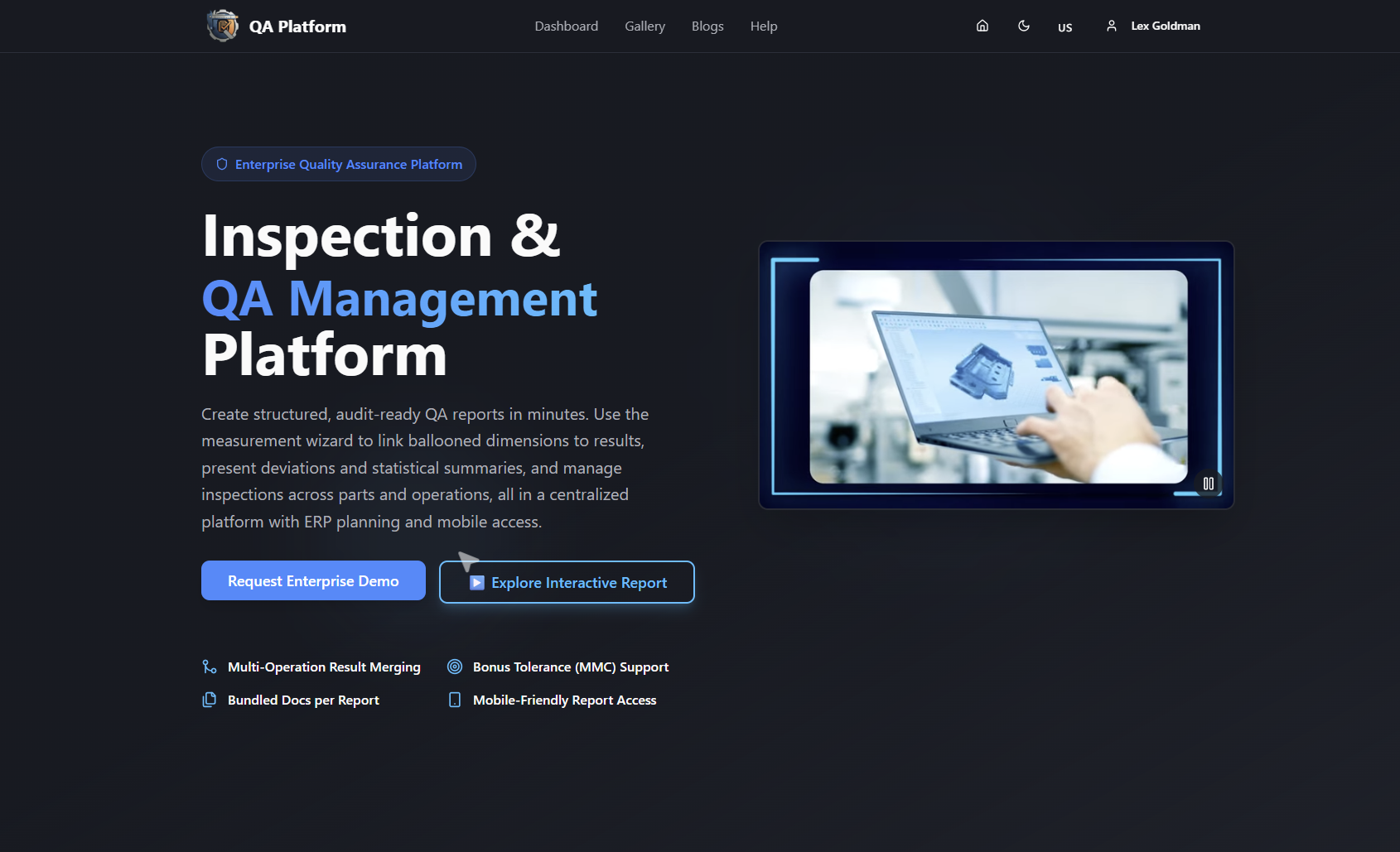
The platform's measurement wizard, CMM import, and revision-controlled drawing ballooning all sit behind the same role-and-scope logic described above, so a quality engineer scoped to one line can't accidentally edit master data on another. Teams that want to see this in practice can start with the Free plan or move directly to Basic at $49.99 per month or PRO at $149.99 per month once a pilot line proves the model out. Organizations with stricter data confidentiality needs can also ask about additional deployment options. Pick one line, scope a handful of roles, and run a real inspection cycle through QA-Report before deciding how far to roll it out.
Sources
For deeper technical and regulatory detail, consult IBM's overview of role-based access control implementation, Cisco's site-based RBAC guidance for industrial operations, and Concentric.ai's explanation of RBAC's role in data governance. QA-Report's own guide to scoping roles by plant, area, line, and cell walks through the same model with manufacturing-specific examples.
FAQ
What Is Role-Based Access Control in Manufacturing?
Role-based access control assigns system permissions to job functions, like operator or quality engineer, instead of to individual users. In manufacturing, it's most effective when paired with site scope, so the same role carries different rights depending on which plant, area, or line it applies to.
How Many Roles Should a Manufacturing Plant Have?
Most mid-market plants only need around six core roles covering operator, shift lead, maintenance, quality, production manager, and admin functions. Research on manufacturing RBAC suggests that exceeding roughly fifteen roles usually signals the system has been over-engineered.
What Is the Difference Between Role and Scope?
Role defines what actions a person can take, such as approving a nonconformance or editing a routing. Scope defines where those actions apply, whether that's a single cell, a line, an area, or an entire site, and the combination of the two determines actual access.
How Often Should Access Reviews Happen?
Access recertification typically happens quarterly or semi-annually depending on how sensitive the role is, with more frequent reviews for anyone holding approval or electronic-signature authority. Deprovisioning on termination or role change should happen immediately, not at the next scheduled review.
Does QA-Report Support Role-Based Shop-Floor Access?
QA-Report includes role-based shop-floor access as part of its integrated MES layer, letting teams scope permissions by role and production area. Pricing starts with a Free plan, with Basic and PRO tiers available for teams that need broader inspection and planning features.