AS9100 is ISO 9001 with roughly 100 aerospace-specific requirements added on top. If your organization supplies parts, assemblies, or services to an aerospace prime contractor or holds a position on a government contract, AS9100 certification is almost certainly required, not optional. ISO 9001 alone will not get you onto an Approved Supplier List (ASL) or through a Boeing, Lockheed Martin, or Airbus source qualification. AS9100 certification also confirms ISO 9001 compliance, so you never need both certificates separately.
Who typically needs AS9100:
- Aerospace manufacturers, machine shops, and MRO providers supplying flight-critical hardware directly to OEMs or primes
- Organizations seeking placement on OASIS (the IAQG's online supplier qualification database) or a prime contractor's ASL
- Suppliers whose customer purchase orders include AS9100 flow-down language or reference AS9100D compliance
Who can operate on ISO 9001 alone:
- Manufacturers supplying non-flight-critical commercial or industrial products with no aerospace customer flow-down
- Service organizations, distributors, or job shops whose aerospace work is incidental and whose customers have not mandated AS9100
The relationship between the two standards is structural: AS9100 incorporates ISO 9001 in full and extends it. Every clause of ISO 9001:2015 appears inside AS9100D. Achieving AS9100 certification means your QMS already satisfies ISO 9001.
Key Takeaways
AS9100 is the mandatory quality standard for aerospace suppliers: it incorporates all of ISO 9001:2015 and adds roughly 100 aerospace-specific requirements that auditors will verify on-site.
| Point | Details |
|---|---|
| AS9100 includes ISO 9001 | One AS9100D certificate satisfies both standards; no separate ISO 9001 certificate is needed. |
| Ticket to trade for aerospace | Without AS9100, your organization cannot appear in OASIS or qualify for most prime contractor Approved Supplier Lists. |
| Timeline to certify | Expect several months to over a year from scratch or a shorter timeline when transitioning from an existing ISO 9001 QMS. |
| Top audit risk areas | FAI records, key characteristic controls, supplier flow-down language, and counterfeit prevention procedures generate the most nonconformities. |
| QA-Report for audit readiness | QA-Report generates AS9102-compliant FAI reports, auto-balloons drawings, imports CMM data, and stores traceability records, reducing audit preparation time significantly. |
Table of Contents
- What does ISO 9001:2015 actually require?
- What AS9100 adds to ISO 9001 for aerospace work
- How AS9100 and ISO 9001 compare across key dimensions
- Understanding the aerospace-specific requirements in depth
- How to get certified: timelines, costs, and the audit process
- When should you choose AS9100 over ISO 9001?
- Your 30/90/180-day action plan for AS9100 certification
- The real challenge of AS9100 is not the paperwork
- QA-Report cuts the time between implementation and audit readiness
- Authoritative sources and further reading
What does ISO 9001:2015 actually require?
ISO 9001 is the world's most widely adopted quality management system standard, applicable to any industry and any organization size. The current revision, ISO 9001:2015, is built on seven quality management principles: customer focus, leadership, engagement of people, process approach, improvement, evidence-based decision making, and relationship management.
The standard's operative requirements run from Clause 4 through Clause 10. Clause 4 establishes organizational context and scope. Clause 5 addresses leadership and quality policy. Clause 6 covers planning and risk-based thinking. Clauses 7 and 8 govern support resources and operational controls. Clause 9 requires performance evaluation through internal audits and management review. Clause 10 drives continual improvement and corrective action.
What ISO 9001 does not explicitly require is worth noting for aerospace teams. The standard contains no mandate for First Article Inspection (FAI), no specific counterfeit parts prevention program, no configuration management process, and no formal key characteristics identification scheme. Those gaps are precisely where AS9100 steps in.
ISO 9001:2015 is certified to by over one million organizations in more than 170 countries, making it the most recognized quality credential in global manufacturing. For aerospace, it is the foundation, not the finish line.
What AS9100 adds to ISO 9001 for aerospace work
AS9100 Rev D (formally AS9100D, published in 2016 and aligned to ISO 9001:2015) is the current aerospace quality management standard. It is developed and maintained by the International Aerospace Quality Group (IAQG) and published through SAE International. The IAQG represents major aerospace manufacturers across the Americas, Europe, and Asia-Pacific sectors, which is why AS9100D carries global recognition across supply chains.
AS9100D contains the complete text of ISO 9001:2015 plus aerospace-specific requirements that address the unique risks of flight-critical production. The additions that matter most to suppliers include:
- First Article Inspection (FAI/AS9102): — A structured production process verification report, documented per AS9102, required before first production delivery and after significant process or design changes.
AS9100 certification demonstrates ISO 9001 compliance as well, so a single certificate covers both requirements for your customers.
How AS9100 and ISO 9001 compare across key dimensions
The table below maps the most decision-critical dimensions side by side. Use it to identify exactly where your QMS needs to grow if you are transitioning from ISO 9001.
| Dimension | ISO 9001:2015 | AS9100D |
|---|---|---|
| Industry scope | Any industry, any product or service | Aerospace, defense, and space supply chains |
| Mandatory aerospace requirements | None | FAI/AS9102, key characteristics, configuration management, product safety, counterfeit prevention, operational risk management |
| FAI / AS9102 documentation | Not required | Required before first delivery and after significant changes |
| Supplier management and flow-down | General supplier evaluation and monitoring | Mandatory flow-down, approved supplier lists, right-of-access, sub-tier controls |
| Audit focus areas | Process conformance, corrective action, customer satisfaction | All ISO 9001 areas plus FAI records, key characteristic controls, counterfeit prevention, configuration records |
| Regulatory / "ticket to trade" | Accepted broadly across industries | Required by most aerospace primes; OASIS visibility for supplier qualification |
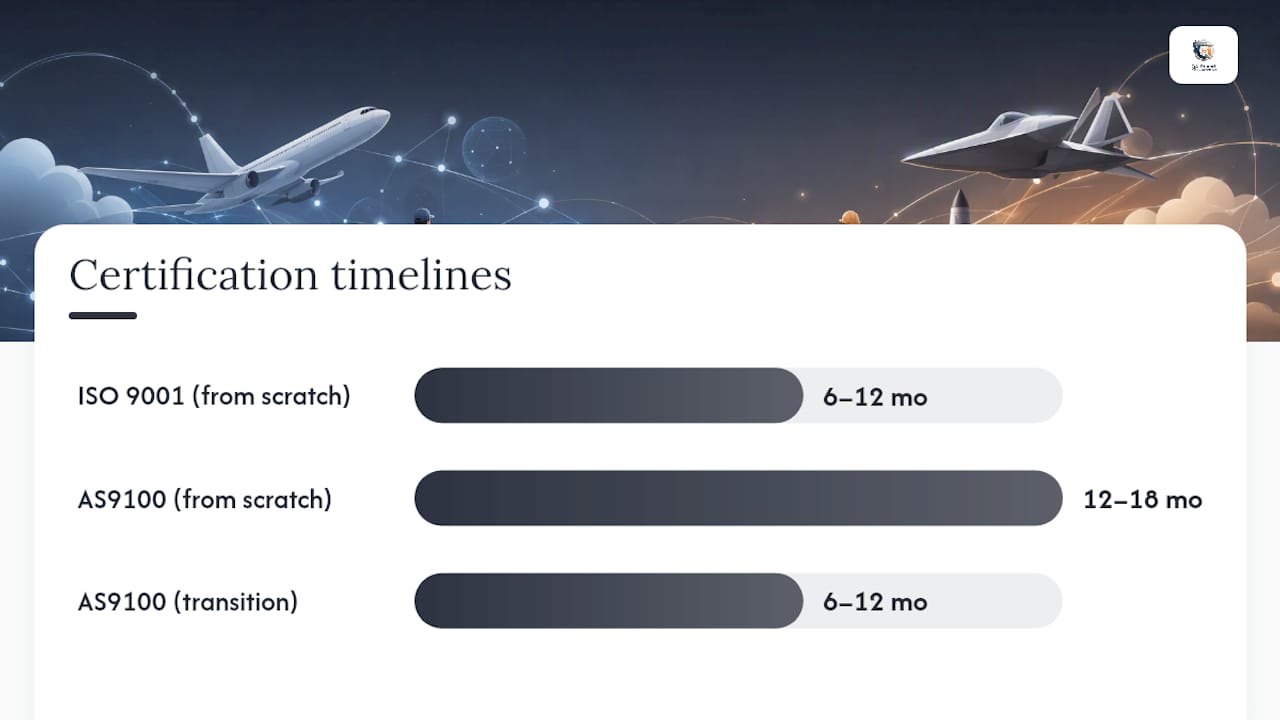
| Typical certification timeline | 6–12 months from scratch | 12–18 months from scratch; 6–12 months transitioning from ISO 9001 |
| Certification cost drivers | Audit days, site count, consultant support | Above, plus special processes (NADCAP), additional audit days for aerospace clauses |
The most impactful gaps for an aerospace supplier moving from ISO 9001 to AS9100 are:
- FAI discipline: — Most ISO 9001 shops have no formal AS9102-compliant FAI process. Building one from scratch is the single largest implementation task.
Prime contractors and government contracts routinely mandate AS9100 as a condition of award. OASIS, the IAQG's online supplier qualification database, is the primary tool procurement teams at Boeing, Airbus, and Raytheon use to verify supplier certification status. Without an active AS9100 certificate registered in OASIS, your organization is invisible to those qualification workflows.
Understanding the aerospace-specific requirements in depth
First Article Inspection and AS9102
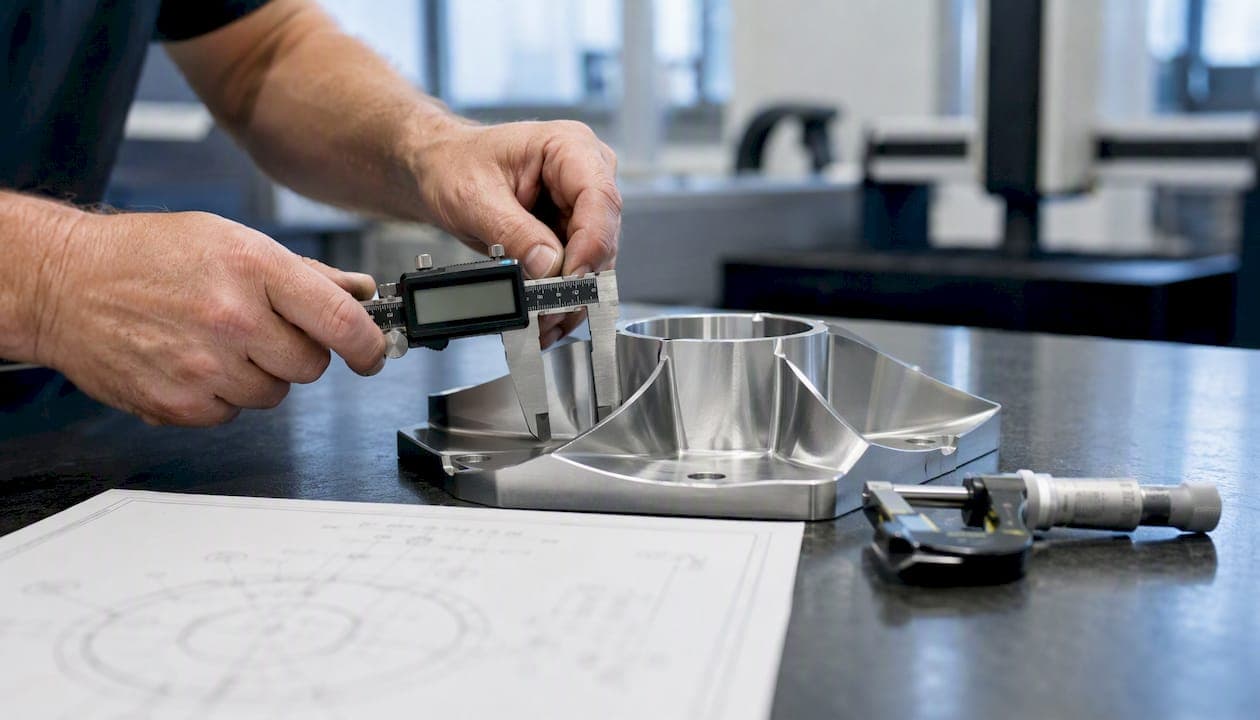
AS9102 defines the format and content of a First Article Inspection report. An FAI is required before the first production delivery of a new part number, and it must be repeated whenever there is a significant change to the design, manufacturing process, or supply chain. The report must document every drawing dimension, tolerance, and note, with measured results linked to each requirement and objective evidence of process capability.

Auditors look for complete balloon drawings that tie each characteristic to a measured result, material certifications, special process approvals, and functional test results where applicable. A free AS9102 FAI template can help your team structure these reports correctly before the audit.
Pro Tip: Map your FAI balloon numbers directly to your inspection records before the audit. Auditors frequently flag FAI packages where the balloon numbering on the drawing does not match the sequence in the measurement report, which creates traceability gaps that generate nonconformities.
Counterfeit parts prevention
Counterfeit electronic components and raw materials are a documented risk in aerospace supply chains. AS9100D requires a formal counterfeit parts prevention program covering procurement from authorized distributors, incoming inspection verification, MTR and certificate of conformance review, and a quarantine and reporting procedure for suspect parts. AS5553 provides the detailed technical requirements for counterfeit electronic parts specifically.
NASA's counterfeit parts training materials emphasize three controls auditors consistently look for: purchasing only from authorized sources, maintaining traceability records through the supply chain, and having a documented quarantine procedure with clear escalation steps. Your incoming inspection process is the last line of defense before a suspect part enters production.
Configuration management
Configuration management under AS9100 means more than keeping drawing revisions current. It requires a documented system for controlling changes to product design and manufacturing processes, tracking approved deviations and waivers, maintaining configuration status accounting records, and verifying that production is always running to the current approved configuration. Auditors will pull a sample of production travelers and cross-reference them against the current drawing revision and any active deviations. Gaps here generate major nonconformities.
Key characteristics and critical items
Key characteristics are features whose variation directly affects safety, fit, function, or regulatory compliance. AS9100 requires your team to identify them on drawings or control plans, define the inspection method and frequency, and maintain records demonstrating control. Critical items, a related concept, are those with specific safety or airworthiness implications requiring additional oversight. Both require documented control plans, not just a note on the drawing.
Supplier controls and flow-down
Supplier quality management under AS9100 goes well beyond ISO 9001's general supplier evaluation. Your QMS must maintain an approved supplier list with defined criteria for entry and removal, flow down applicable AS9100 requirements to sub-tier suppliers, and retain evidence of that flow-down in purchase order language. Right-of-access clauses, allowing your customer and regulatory authorities to audit your suppliers, must appear in your supplier agreements. Auditors routinely request a sample of purchase orders to verify flow-down language is present and specific.
How to get certified: timelines, costs, and the audit process
The certification pathway
Certification to AS9100D follows a structured sequence. A gap analysis against the current standard identifies where your QMS falls short. Implementation closes those gaps through procedure development, training, and process changes. A Stage 1 documentation review (typically conducted remotely) confirms your QMS documentation is complete and ready for on-site assessment. The Stage 2 on-site audit evaluates whether your documented processes are actually operating as described. Surveillance audits follow annually, with a full recertification audit every three years.
Timelines and cost drivers
Organizations starting from scratch typically need 12–18 months to reach certification. Teams already holding ISO 9001 certification can often close the gap in 6–12 months, since the QMS foundation is already in place and the work focuses on the aerospace-specific additions. Cost drivers include the number of audit days (determined by site size and scope), the number of physical locations, consultant support for gap analysis and implementation, and any NADCAP accreditation requirements for special processes such as welding, heat treating, or non-destructive testing.
Registrar selection is not optional. Only IAQG-authorized certification bodies may issue AS9100 certificates that are recognized in OASIS. Verify your registrar's IAQG authorization before signing any certification agreement — a certificate from an unauthorized body has no value in aerospace procurement.
What auditors commonly request
Auditors conducting AS9100 Stage 2 assessments consistently pull evidence in these areas:
- Complete FAI packages (AS9102) for current production part numbers, including balloon drawings and measured results
- Configuration records: current drawing revisions, approved deviations, and change control logs
- Supplier flow-down evidence: purchase orders with AS9100 requirements explicitly stated
- Counterfeit prevention records: authorized distributor lists, incoming inspection records, and suspect-part quarantine logs
- Key characteristic control plans and measurement records
- Internal audit records and management review minutes covering aerospace-specific clauses
- Corrective action records for any previous nonconformities
Industry auditors flag inadequate FAI records, missing key-characteristic controls, weak supplier flow-down, and insufficient counterfeit prevention measures as the most frequent sources of nonconformities on AS9100 assessments.
When should you choose AS9100 over ISO 9001?
The decision is usually made for you by your customer base, but the criteria below help clarify the logic.
Choose AS9100 when:
- Your products are flight-critical components, assemblies, or systems
- A prime contractor or OEM requires AS9100 as a condition of award or supplier qualification
- Your purchase orders include AS9100 flow-down language
- You want visibility in OASIS for aerospace procurement teams
- You supply to both commercial aerospace and defense markets
ISO 9001 is sufficient when:
- Your products are commercial or industrial with no aerospace customer flow-down
- No customer contract references AS9100 compliance
- Your aerospace work is a small fraction of revenue and no prime has mandated the standard
Readiness checklist before pursuing AS9100:
- Document control system is current and version-controlled
- A formal FAI process exists or is being built to AS9102
- Supplier traceability records (MTRs, certificates of conformance) are retained and retrievable
- Key characteristics are identified on drawings or control plans
- Counterfeit prevention procedures are documented and trained
- Internal audit program covers all QMS clauses
- Management review addresses quality objectives and resource adequacy
Hybrid scenarios: Many suppliers serve both aerospace and commercial customers. A single AS9100 QMS can serve both, since AS9100 satisfies ISO 9001 requirements. The aerospace-specific procedures (FAI, counterfeit controls, configuration management) apply to aerospace work orders; commercial work runs on the same QMS with those controls applied proportionally to risk. This is more efficient than maintaining two separate systems.
Specialty component suppliers, including those providing aerospace glass solutions for optical or structural applications, face the same flow-down requirements and benefit from the same hybrid approach.
Your 30/90/180-day action plan for AS9100 certification
30-day quick wins
- Assign a quality manager as the AS9100 implementation lead with defined authority and time allocation
- Commission a formal gap analysis against AS9100D, documenting every clause gap with an owner and target date
- Identify all key characteristics on current production drawings and flag those without documented control plans
- Download or build an AS9102-compliant FAI template and run a pilot FAI on your highest-volume part number
- Audit your supplier list: verify which suppliers hold AS9100 or ISO 9001 certification and which do not
90-day medium-term tasks
- Implement configuration management procedures: drawing revision control, deviation/waiver tracking, and change control logs
- Train procurement on counterfeit parts prevention: authorized distributor requirements, incoming verification steps, and suspect-part handling
- Update purchase order templates to include AS9100 flow-down language for all aerospace suppliers
- Complete a full internal audit cycle covering all AS9100 clauses, not just the ISO 9001 baseline
- Conduct a management review that explicitly addresses aerospace-specific quality objectives and resource gaps
180-day longer-horizon tasks
- Close all major nonconformities identified in the gap analysis and internal audits with verified corrective actions
- Run a mock Stage 2 audit using an experienced lead auditor or consultant to identify remaining gaps under audit conditions
- Select and contract an IAQG-authorized registrar; confirm audit day estimates and scheduling
- Verify NADCAP requirements for any special processes in your scope and initiate accreditation if needed
- Register your organization in OASIS once certification is achieved
Transitioning from ISO 9001 to AS9100 in the 6–12 month window is achievable when the gap analysis is honest and the implementation is resourced properly. The teams that miss that window typically underestimate the FAI build-out and the supplier flow-down documentation effort.
The real challenge of AS9100 is not the paperwork
Most quality managers approaching AS9100 for the first time assume the hard part is documentation. Write the procedures, fill in the templates, pass the audit. That framing is understandable, but it misses where most implementations actually break down.
The documentation is the easy part. The hard part is getting your procurement team to actually verify authorized distributor status before placing an order, getting your production engineers to treat key characteristic control plans as living documents rather than one-time submissions, and getting your suppliers to understand that flow-down language in a purchase order is not a formality. AS9100 is a cultural change as much as a procedural one. Lead auditors consistently note that the organizations that struggle most are those that treat the standard as a compliance exercise rather than an operating discipline.
There is also a practical observation worth making about inspection software. Teams that try to manage FAI records, balloon drawings, and CMM data in spreadsheets and shared drives spend a disproportionate amount of their audit preparation time just locating and formatting evidence. That is time that should be spent verifying the substance of the records, not assembling them. The inspection documentation practices your team builds during the AS9100 transition will either accelerate every future audit or create recurring friction. The choice of tooling matters more than most implementation plans acknowledge.
AS9100 is worth pursuing beyond the contract requirement. The discipline it imposes on configuration management, supplier controls, and FAI traceability makes production more predictable and defect escape rates lower. The certificate is the outcome; the operating discipline is the value.
QA-Report cuts the time between implementation and audit readiness
Preparing AS9100-compliant FAI packages manually, managing balloon drawings in PDF editors, and chasing CMM data across shared drives are the three tasks that consume the most time during an AS9100 transition. QA-Report is built to eliminate exactly that friction.
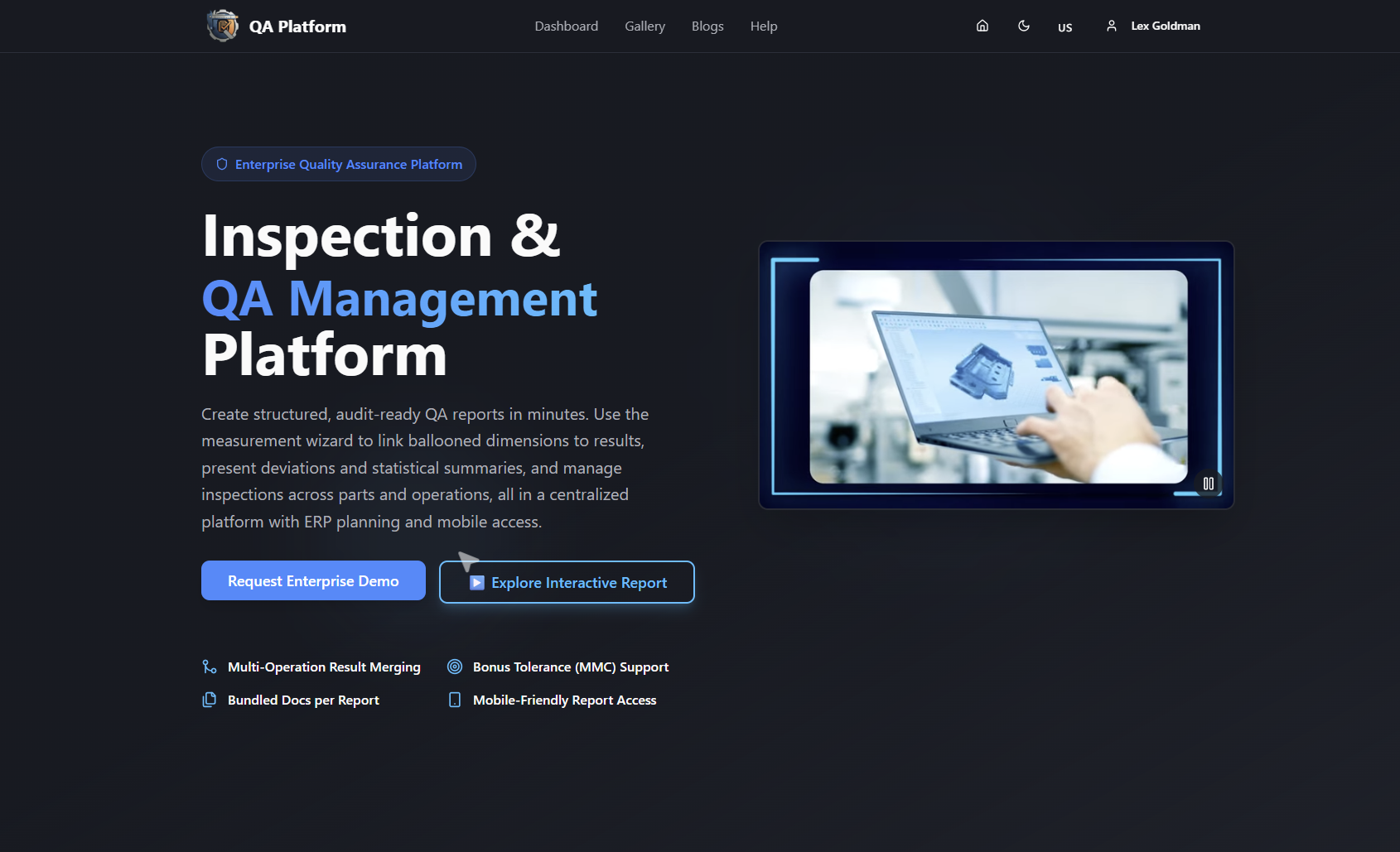
The platform generates audit-ready AS9102 FAI reports with automatic drawing ballooning, CMM data import, and out-of-tolerance flagging in minutes rather than hours. Every measured result links directly to its ballooned characteristic, creating the traceability chain auditors require. Material certifications and supplier records attach to the part record, so your counterfeit prevention and MTR documentation is centralized and retrievable on demand. The MES layer tracks production by batch and serial number, supporting the configuration status accounting AS9100 requires.
Teams using QA-Report arrive at Stage 2 audits with complete, formatted FAI packages and traceable inspection records already organized. Start a free trial at qa-report.com and see how quickly your team can build audit-ready documentation.
Authoritative sources and further reading
The full text of AS9100D and related standards must be purchased from the issuing bodies. Below are the primary sources for official documents and guidance:
- AS9100 vs ISO 9001: differences
- AS9100 — SAE International standards
- NASA counterfeit parts training handout
- AS9100 vs ISO 9001: Aerospace Quality Standards Explained
- AS9100 vs ISO 9001: Key Differences 2026
- International Aerospace Quality Group (IAQG)
Purchasing the full standard text from SAE or ISO is required for implementation. Summaries and guides are useful for orientation, but your QMS procedures must reference and comply with the actual standard language.