
ERP quality integration creates a digital thread connecting orders, materials, inspections, and nonconformance records into one traceable system, producing audit-ready evidence and faster corrective action. The recommended approach uses native ERP quality modules where they meet your inspection needs, and falls back to an API or middleware pattern with disciplined master-data governance when they do not. Done well, integration reduces manual handoffs between systems and shortens the path from a detected defect to a closed CAPA.
TL;DR:
- Native ERP modules offer quick integration but may lack advanced inspection features like GD&T or CMM data import.
- Proper mapping of core workflow points such as receiving, in-process, and lot traceability is essential to sustain audit trail integrity.
- Choosing the right architecture depends on inspection complexity and data volume, with security built in from the start to prevent costly retrofitting.
- Validation and measurement of KPIs like CAPA closure time and defect escape rate are crucial for confirming value post-implementation.
- Avoid common pitfalls such as shared logins, poor master-data governance, and big-bang rollouts to ensure a reliable and compliant digital thread.
Table of Contents
- What ERP-QMS integration means and why it pays off
- Core integration points and workflows to connect
- Choosing an architecture: native modules, middleware, or MES
- What auditors expect and how integration design meets it
- Building the implementation roadmap
- Validating the integration and measuring what matters
- Common pitfalls and how to avoid them
- Mapping inspection and MES capabilities to the digital thread
- Getting your team through the transition
- Migrating data without losing consistency
- Evaluating integration vendors and solutions
- Leadership priorities for a digital thread project
- How QA-Report fits into your integration plan
- Where to go for deeper guidance
- Sources
- FAQ
What ERP-QMS integration means and why it pays off
ERP quality integration links your quality management system to enterprise resource planning so that inspection results, nonconformances, and corrective actions flow through the same digital thread as purchase orders, work orders, and inventory transactions. Instead of an inspector recording results in one system and a quality engineer re-entering them into another, the data moves once and stays connected to its source.
The financial case rests on three drivers. Manual re-entry between disconnected systems introduces transcription errors that surface later as scrap, rework, or, worse, a shipped nonconformance. Corrective actions move faster when a CAPA can trace directly back to the receiving inspection or work order that triggered it, rather than requiring an engineer to reconstruct the sequence from separate logs. Audits go smoother when a single system, rather than a patchwork of spreadsheets and disconnected databases, can produce the full history of a part.
Consider a supplier audit where an assessor asks for the inspection history of a specific lot going back eighteen months. In a disconnected environment, that request means pulling records from the ERP, the quality system, and possibly a shared drive of PDFs. In an integrated environment, it means running one report.
- Fewer transcription errors between inspection and inventory systems
- Faster CAPA initiation because nonconformance data is already linked to the triggering event
- Simplified audit response, since one system holds the full chain of custody
- Reduced duplicate data entry across quality and production teams
Core integration points and workflows to connect
A working integration touches specific points in the production and quality process. Mapping these correctly, before writing a single connector, determines whether the resulting system holds up under audit scrutiny.
- Receiving inspections: tie inspection results to the purchase order and goods receipt so that accepted, rejected, or conditionally released material updates inventory status automatically.
- In-process inspection: link results to the production order so that a usage decision, whether to proceed, hold, or scrap, is recorded against the specific operation and lot.
- Lot and serial traceability: connect material batch to inspection record to finished good, so a single serial number can be traced backward through every inspection it passed.
- Supplier quality events: feed rejection and deviation data back into the vendor master and purchasing workflows, so supplier scorecards update without manual tallying.
- CAPA triggers: configure event-driven rules so that a rejection, return, or failed inspection automatically opens a corrective action record rather than waiting for someone to notice a pattern.
The digital thread concept applies directly here: each of these five touchpoints is a link in a chain that, if broken, leaves a gap an auditor will find. A single missing connection, say, a supplier rejection that never updates the vendor master, undermines the traceability the rest of the system provides.
Pro Tip: Map your event triggers before you map your data fields. Knowing which ERP event should fire a CAPA matters more, at the design stage, than knowing which database column stores the defect code.
Choosing an architecture: native modules, middleware, or MES
The architecture decision shapes cost, maintainability, and how defensible your records are under audit. Four patterns cover most manufacturing environments.
- Native QMS/ERP modules integrate fastest since the data model already exists inside the ERP, but they can lack specialized inspection features like GD&T measurement mapping or CMM data import.
- Packaged eQMS with a certified connector offers a middle ground, keeping specialized inspection functionality while relying on a vendor-supported integration to the ERP.
- API-first and middleware patterns use canonical data models and event-driven messaging, or in older environments, an enterprise service bus or scheduled ETL jobs, to move data between systems that were never designed to talk to each other.
- MES as an intermediary layer makes sense for high-frequency shop-floor data. Routing dimensional measurements and operator entries through an MES before they reach the ERP avoids overwhelming the ERP with transaction volume it was not built to handle, a point echoed in NIST's assessment of digital thread architectures, which recommends targeted use of high-integrity ledgers rather than routing every shop-floor event through the core system of record.
Choosing between these patterns often comes down to how specialized your inspection needs are and whether shop-floor data volume would strain your ERP directly. Deciding when to route data through MES versus a direct QMS/ERP connection is worth resolving before development starts, not after.
Whichever pattern you choose, security has to be designed in from the start: unique authenticated logins, encrypted data in transit and at rest, and logging that captures who changed what and when. Retrofitting security controls onto a live integration is far more expensive than building them in from day one.
What auditors expect and how integration design meets it
Auditors reviewing an integrated quality system look for three things above all: contemporaneous records, unique attribution to the person who created or changed them, and an audit trail that cannot be altered after the fact.
The regulatory landscape sets specific expectations here. The FDA's Quality Management System Regulation, effective February 2, 2026, aligns device CGMP requirements under 21 CFR Part 820 with ISO 13485:2016, changing how inspection processes and electronic records are evaluated during audits. Integrations built for medical device manufacturers need to account for this alignment, not treat ISO 13485 and CGMP as separate compliance tracks.
FDA guidance on data integrity is specific about what this means in practice: systems must restrict the ability to alter specifications to authorized personnel only, administrator roles must be separate from the people who own the records, and audit trails and contemporaneous electronic saving are required for CGMP records.
Translated into integration design, that guidance produces concrete rules:
- Every inspection result, usage decision, and corrective action carries a timestamp and a unique user ID, never a shared login.
- Audit logs are immutable and exportable, not editable fields in a shared spreadsheet.
- System administrator access is separated from the roles that create or approve quality records.
- Document and change control workflows stay synchronized across the ERP and QMS, so a revised drawing or specification updates in both systems at once.
A canonical, standardized data model reduces the brittle point-to-point mappings that break during system upgrades, according to NIST's manufacturing supply chain roadmap, which identifies data silos and inconsistent semantics as leading barriers to reliable digital thread adoption. Investing in that canonical model early costs more up front and saves considerably more later.
Electronic signatures deserve particular attention in this context, since they are frequently the weakest link in an otherwise well-designed integration. A practical guide to electronic signature compliance is worth reviewing before finalizing your access control design.
Building the implementation roadmap
A successful integration project follows a sequence, and skipping steps to save time early almost always costs more time later.
- Align stakeholders and scope the project: identify which plants, product lines, and ERP modules are in scope before any technical work begins.
- Clean up master data: part numbers, supplier codes, and specification revisions need to match across systems, or every downstream mapping inherits the mismatch.
- Build canonical data mappings: define how a field in the QMS corresponds to a field in the ERP, documented once, referenced everywhere.
- Test in stages: move through a staging environment, then system integration testing, then user acceptance testing (UAT), with a software acceptance review (SAR) documenting that acceptance criteria were met before go-live.
- Roll out in phases: start with one plant or product line, validate the results, then extend.
Cost and timeline pressure tends to concentrate in three places: master-data cleanup that turns out to be larger than expected, legacy ERP systems with limited or undocumented APIs, and regulatory validation work for regulated industries where every test case needs documented evidence.
Change management runs alongside every technical step. Training needs to start before go-live, not after, and it needs to cover why the workflow changed, not just how to click through the new screens.
Pro Tip: Budget master-data cleanup as its own project phase with its own timeline. Teams that fold it into "integration development" consistently underestimate how long it takes.
Validating the integration and measuring what matters
Validation before go-live and measurement after go-live are both required, and they answer different questions: does the data move correctly, and is the integration delivering value.
Validation checklist items include data fidelity checks (does a value entered in the QMS arrive unchanged in the ERP), reconciliation reports comparing record counts between systems, and audit trail tests confirming that every change captures a timestamp and a user ID.
Once live, track a small set of KPIs rather than a large dashboard nobody reviews:
- CAPA closure time, from trigger to verified closure
- Inspection throughput, units inspected per shift or per inspector
- Defect escape rate, nonconformances found after release rather than before
- Audit response time, how long it takes to produce a requested record set
- Rework and scrap rates, tracked by cause code where the integration supports it
Data integrity and governance failures are among the most common causes of integration project failure, per NIST's digital thread roadmap, which points to data silos and inconsistent semantics as recurring adoption barriers. Sampling a subset of records monthly against source documents catches integration drift before it becomes an audit finding.
Common pitfalls and how to avoid them
Most integration failures trace back to a handful of repeated mistakes rather than exotic technical problems.
- Shared logins undermine every audit trail claim you make. Enforce unique user accounts and separate administrator roles from record owners from the start.
- Skipping master-data governance guarantees repeated integration breakage. Clean, canonical data mapped once prevents the same mismatch from recurring at every upgrade.
- Stripping inspection context during export destroys the evidence an auditor needs. Ballooned drawing references, operator identity, and fixture or instrument calibration IDs need to travel with the measurement data, not get left behind in the source system.
- Big-bang rollouts multiply risk. A phased approach starting with one pilot plant surfaces problems while they are still small and cheap to fix.
Mapping inspection and MES capabilities to the digital thread
Software that already implements these controls shortens the path from plan to pilot. A measurement wizard that links ballooned drawing dimensions to measured results and auto-flags out-of-tolerance deviations preserves exactly the kind of inspection evidence, drawing reference, measured value, and pass or fail decision, that auditors ask for when reviewing a usage decision. CMM data import can bring machine-measured results into the same record without manual transcription, closing one of the more common sources of data entry error.
An integrated MES layer can manage route cards, batch and operation tracking, and rejection and recovery data, feeding the kind of production-linked information that a receiving or in-process inspection workflow needs to stay connected to the ERP side of the digital thread.
- Ballooned drawings and CMM import preserve measurement context at the point of capture
- Auto-flagging of out-of-tolerance results reduces reliance on manual review to catch deviations
- Route cards and rejection tracking in the MES layer supply production context back to inspection records
A reasonable pilot scope starts with mobile inspection capture on a single line, validates that audit logs capture user attribution correctly, then extends to supplier quality events once the core workflow is proven.
Getting your team through the transition
Change management determines whether an integration succeeds as much as the technical architecture does. Inspectors and quality engineers who have worked a certain way for years will resist a new system if they do not understand why it changed or how it makes their job easier, not harder.
Start training before go-live, using real inspection scenarios from your own production line rather than generic vendor demos. People retain a workflow better when it matches the parts and defects they actually see. Identify a small group of power users on the shop floor early and let them test the system before the full rollout. Their feedback catches usability problems a project team sitting in a conference room will miss, and their advocacy carries more weight with peers than a memo from management.
Communicate the reason for the change clearly: fewer duplicate data entries, faster answers when a customer asks about a lot, less time spent hunting for paperwork during an audit. Framing the integration as something that removes friction from an inspector's day, rather than as a compliance mandate imposed from above, changes how readily people adopt it.
Phase the rollout by plant or product line, and treat the first phase as a learning exercise. Document what broke, what confused people, and what took longer than expected, then apply those lessons before extending to the next phase. A rollout plan that assumes the first phase will go exactly as designed rarely survives contact with a real shop floor.
Migrating data without losing consistency
Data migration is where many integration projects run into trouble, because it exposes years of inconsistent part numbering, duplicate supplier records, and specification revisions that were never properly retired.
Start by auditing your existing data before migration begins, not during it. Identify duplicate records, orphaned references, and fields that have been used inconsistently across departments. A part number that means one thing in the ERP and something slightly different in a legacy spreadsheet will cause mapping errors that surface weeks after go-live, usually during an audit rather than during testing.
Migrate in stages rather than all at once. Move master data first (parts, suppliers, specifications), validate it, then migrate transactional data (inspection records, CAPA history) once the master data is confirmed correct. Running both in parallel multiplies the number of places an error can hide.
Reconciliation reports comparing record counts and key field values between the source and target systems catch migration errors before they become production problems. Run these reports after every migration batch, not just once at the end.
Keep a rollback plan ready for the migration itself, separate from the rollback plan for the integration as a whole. A failed migration batch that corrupts master data is a different kind of problem than an integration that fails to fire a CAPA trigger, and it needs its own recovery path.
Evaluating integration vendors and solutions
Selecting a vendor or platform for ERP quality integration comes down to a short list of criteria that matter more than feature checklists.
Ask whether the vendor supports your specific ERP through a certified connector or a documented API. SAP's own documentation on integrating ERP quality management with external inspection engines illustrates the level of technical detail, inspection lot origins, sample-type mappings, and required BAdI implementations, that a genuinely supported integration needs. A vendor who cannot speak to this level of detail for your ERP is asking you to build custom middleware from scratch.
Confirm regulatory alignment for your industry. A medical device manufacturer needs a vendor whose reporting satisfies ISO 13485 documentation requirements and the FDA's updated QMSR expectations; an automotive supplier cares more about PPAP and AS9102-style reporting formats.
Check deployment flexibility. Some organizations, particularly in defense or medical device manufacturing, need on-premise or hybrid deployment for data confidentiality reasons rather than a purely cloud-based platform.
Finally, evaluate how the vendor handles measurement data specifically: does it import CMM output directly, does it preserve ballooned drawing references, and does it auto-flag out-of-tolerance results, or does someone still need to review every measurement by hand.

Leadership priorities for a digital thread project
The integration projects that succeed treat compliance gaps as the starting point, not an afterthought layered on at the end. If your current audit response takes days because records live in three disconnected systems, that gap should top the roadmap, ahead of features that are merely convenient.
Digital thread projects are organizational change wearing a technical disguise. The connectors and data mappings matter, but the people who will maintain them, and the governance that keeps master data clean, determine whether the integration still works in three years.
— Michael Chen
How QA-Report fits into your integration plan
Building a compliant digital thread does not require replacing your ERP or writing custom middleware from scratch. QA-Report handles the inspection side of the equation directly: automatic drawing ballooning, CMM import, tolerance validation, and audit-ready PDF reports that satisfy ISO 9001, AS9100, and PPAP requirements, all generated in one platform rather than assembled from spreadsheets after the fact.
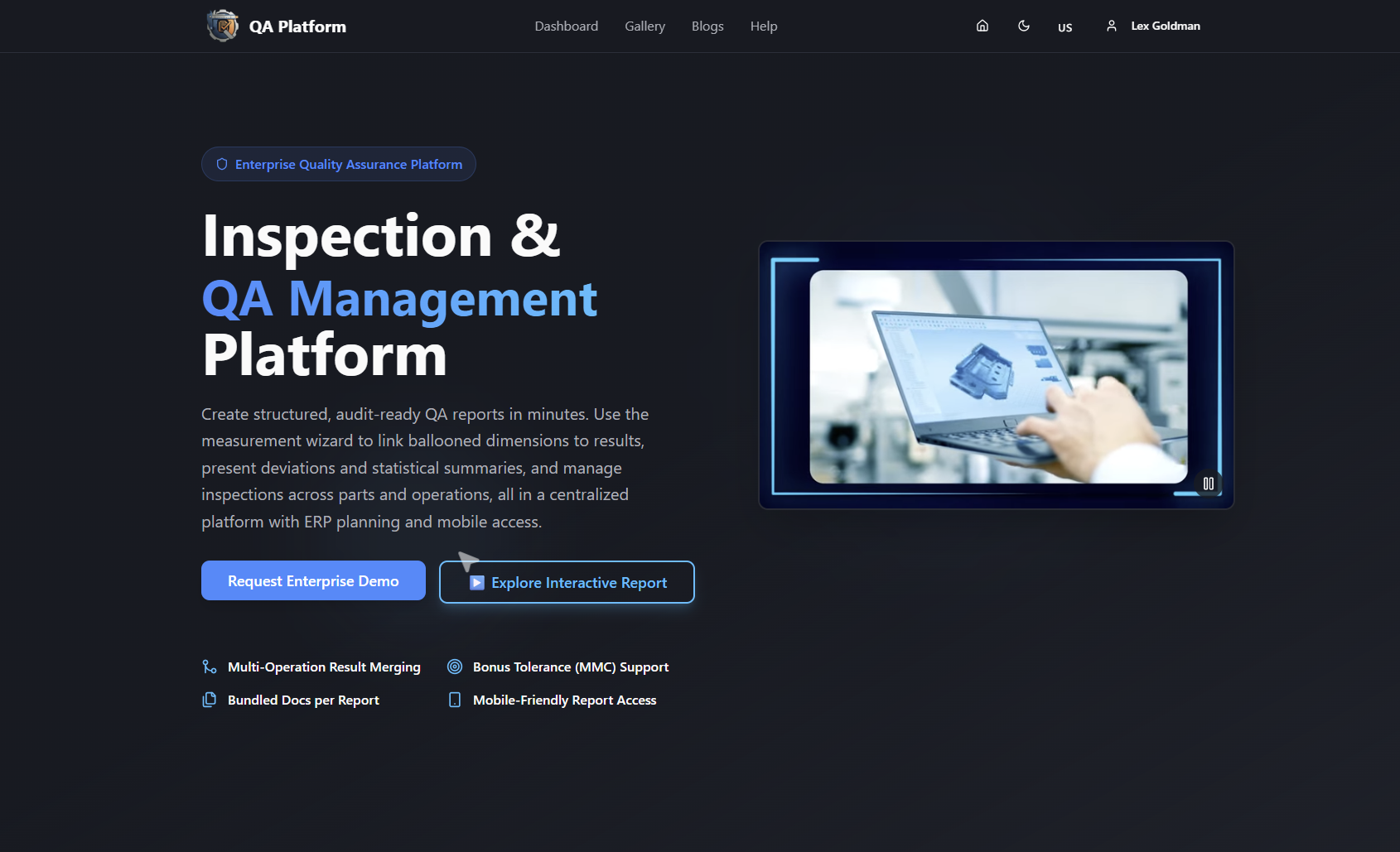
The integrated MES layer adds route cards, kanban and Gantt planning, and rejection and recovery tracking, giving your ERP the production and quality context it needs without a separate system to maintain. For teams evaluating a starting point, a single-line pilot covering receiving inspections is a practical scope: small enough to validate quickly, concrete enough to show whether the audit trail and reporting hold up under real use.
The vendor offers a Free plan and paid tiers including Basic and PRO monthly subscriptions, alongside On-Premise and Enterprise Solutions for organizations that need dedicated deployment. Full details are on the pricing page, and the product overview walks through the ballooning, CMM import, and MES features in more depth before you commit to a trial.
Where to go for deeper guidance
For regulatory detail, start with the FDA's QMSR page and its data integrity guidance. For architecture and governance, NIST's digital thread roadmap and its reference model on securing product data cover standardization and provenance. For implementation patterns, SAP's QM-QIE integration documentation shows concrete technical steps. Supplier quality teams working with finishing processes may also find industry standards for coating testing and certification useful as a practical reference point.
Sources
- Quality Management System Regulation (QMSR) | FDA
- Roadmap to Strengthen the U.S. Manufacturing Supply Chain via Digital Thread Technology
- Securing the Digital Thread for Smart Manufacturing: A Reference Model for Blockchain-Based Product Data Traceability
FAQ
What is ERP integration?
ERP integration connects an enterprise resource planning system to other business systems, such as a quality management system, so data flows automatically between them instead of requiring manual re-entry. In a quality context, this means inspection results, nonconformances, and corrective actions stay linked to the purchase orders, work orders, and inventory records they relate to.
Can you give an example of ERP-QMS integration?
A common example is linking receiving inspection results to a purchase order and goods receipt, so that a rejected lot automatically updates inventory status and notifies purchasing without a separate manual step. Another is an event-driven CAPA trigger, where a failed in-process inspection in the QMS automatically opens a corrective action record tied to the specific production order in the ERP.
What are the four types of ERP?
ERP systems are generally categorized by deployment and scope: on-premise, cloud-based, hybrid, and industry-specific or open-source systems built for particular sectors. The right category depends on factors like data confidentiality needs, existing infrastructure, and industry-specific compliance requirements such as those covered by ISO 13485.
What are the five ERP modules?
Definitions vary by vendor, but a common set of core ERP modules includes finance and accounting, procurement, inventory and materials management, production or manufacturing, and human resources. Quality management is sometimes included as a sixth core module or delivered as an integrated add-on, depending on the ERP platform.
How does ERP quality integration improve compliance?
Integration improves compliance by creating a single, traceable record connecting inspections, materials, and corrective actions, which satisfies auditor expectations for contemporaneous, attributable records under frameworks like the FDA's QMSR. It also reduces the risk of gaps or inconsistencies that arise when quality data lives in disconnected spreadsheets or standalone systems.