The Production Part Approval Process defines five submission levels — Level 1 through Level 5 — and the single most important rule every supplier must internalize: the customer specifies the required level, and you must complete all 18 PPAP elements regardless of which level is declared. The level only controls what gets submitted to the customer; it never reduces your internal documentation obligation.
Here is what each level means at a glance:
- Level 1: Part Submission Warrant (PSW) only submitted to the customer; all supporting data retained at the supplier.
- Level 2: PSW plus physical sample parts and a limited subset of supporting data submitted.
- Level 3: PSW, sample parts, and the complete 18-element data package submitted — the default for new parts and tooling changes.
- Level 4: Customer-specified requirements; the customer defines exactly what to submit.
- Level 5: Full submission package reviewed on-site at the supplier's facility during a customer audit.
Level 3 is the most common submission level across automotive supply chains because it gives customers full visibility into process capability without requiring an on-site visit. If your customer has not specified a level, do not assume Level 1 — confirm in writing before you begin.
Pro Tip: Before starting any PPAP, request the customer's PPAP requirements document or purchase order notes. Customers sometimes specify the level in a supplier quality manual rather than on the drawing itself, and missing that reference is one of the most avoidable causes of resubmission.
Key Takeaways
All five PPAP submission levels require suppliers to complete all 18 PPAP elements internally; the level only determines which documents are physically submitted to the customer.
| Point | Details |
|---|---|
| Customer sets the level | Never self-select a submission level; confirm the required level in writing before starting. |
| All 18 elements are mandatory | Completing every element is required regardless of level; only the submission scope changes. |
| Level 3 is the default | New parts and tooling changes almost always require a full Level 3 package with PSW, samples, and complete data. |
| PSW requires authorized signature | The Part Submission Warrant must be signed by a representative with authority to bind the organization. |
| QA-Report for PPAP prep | QA-Report automates ballooning, CMM import, MSA calculation, and document management to reduce Level 3 preparation time significantly. |
Table of Contents
- What is PPAP and when does your customer require it?
- How each PPAP level works in practice
- The 18 PPAP elements: your complete checklist
- Who decides the PPAP level, and how should you prepare?
- How structured QA software reduces PPAP errors and rework
- What quality managers get wrong about PPAP levels
- QA-Report cuts PPAP preparation time from days to hours
- Sources
What is PPAP and when does your customer require it?
The Production Part Approval Process is the formal method automotive and manufacturing customers use to verify that a supplier's production process can consistently produce parts meeting all engineering requirements. The Automotive Industry Action Group (AIAG) is the authoritative governing body for PPAP in the United States, and its PPAP manual — currently in its fourth edition — defines the five submission levels, all 18 required elements, and the acceptance criteria customers apply.
PPAP is typically required in the following situations:
- A new part or product is being introduced into production.
- An existing part undergoes an engineering change (drawing revision, material change, or tolerance update).
- The production location, tooling, or manufacturing process changes.
- A supplier change occurs anywhere in the supply chain.
- A part is classified as safety-critical or has a regulatory compliance requirement.
- Production was interrupted for an extended period (often 12 months or more, depending on customer requirements).
Every PPAP submission, regardless of level, includes a Part Submission Warrant (PSW). The PSW is a standardized form that summarizes the submission, identifies the part, lists the applicable drawing revision, and carries the authorized signature of a supplier representative. Think of the PSW as the cover sheet that makes the entire package official — without it, no submission is complete. Professional bodies including SAE International and ASQ provide supporting guidance on capability indices and measurement system analysis practices that feed directly into PPAP documentation. For a broader look at how PPAP fits into your overall quality assurance process, the intersection with ISO 9001 and AS9100 is worth understanding before your first submission.
How each PPAP level works in practice
Customers normally specify the submission level, and suppliers should never self-select. That said, understanding exactly what each level demands lets you prepare the right package, set realistic timelines during quoting, and have an informed conversation with your customer when the level seems disproportionate to the change involved.
Level 1: PSW only
The supplier submits only the signed PSW. All supporting documentation — dimensional results, material certifications, capability studies — is completed and retained at the supplier facility but never sent to the customer unless requested. Level 1 is typically reserved for bulk materials, catalog items, or parts with a long, stable production history where the customer has high confidence in the supplier's process. Do not mistake "PSW only" for "minimal work." Every one of the 18 elements still needs to be completed and filed internally.
Level 2: PSW, samples, and limited data
The supplier submits the PSW, physical sample parts, and a limited subset of supporting documentation. Customers choosing Level 2 typically want dimensional results for key characteristics and material certifications, but not the full capability study or complete control plan. It is a middle ground often used for minor engineering changes to established parts.
Level 3: PSW, samples, and the complete data package
Level 3 requires the PSW, physical sample parts, and complete supporting data for all 18 elements. Two items — the master sample and checking aids — are typically retained at the supplier rather than shipped to the customer, but they must be available for audit at any time. This is the default level for new parts and tooling changes across most automotive programs, and it gives customers the clearest picture of process capability without requiring an on-site visit. If your customer has not specified a level, Level 3 is the safest assumption.
Level 4: Customer-specified requirements
Level 4 has no fixed content list. The customer defines exactly which elements to submit, and those requirements must be documented in writing — typically in a supplier quality manual, a purchase order, or a formal PPAP requirements form. Before preparing a Level 4 package, get the customer's specific list in writing and confirm it. Verbal agreements create resubmission risk.
Level 5: Full package with on-site review
Level 5 requires the complete 18-element submission package, but the review happens at the supplier's facility. A customer representative or audit team visits the shop floor to verify that the production controls, checking aids, master samples, and process documentation are physically present and match the submitted records. Level 5 is typically reserved for safety-critical or high-complexity parts where the customer needs to validate shop-floor controls live. Prepare your master samples, checking aids, and process documentation for immediate access before the audit date.

Submitted vs. retained: a level-by-level reference
| PPAP Level | Submitted to Customer | Retained at Supplier |
|---|---|---|
| Level 1 | PSW only | All 18 elements + supporting data |
| Level 2 | PSW, samples, limited data subset | Remaining elements + master sample |
| Level 3 | PSW, samples, full 18-element package | Master sample, checking aids |
| Level 4 | PSW + customer-specified elements | All other elements |
| Level 5 | Full package (reviewed on-site) | Master sample, checking aids (on-site access) |
Pro Tip: When packaging a Level 3 or Level 5 submission, organize documents in the same order as the 18 elements. Customers reviewing dozens of supplier packages will flag a disorganized submission before they flag a minor data gap. The PSW should always be on top, signed by an authorized representative — not a quality technician, but someone with authority to bind the organization.
The 18 PPAP elements: your complete checklist
The 18 elements apply to every submission level — the level only determines which ones travel to the customer. Work through this list systematically before any submission.
- Design Records — The approved drawing or CAD model at the current revision level. Confirm the revision matches the purchase order.
- Engineering Change Documents — Any authorized engineering change notices (ECNs) affecting the part since the last approved design record.
- Customer Engineering Approval — Written confirmation from the customer's engineering team that the design meets requirements; required when the customer's engineering team has reviewed prototype or pre-production samples.
- Design Failure Mode and Effects Analysis (DFMEA) — Required when the supplier is responsible for the design; if the customer owns the design, this element may not apply but must be documented as such.
- Process Flow Diagram — A step-by-step map of the manufacturing process from raw material receipt through shipping, including all inspection and test points.
- Process Failure Mode and Effects Analysis (PFMEA) — Risk analysis of the manufacturing process identifying potential failure modes, their effects, and controls. Dedicated PFMEA software can significantly reduce preparation time for this element.
- Control Plan — Documents the controls applied at each process step to prevent defects from reaching the customer; must align with the PFMEA and process flow.
- Measurement System Analysis (MSA) — Gage R&R studies for all measurement systems used to verify key characteristics. Common industry guidance treats total Gage R&R below a low threshold as acceptable, a mid-range as conditionally acceptable, and above a higher threshold as unacceptable.
- Dimensional Results — Measured values for every characteristic on the drawing, with balloon numbers tied to the drawing. CMM data import directly into your reporting tool prevents the manual-entry errors that most commonly trigger out-of-tolerance flags.
- Records of Material / Performance Test Results — Material certifications, chemical analysis, and functional test results confirming the part meets all specification requirements.
- Initial Process Studies — Statistical capability data (Ppk/Cpk) for all special characteristics. Common industry guidance targets higher capability indices as acceptable and somewhat lower indices as conditionally acceptable.
- Qualified Laboratory Documentation — Accreditation records (e.g., ISO/IEC 17025) for any external lab that performed testing; internal lab scope documentation for in-house testing.
- Appearance Approval Report (AAR) — Required for parts with appearance specifications; documents customer sign-off on color, texture, and finish.
- Sample Production Parts — Physical parts from the production run used for the PPAP; typically a minimum of one part for Level 1, with the number increasing by level and customer requirement.
- Master Sample — A production part signed off by both supplier and customer as the reference standard; retained at the supplier and used to calibrate checking aids and train inspectors.
- Checking Aids — Fixtures, gauges, templates, or other tools used to verify part conformance; retained at the supplier and available for audit.
- Customer-Specific Requirements — Any additional requirements defined in the customer's supplier quality manual or purchase order that are not covered by the standard 18 elements.
- Part Submission Warrant (PSW) — The formal cover document summarizing the submission; must be signed by an authorized supplier representative and submitted with every PPAP regardless of level.
A practical reference for inspection documentation best practices can help your team build the traceability chain that connects Elements 9, 10, and 11 without gaps.
Who decides the PPAP level, and how should you prepare?
The customer decides. That is the short answer, and it is not negotiable in most automotive programs. Suppliers should never self-select a submission level — doing so creates liability if the customer later determines a higher level was warranted.
Factors customers weigh when specifying a level
Customers consider several variables when assigning a level during the quoting or sourcing phase:
- Part criticality: Safety-critical or regulatory parts almost always require Level 3 or Level 5.
- Supplier history: A long-tenured supplier with zero PPM rejections may receive a Level 1 or 2 for a minor change; a new supplier rarely does.
- Process novelty: New tooling, new processes, or new materials push customers toward Level 3.
- Engineering change scope: A cosmetic revision may warrant Level 2; a tolerance change on a critical dimension typically triggers Level 3.
- Part complexity: High-complexity assemblies with many special characteristics tend to require full Level 3 packages.
Negotiating the level during quoting
Negotiation is reasonable when you have documented evidence that a lower level is appropriate — for example, a legacy part with years of stable Cpk data and no process changes. Reference the AIAG PPAP manual during that conversation; citing the governing standard reduces ambiguity and keeps the discussion objective.
Timeline expectations by level
The time needed to prepare submissions increases by level: Level 1 can be prepared quickly, Level 2 takes longer, and Level 3 often requires multiple weeks especially when new tooling or processes are involved. Suppliers commonly add contingency time to ensure data completeness. Level 5 adds the scheduling complexity of a customer site visit on top of the full Level 3 package.
Pre-submission checklist before you send any package:
- All 18 elements completed and filed internally, regardless of submission level.
- PSW signed by an authorized representative (not a technician).
- Balloon numbers on the drawing match the dimensional results report exactly.
- MSA studies completed for all measurement systems used on key characteristics.
- Lab accreditation documents current and attached.
- Master sample identified, signed, and stored accessibly.
- Customer-specific requirements section reviewed against the customer's supplier quality manual.
The most common cause of last-minute rejection is a PSW signed by someone without the authority to bind the organization. Confirm your authorized signatories before the submission date, not the morning of.
How structured QA software reduces PPAP errors and rework
Manual PPAP preparation has predictable failure modes. Balloon numbers drift when drawings are revised and the dimensional results sheet is not updated in parallel. MSA calculations done in spreadsheets carry formula errors that only surface during customer review. CMM output pasted manually into a report introduces transposition errors on critical dimensions. These are not rare edge cases — they are the routine causes of Level 3 resubmissions.
Features that matter in a PPAP/FAI platform
| Feature | What it prevents |
|---|---|
| Automatic drawing ballooning | Balloon-to-dimension mismatch when drawings are revised |
| CMM data import and auto-mapping | Manual transcription errors on dimensional results (Element 9) |
| MSA calculator (Gage R&R) | Spreadsheet formula errors in measurement system studies (Element 8) |
| Capability index calculation (Ppk/Cpk) | Incorrect initial process study results (Element 11) |
| PSW template with signature workflow | Missing or unauthorized PSW signatures |
| Document vault with version control | Submitting superseded drawing revisions |
| Audit trail | Inability to demonstrate traceability during a Level 5 on-site review |
A supplier preparing a Level 3 package for a new machined component can spend 15–20 hours manually ballooning a complex drawing, cross-referencing CMM output, and formatting the dimensional results report. Platforms that import CMM data directly and auto-map measurements to ballooned dimensions cut that specific task to under two hours — and eliminate the class of errors that comes from copying numbers by hand. For teams evaluating options, a comparison of APQP/PPAP software features is a useful starting point.
Pro Tip: Run a mock Level 3 audit on your own package before submission. Assign one team member to act as the customer reviewer and work through the 18 elements in order, checking that every balloon number, every MSA result, and every capability index matches the submitted data. This internal dry run catches the majority of resubmission triggers before they reach the customer.
What quality managers get wrong about PPAP levels
The three mistakes that appear most often in supplier PPAP submissions are not about missing documents — they are about misunderstanding the relationship between submission level and internal obligation.
The first is treating Level 1 as "light" PPAP. Suppliers who receive a Level 1 request sometimes complete only the PSW and file nothing else. When that customer later requests an audit or escalates to Level 3 for a subsequent change, the supplier has no retained records to produce. The PSW-only submission is a customer-facing shortcut, not an internal one.
The second mistake is letting the submission level drive the timeline rather than the actual work. A Level 3 package takes as long as it takes to collect valid capability data from a production run. Compressing the timeline by using pre-production or prototype data in place of production-run data is a common shortcut that customers increasingly catch — and it invalidates the submission.
The third, and most time-consuming to fix, is ballooning errors. When a drawing is revised mid-project and the balloon numbers shift, every row in the dimensional results report becomes misaligned. Automated ballooning tools that link drawing dimensions directly to measured results prevent this entirely. The time saved on a single Level 3 submission with a complex drawing more than justifies the investment in a structured QA platform.
Cross-functional coordination is the habit that separates consistently approved suppliers from those who resubmit. Engineering, production, and quality need to be aligned on the production run date, the measurement plan, and the MSA schedule weeks before the submission deadline — not days before. A shared PPAP tracker with assigned owners for each of the 18 elements is a low-tech solution that works reliably.
QA-Report cuts PPAP preparation time from days to hours
Producing a compliant Level 3 PPAP package manually is one of the most document-intensive tasks in supplier quality. QA-Report is built specifically for this workload.
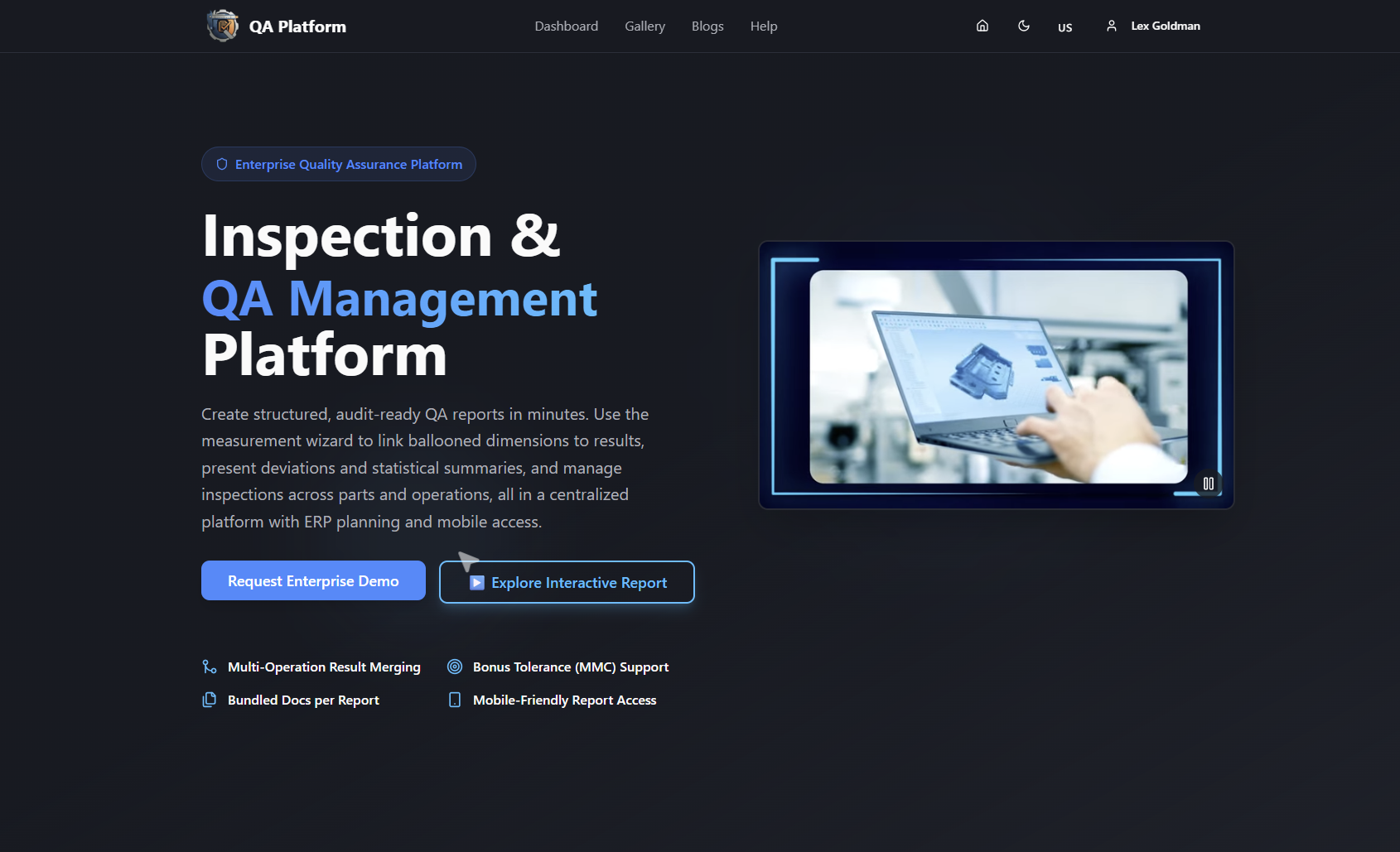
The platform's measurement wizard links every ballooned drawing dimension directly to measured results, auto-flags out-of-tolerance deviations, and generates a professional PDF report that satisfies PPAP dimensional results requirements (Element 9). CMM data imports automatically and maps to the correct balloon numbers, eliminating the transcription errors that trigger the majority of resubmissions. Built-in MSA calculators handle Gage R&R studies for Element 8, and the document vault with full audit trail covers the traceability requirements that Level 5 on-site reviews demand.
For teams preparing their first structured PPAP submission or moving from spreadsheets to a dedicated platform, Qa-report. Have a sample part drawing and your target submission level ready — the platform's setup wizard walks you through the ballooning and inspection workflow in under 30 minutes.
Sources
The following references are the authoritative and practical starting points for PPAP requirements, element definitions, and submission-level guidance:
- PPAP: Production part approval process | KAIZEN™ Article
- What Are the 18 Documents of PPAP? An Engineer's Guide