
For a US manufacturer, an audit trail is a secure, time-stamped record of who created, changed or deleted a quality record, when, and why. The old value must survive next to the new one. Regulators in aerospace, automotive and medical device work all ask for the same thing: a record that reconstructs events without anyone's memory. A quality platform that writes the trail automatically as inspectors and engineers work, such as QA-Report, makes that expectation part of the daily routine instead of a scramble before an audit.
This guide covers what the main US rules require, what an entry must contain, how to review and retain trails, and where inspection and production records fit.
TL;DR
- An audit trail must be secure, computer-generated and time-stamped, and it must record creation, modification and deletion of electronic records without obscuring earlier entries.
- Each entry should show who, what, when, the old value, the new value and, where changes occur, the reason.
- Retain the trail at least as long as the record it describes, and keep it available for FDA review and copying.
- Review trails with the records they belong to: at the frequency the regulation sets, or by risk assessment where none is set.
- Since February 2, 2026, the QMSR makes ISO 13485 part of 21 CFR Part 820, and management review, quality audit and supplier audit reports are no longer shielded from inspectors.
Table of Contents
- What an audit trail is
- Which rules apply to you
- What Part 11 requires of the trail
- What each entry should contain
- Protecting, reviewing and retaining trails
- Controlled documents and change records
- What changed in 2026
- Where inspection records fit
- Keeping it all in one system
- Perspective
- FAQ
- Sources
What an audit trail is
NIST defines an audit trail as a chronological record that reconstructs the sequence of activities surrounding or leading to an operation, procedure or event, from inception to final result. FDA's version is narrower and more useful on the shop floor: in its December 2018 data integrity guidance, an audit trail is a secure, computer-generated, time-stamped electronic record that lets you reconstruct the course of events around the creation, modification or deletion of an electronic record.
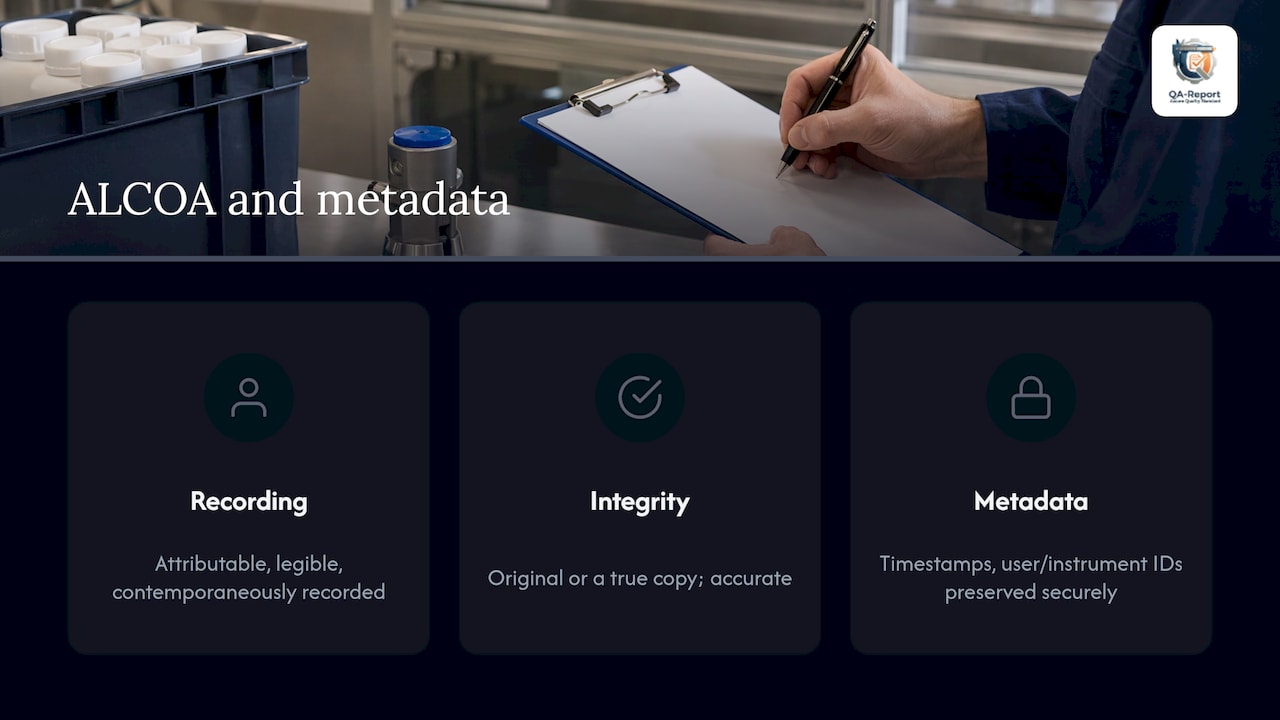
The same guidance asks that data be ALCOA: attributable, legible, contemporaneously recorded, original or a true copy, and accurate. The metadata behind a value (date and time stamps, user ID, instrument ID) must be preserved securely for the whole retention period.
In practice, a first article inspection (FAI) report is a good test. If a dimension was re-measured, a tolerance was edited or a drawing revision was swapped, the trail should show the sequence without anyone explaining it.
Which rules apply to you
No single US law says "audit trails" for all manufacturing. Several rules apply depending on what you make and who your customer is.
| Source | Who it covers | What it asks of the trail |
|---|---|---|
| 21 CFR Part 11 | Electronic records kept under any FDA records requirement | Systems, controls and documentation available for FDA inspection |
| 21 CFR 11.10(e) | Closed systems | Secure, time-stamped trail of operator entries and actions that create, modify or delete records |
| QMSR (21 CFR Part 820) | Finished device manufacturers distributing devices commercially | ISO 13485:2016 incorporated by reference, effective February 2, 2026 |
| 45 CFR 164.312(b) | HIPAA covered entities and business associates | Mechanisms that record and examine activity in systems holding electronic protected health information |
If you build medical devices, Part 11 and Part 820 are your core pair. Aerospace and automotive shops usually meet audit trail expectations through customer and standard requirements (AS9100, PPAP), and the controls above are a sound benchmark for the same discipline. HIPAA matters only if your systems hold patient health information.
For a clause-by-clause mapping, see our guide to matching Part 11 clauses to FDA inspection evidence. For the regulatory background on secure, time-stamped trails, this overview of Part 11 compliance is a helpful companion.
What Part 11 requires of the trail
Section 11.10(e) is the core. The trail must independently record the date and time of operator entries and actions that create, modify or delete electronic records. A change must not obscure what was recorded before. The audit trail documentation must be kept at least as long as the electronic records themselves and be available for agency review and copying.
FDA's October 2024 Q&A guidance for clinical investigations spells out expectations that are useful well beyond that setting:
- Capture all changes to a record, who made them, and when.
- Include the reason for the change.
- Record the old value and the new value.
- Protect the trail from modification and disabling.
- Keep it in a searchable, sortable format.
The same guidance says keystroke-level logging is not required. Deliberate actions such as save or submit are what matter.
Enforcement discretion, and what it does not change
In its 2003 Part 11 scope and application guidance, FDA said it would exercise enforcement discretion on the computer-generated, time-stamped audit trail provisions. It still enforces the underlying predicate rules, which require documenting the date, time and sequence of events and ensuring that changes do not obscure previous entries. Treat the trail as expected, not optional.
What each entry should contain
FedRAMP's audit and accountability controls are written for IT systems, but their AU-03 content list is a clear template: what type of event occurred, when, where, the source, the outcome, and the identity of the people or objects involved. NIST's AU-3 control adds time stamps, user or process identifiers, success or failure, and filenames.
For a quality record, translate that into a checklist:
- User identity: a named account, never a shared login.
- Date and time from a controlled clock.
- The record affected, such as the report, balloon number, characteristic or drawing revision.
- Old value and new value.
- Reason for the change.
- Outcome, such as saved, approved, rejected or signed.
Sharing logins is where trails most often lose their value, because "attributable" stops meaning anything. Role-based access, which QA-Report provides for shop-floor and office users, keeps every entry tied to a person.
Protecting, reviewing and retaining trails
Protection
FedRAMP's AU-09 requires protecting audit information and logging tools from unauthorized access, modification and deletion. HHS makes the practical point in its January 2017 newsletter: restrict access to authorized personnel, because tampering with logs is how intruders cover their tracks.
Review
FDA's 2018 guidance says audit trails are reviewed as part of the record they belong to. Production and control records, including audit trails, are reviewed and approved by the quality unit under 21 CFR 211.192. Where a regulation sets a review frequency, such as after each significant step or before batch release, the trail follows it. Where none is set, frequency comes from a risk assessment of data criticality, controls and product-quality impact.
A workable routine for a machine shop:
- Review the trail of an FAI or inspection report before approval, not after shipment.
- Look specifically for edits after a first approval, deleted measurements and changed tolerances.
- Raise any unexplained change as a nonconformance and record the outcome.
Retention
Under Part 11, the trail is kept as long as its record. For device manufacturers, the former 21 CFR 820.180 required records for the design and expected life of the device, and never less than two years from commercial release. Records had to be legible, protected from loss, backed up when automated, and ready for FDA review. Our guide to ISO 13485 record retention breaks down periods record by record. HIPAA documentation follows a separate rule: six years from the later of creation or last effective date.
Controlled documents and change records
Audit trails are not only about measurements. FDA's training material on Part 820 document controls says procedures must cover approval with dated signatures, distribution that removes obsolete documents from use, and changes. A change record includes the description of the change, the affected documents, the approver's signature, the approval date and the effective date.
That is exactly what an engineering change leaves behind. See our engineering change order checks and the guide to electronic signatures in manufacturing for how signatures tie into the trail.
What changed in 2026
Two changes matter now.
- The QMSR final rule, published February 2, 2024 and effective February 2, 2026, incorporates ISO 13485:2016 into Part 820. It removed the former exemption that kept management review, quality audit and supplier audit reports from inspectors. Expect those records, and their change history, to be requested.
- FDA's Computer Software Assurance guidance of February 3, 2026 recommends a risk-based approach to assuring production and quality system software, and notes that Part 11 generally applies to Part 820 documents kept electronically.
The practical conclusion: your quality software is itself in scope, and its trail needs to be defensible.
Where inspection records fit
Inspection data is the most frequently challenged record type, because a changed measurement can change a disposition. Link every ballooned dimension to its measured result, keep drawing revisions explicit, and make sure edits create entries instead of overwriting. Related practice is covered in our guides on inspection documentation, batch traceability, serial number tracking and the device history record.
Keeping it all in one system
QA-Report is a cloud-based inspection and reporting platform where ballooned drawings, measured results, out-of-tolerance flags, batch and serial tracking, a document vault and team permissions live in one place, with cloud and on-premise deployment for sensitive industries. Plans are Free at $0 per month, Basic at $49.99 per month and PRO at $149.99 per month, with On-Premise and Enterprise on request. See the plans and pricing.
If your inspectors measure on CMMs, the CMM inspection software page shows how machine data reaches the report without retyping, which removes a common source of untraceable edits.
Perspective
Most audit findings we hear discussed are not about missing records. They are about records nobody can explain: a value that changed, a revision nobody can place, a signature with no context.
Our view is that the trail should be a by-product of doing the work, not a separate task. When ballooning, measurement, tolerance validation, batch tracking and report sharing sit in one platform, each action already has an owner, a time and a place in the sequence.
That is why we built QA-Report as one centralized system, with role-based access and deployment options that suit sensitive production. A broken chain of custody is a broken chain; a single system keeps the links together.
Michael Chen
FAQ
Is an audit trail legally required for every manufacturer?
No single rule covers everyone. Part 11 applies to electronic records kept under FDA requirements, and the QMSR now governs finished device manufacturers. Aerospace and automotive customers usually require equivalent traceability through AS9100 or PPAP.
How long must an audit trail be kept?
Under 21 CFR 11.10(e), at least as long as the electronic record it describes, and available to FDA for review and copying. Device record periods depend on the record and device life.
How often should audit trails be reviewed?
At the frequency the applicable regulation sets, for example before batch release. Otherwise, set it by risk assessment of data criticality and product-quality impact, and review the trail together with the record.
Does every keystroke need to be logged?
No. FDA's 2024 guidance says deliberate actions such as save or submit are what must be captured, including original entries when a correction is made.
Sources
- NIST CSRC: audit trail glossary
- FDA data integrity and CGMP guidance, December 2018
- eCFR: 21 CFR Part 11 Subpart A
- eCFR: 21 CFR 11.10
- FDA: QMSR
- eCFR: 45 CFR 164.312
- KoHealth Labs: 21 CFR Part 11 compliance
- FDA: Part 11 scope and application, 2003
- FDA: electronic systems and records guidance, October 2024
- FedRAMP: audit and accountability
- NIST SP 800-53 AU-3
- HHS OCR cybersecurity newsletter, January 2017
- Cornell LII: 21 CFR 820.180
- HHS: HIPAA Security Rule summary
- FDA: Part 820 document controls
- Federal Register: QMSR final rule
- FDA: Computer Software Assurance guidance, February 2026