
An engineering change order is the formal document that authorizes, defines, and controls how a design change gets implemented. We consider an ECO successful only when it clears three bars: it carries proper approval, it documents a complete impact assessment, and its implementation can be traced from the original request through to as-built production records.
TL;DR:
- A complete impact assessment is essential for ECO approval, covering technical, schedule, cost, supplier, and certification impacts before implementation.
- Effectivity should be carefully chosen: serial and unit effectivity provide precise control but increase administrative effort, while date or lot effectivity often suffice.
- Traceability requires linking change records to inspection evidence and original design documentation to meet audit standards.
- Merging ECR, ECO, and ECN documents increases audit risk; keeping them separate ensures a clear change history.
- Using pilot programs and digital tools like QA-Report can improve tracking, reduce rework, and strengthen audit readiness.
Table of Contents
- What is an ECO and how it differs from ECR and ECN
- ECO lifecycle and essential fields
- Impact assessment and effectivity strategies
- Practical ECO template and step-by-step checklist
- Traceability, configuration status accounting, and audit readiness
- Common mistakes and best practices for change governance
- When to modernize your change management tooling
- How QA-Report connects ECOs to inspection evidence
- FAQ
- Sources
What is an ECO and how it differs from ECR and ECN
Three documents drive change control, and conflating them is one of the fastest ways to make an audit trail unreadable. The engineering change request (ECR) is the proposal: anyone on a design, quality, or manufacturing team can raise one to flag a problem or suggest an improvement. The engineering change order (ECO) is the authorization: it carries the formal review, the impact assessment, and the sign-offs that make a change official. The engineering change notice (ECN) is the execution vehicle: it tells the shop floor, suppliers, and downstream systems exactly what changed and when it takes effect.
ISO 10007 and related configuration management guidance frame this separation as a core discipline, not paperwork for its own sake. Keeping requests, authorizations, and notices as distinct artifacts gives every change a clean paper trail: an auditor can see who asked for the change, who approved it, and who executed it, without untangling three conversations buried in one document.
A quick way to keep these straight:
- ECR: raised by anyone who spots a defect, design flaw, or improvement opportunity.
- ECO: created by engineering once the request passes initial screening, and it carries the approval record.
- ECN: issued after ECO approval to instruct production, quality, and suppliers on implementation.
Industry practice varies slightly by sector. Aerospace and defense programs tend to formalize all three stages with distinct forms and approval gates, while smaller machine shops sometimes merge the ECR and ECO into a single lightweight document. The risk of merging them shows up later, when someone needs to prove that a change was reviewed before it was approved and finds no record that separates the two steps.
ECO lifecycle and essential fields
Processing an ECO follows a fairly consistent sequence regardless of industry, though the formality of each step scales with how regulated your product is.
- Locate or originate: check whether an open ECO already covers the issue before creating a duplicate.
- Enter the change: log the ECR reference, originator, date, and a clear description of the problem or improvement.
- Route for review: send the draft to engineering, quality, manufacturing, and procurement based on what the change touches.
- Define the change: specify exactly what parts, drawings, specifications, or processes are affected, and how.
- Assess impact: document technical, schedule, cost, and operational consequences before anyone signs off.
- Approve: route to the designated approval authority, which may shift based on the severity of the impact.
- Issue the ECN: translate the approved ECO into shop-floor instructions, supplier notifications, and effectivity rules.
Certain fields show up on nearly every well-run ECO form, and each one earns its place:
- Unique identifier: lets every downstream document, inspection report, and as-built record reference the same change.
- Originator and date: establishes who raised the issue and when, which matters for both accountability and cycle-time tracking.
- Reason for change: distinguishes a corrective action from a cost reduction or a performance improvement, since each may need different scrutiny.
- Impacted items: lists every part number, drawing, specification, or document the change touches.
- Effectivity: states precisely when and where the change takes hold in production.
- Approvals: records who signed off and in what role, satisfying the traceability expectations in FAA ORDER 1800.66A.
Our guide to revision control implementation walks through setting up the routing and approval logic behind these fields in more detail.
Impact assessment and effectivity strategies
An ECO without a real impact assessment is a request wearing an approval stamp. Before anyone signs, the assessment should scope out technical risk, supplier lead times, schedule disruption, cost (both of making the change and of not making it), and any test or certification work the change triggers.
- Technical impact: does the change affect form, fit, or function on mating parts or systems?
- Supplier impact: do vendors need new drawings, new tooling, or requalification?
- Schedule impact: can production absorb the change without a line stoppage?
- Cost impact: what does implementation cost against the cost of leaving the defect or inefficiency in place?
- Test and certification impact: does the change require re-testing, re-certification, or regulatory notification?
Effectivity, meanwhile, is where teams often underthink the trade-offs:
- Date effectivity: simplest for ERP systems to enforce, but a date can slip past the actual production schedule, creating a gap where neither the old nor the new configuration is clearly in effect.
- Lot or batch effectivity: ties the change to a specific production run, useful when parts move through discrete batches rather than a continuous line.
- Serial or unit effectivity: the most precise and the most administratively demanding, generally reserved for safety-critical or highly regulated components.
Pro Tip: Choose serial or unit effectivity only when the cost of ambiguity (a recall, a safety issue, a certification gap) clearly outweighs the extra tracking overhead; otherwise, lot effectivity usually covers the same risk at a fraction of the administrative load.
NIST guidance on engineering change cost stresses that impact analysis belongs early in the process, before detailed implementation planning starts, since costs climb sharply the later a change is caught.
Practical ECO template and step-by-step checklist
A workable ECO template does not need to be elaborate, but it does need every field an auditor or a production planner will eventually ask for.
Core template fields:
- Unique ECO identifier and revision reference
- Summary of the change in plain language
- Reason for change (defect, improvement, cost reduction, obsolescence)
- Affected configuration items, drawings, and documents
- Impact summary (technical, schedule, cost, supplier, certification)
- Effectivity rule (date, lot, or serial) and the specific value
- Approval signatures with role and date
- Verification steps required before closure
- Links to supporting inspection reports or test data
Routing this template through a consistent chain keeps the process moving without surprises:
- Originator drafts the ECO from an approved ECR and attaches supporting data.
- Reviewer (engineering or quality) checks the impact assessment for completeness.
- Manufacturing confirms whether the change fits current tooling and scheduling.
- Procurement flags any supplier lead time or requalification needs.
- Release authority signs final approval and triggers the ECN.
Timeline choices deserve their own line in the record rather than a verbal agreement: an immediate scrap decision discards existing inventory outright, a next-run decision lets current stock sell through before the change applies, and a phased retrofit schedules the change across existing units in the field. Our batch traceability guide covers how to document these choices so they hold up during an audit.
Traceability, configuration status accounting, and audit readiness
Traceability on an ECO runs in two directions: backward to the requirement or defect that triggered the change, and forward to the as-built evidence that proves the change was actually implemented. A broken link in either direction is a broken chain, and auditors tend to find exactly where it snapped.
The practical artifacts to attach include the original ECR, the impact assessment, approval records, and the inspection evidence (FAI, PPAP, or CMM reports) that confirms the new configuration matches the drawing. FAA ORDER 1800.66A requires configuration status accounting precisely for this reason: it gives auditors a single reference point showing what configuration a given unit was built to at a given time.
Research on integrated change management frameworks finds that linking design semantics with ERP data improves prediction of how a change will propagate through downstream documents, reducing the rework that comes from catching impacts too late.
Our digital thread guide for quality engineers covers how to connect model-based design data directly to inspection records, which is the forward half of this traceability chain in practice.

Common mistakes and best practices for change governance
The failure modes behind most audit findings are predictable: ECR and ECO documents merged into one record, impact analysis skipped under schedule pressure, effectivity chosen for convenience rather than risk, and suppliers notified informally instead of through a documented ECN.
- Mandatory impact fields: make the assessment required, not optional, before routing for approval.
- Role-based approvals: route higher-risk changes to a review board rather than a single sign-off.
- Automated notifications: trigger supplier and department alerts directly from ECN issuance instead of relying on someone to remember.
- Change bundling: group related minor changes into one ECO cycle to reduce approval overhead without hiding scope.
Pro Tip: If a change affects safety, certification, or a component with field failure history, the extra administrative cost of serial-level effectivity is almost always smaller than the cost of a recall with no clean cutoff point.
When to modernize your change management tooling
Spreadsheet-based ECO tracking tends to hold up fine at low volume. It starts breaking down once ECO counts climb, regulatory audits become routine, or a supply chain spans enough vendors that manual notification becomes unreliable. A minimal pilot works best: pick one product line, enforce the mandatory fields above, require a documented impact summary, and link every ECO to its inspection evidence before calling it closed. Teams that run this pilot typically see fewer rework cycles, faster approval turnaround, and a cleaner audit trail without rebuilding their whole process at once.
— Michael Chen
How QA-Report connects ECOs to inspection evidence
Once an ECO calls for a new effectivity date, lot, or serial threshold, someone still has to prove the new parts actually meet the revised drawing. QA-Report links automatic drawing ballooning, CMM data import, and GD&T validation directly to first article and PPAP reports, so the inspection evidence behind an ECO lives next to the change record instead of in a separate folder.
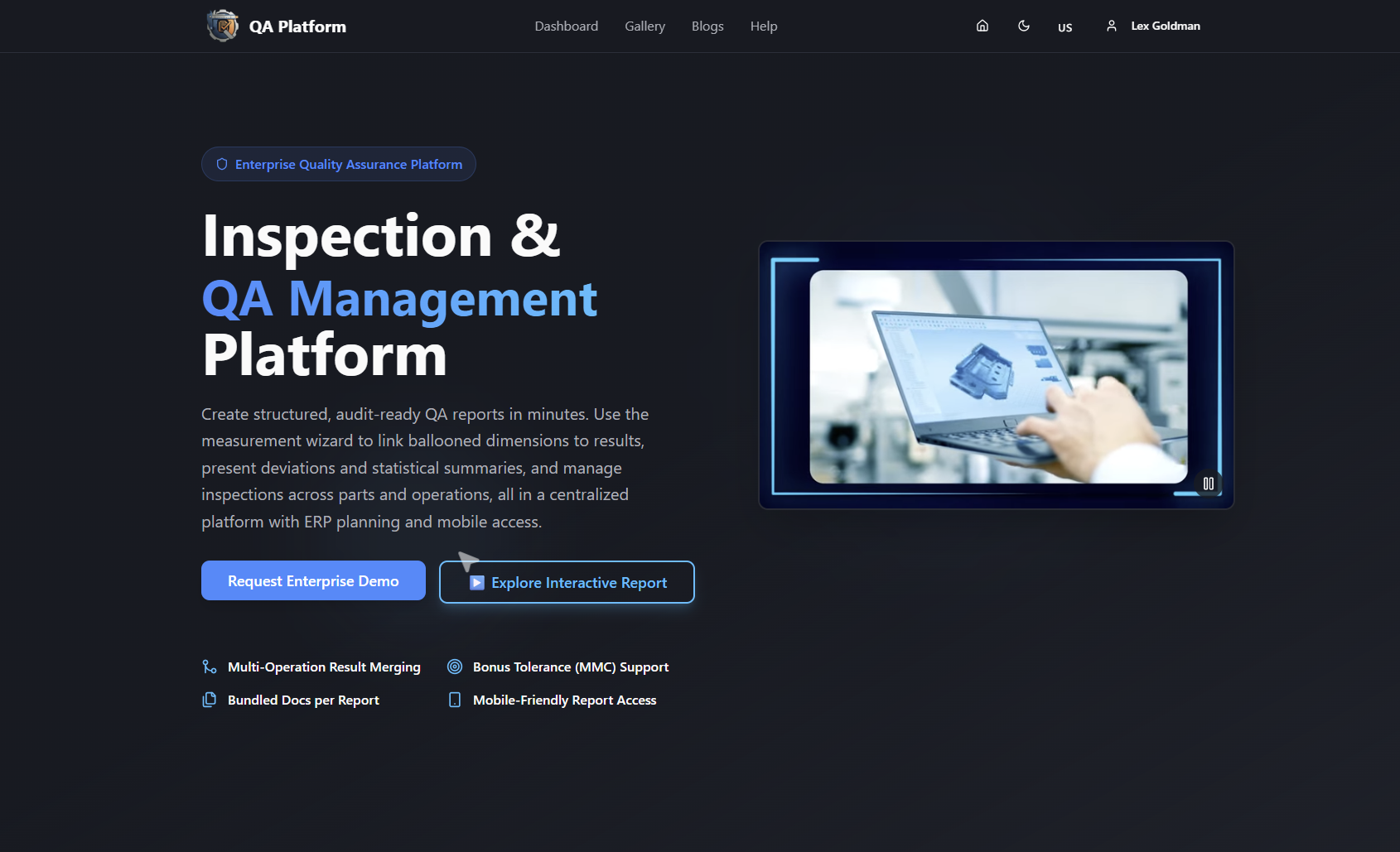
A practical pilot: pick one product line, route its next ECO's effectivity verification through QA-Report, and attach the resulting FAI report directly to the change record. Plans start with a Free tier, and paid tiers begin at $49.99 per month on the pricing page for teams ready to evaluate it against their current process.
FAQ
What is ECN and ECO?
An ECO is the formal, approved authorization for a design change, while an ECN is the notice that communicates the approved change to the shop floor, suppliers, and other affected teams. The ECO documents the decision and its impact assessment; the ECN triggers the actual implementation.
What is an ECN in manufacturing?
An engineering change notice is the document that instructs production, quality, and supply chain teams on exactly what changed and when it takes effect, following ECO approval. It typically specifies the effectivity rule, whether by date, lot, or serial number, so teams know which units the change applies to.
What is the difference between ECN and ECR?
An ECR is the initial request that flags a problem or improvement opportunity, raised before any formal review happens. An ECN comes much later in the process, after an ECO has been approved, and serves only to communicate implementation details to those who need to act on the change.
What is ECN in PPAP?
Within a PPAP submission, an ECN documents that a specific engineering change has been implemented and provides the effectivity details that tie the submitted parts to a verified configuration. Reviewers use it to confirm that the parts being submitted reflect the approved, current revision rather than an outdated one.
Sources
For readers who want the primary references behind this guide, FAA ORDER 1800.66A covers configuration management requirements, NIST's cost improvement guidance addresses change cost analysis, IRQB Guideline 8 lists practical inputs for change management, and a recent Springer study examines integrated engineering change management frameworks. For a broader overview of workflow automation options, see this engineering workflow automation comparison.
- Integrated engineering change management framework for efficient information flow to product design systems | The International Journal of Advanced Manufacturing Technology
- ORDER 1800.66A National Policy
- COST IMPROVEMENTS — NIST document