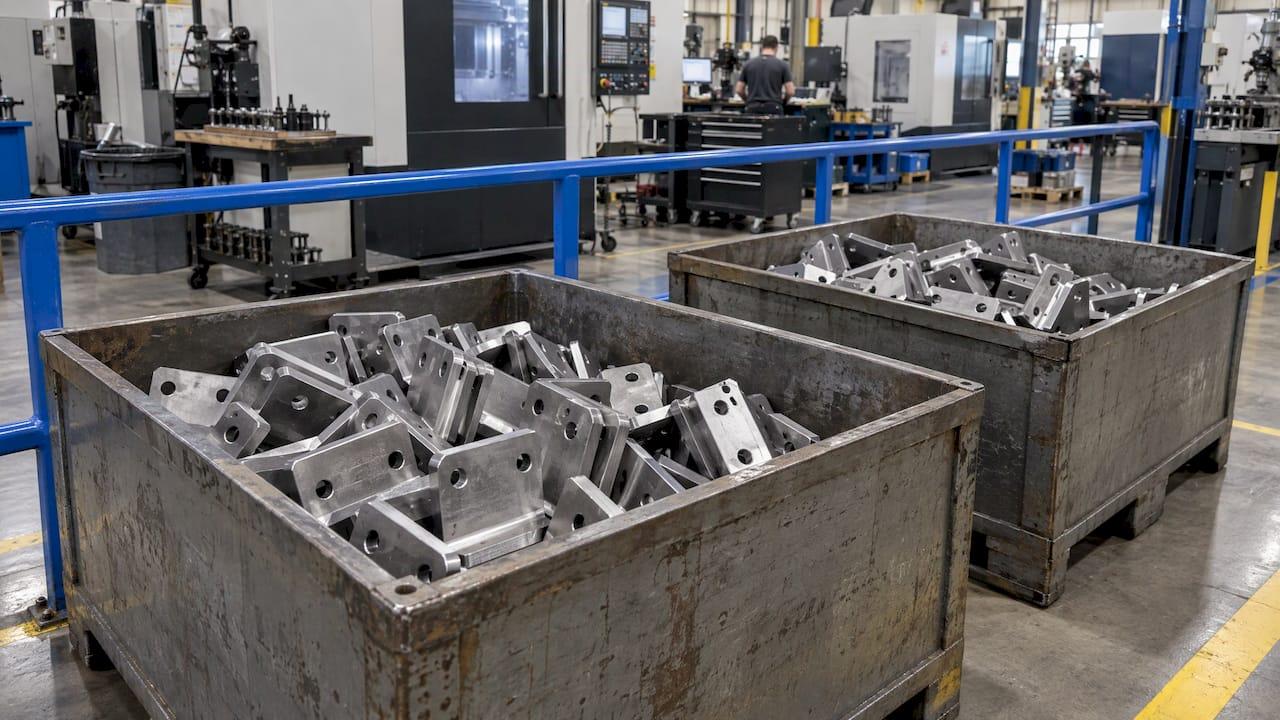
A quality escape is a nonconforming part that gets past the check that should have caught it. Containment is what you do in the first hours after you learn about it: stop more bad product from moving, find every part and customer that could be affected, and tell the customer before they find out on their own. Teams that contain well have one thing in common. They can answer "which parts, which lots, which customers" from records in minutes, not days. That is a traceability problem before it is anything else, and it is the reason we build QA-Report around batch and serial tracking, inspection records and production routes in one place.
This guide is for quality managers and engineers at manufacturers and machine shops in the US, Canada, the UK, France and Germany. It covers the definition, the first-hour actions, how to size the problem, what to put in the customer notice, and how containment hands off to root cause.
TL;DR
- A quality escape is a defect that passes normal controls and is found at a later internal step, by the customer, or in the field. Where it is found decides how costly it is.
- Contain before you investigate: hold suspect stock, stop shipments, divert parts in transit, and name one point of contact.
- Scope with a clean point, the last verified good part, and with traceability that reaches shift, machine and operator, not only the lot number.
- Notify affected customers quickly with the quantity, serial range, defect, containment and disposition, even if the root cause is still unknown.
- Containment is temporary. Close the case only after the cause is removed and the fix is verified across the wider population.
Table of Contents
- What counts as a quality escape
- The first hours: contain before you investigate
- Scoping the escape with a clean point
- Traceability decides how fast you can contain
- Rapid response protocol and the audit trail
- What the customer notice must contain
- From containment to root cause and verified correction
- Putting this routine into QA-Report
- Perspective
- FAQ
- Sources
What counts as a quality escape
A nonconformance caught where it should be caught is a normal day in a quality system. It becomes an escape when it passes beyond the control or process step where it should reasonably have been detected. A glossary definition describes it as a defect found only after moving to the next internal step, to the customer, or to field service.
Two cases matter in practice:
- Internal escape: the defect is found at a later in-house operation. The part never left the building, but your inspection point missed it.
- External escape: the customer or the field finds it after shipment. Supplier quality agreements often define it narrowly. One published supplier quality agreement treats an escape as nonconforming product that has physically shipped, whoever detects it, and requires immediate additional containment and notice to the buyer by telephone and email.
Track the two separately. An escape to the next station and an escape to the customer are different indicators with different starting sets, and temporary segregation and permanent prevention are different goals. One is not closed because the other is done, as the quality-at-source lesson from Yamazovas puts it.
Most escapes are not careless shipping decisions. Hengsheng Precision Engineering gives a typical example: an inspector checks a bore with a two-point micrometer when the drawing called for a three-point measurement. The check ran and the record passed, but it tested the wrong thing. Keep that in mind later, because it shapes how you scope the problem.

The first hours: contain before you investigate
The instinct is to find out why it happened. Resist it. Until you know how much suspect material exists and where it sits, a root-cause investigation has no boundary. DSP Troy's automotive guidance puts containment ahead of investigation for the first 48 hours and calls silence toward the customer the worst response.
A workable first-hour sequence:
- Secure safety. If the defect could hurt someone, pull affected units from use, halt shipments and stop the process that is making more of them.
- Name a containment lead and one point of contact for all outside communication. Everyone else routes questions to that person.
- Place a system hold on the suspect part numbers, lots or serials in your ERP or production system, and physically tag and segregate stock. Visible "quality hold" tags on work in process, finished goods and service stock keep a well-meaning operator from shipping a held pallet.
- Stop or divert what is in transit. Ask distributors or downstream plants to hold stock on their side.
- Preserve evidence. Do not rework, relabel, repack, scrap or edit records until your agreed procedure allows it. Supplier Ally's guidance makes this point for notifications, and it holds for any escape, because the records are how you prove scope later.
- Escalate by a defined matrix: quality, engineering, production, regulatory and legal, as your product and contracts require.
Aerospace suppliers work to explicit clocks. Sensata's aerospace procedure for control of nonconforming product (revision dated June 2023) calls for containment actions such as a stop order, stock purge and quality alert to start immediately once delivered product is found nonconforming. It also calls for an impact evaluation within one working day and notification of all affected customers within 24 hours of confirming the discrepancy. Your own contracts may set tighter or looser limits. Read the quality clauses of your biggest customers now, before you need them.
Scoping the escape with a clean point
Containment is only as good as its boundary. Too narrow and a bad part ships next week. Too wide and you sort or scrap good stock and halt a customer's line for nothing.
The core idea is the clean point: the last known good part, verified by date, time or serial number, before the first suspect part was made. PTI QCS describes it as the figure that tells the customer how far back to check its inventory. It also recommends traceability that reaches production dates, shifts, machine numbers and operator IDs, not only the lot number.
Two cautions keep the boundary honest:
- A check can bound the suspect interval only if it could have detected this failure. The EMS Handbook's bookend principle uses the last relevant known-good event, such as a passing hourly check or a verified setup, as one end and the detection point plus affected work in process as the other. A passing check that measured a different feature proves nothing. For intermittent problems with uncertain edges, it suggests holding at least the whole shift for a 100% sort.
- Claim only the resolution your records support. If traceability resolves to a batch or work order, hold the whole work order instead of asserting a serial-level boundary you cannot back up.
Start with the narrowest verified range and expand if the same tool, material, label roll, fixture or work instruction was used across other lots. Show the inclusion and exclusion logic from work orders, process parameters, inspection records, packing records and shipping documents.
Worked example
A machine shop finds on Tuesday that a bore diameter on a bracket is running at the high limit. The last in-process check that measured that bore passed at 10:15 on Monday, on machine 4. That check is the clean point. Everything machined on that machine after it, plus any bracket from the same program and fixture on other machines, is suspect. Records show 600 pieces made since, 140 on hand, 90 in final inspection and 370 shipped in two lots to one customer. The shop holds the first 230, notifies the customer about both lots with serial ranges, and sorts the 140 and 90 against the drawing. Because the records resolve to the work order and not to the serial, it holds the whole work order. With that answer ready in the first hour, nobody has to guess.

Traceability decides how fast you can contain
The worked example works only if you can answer three questions from records: which material lots went into each operation, which parts came off which machine and shift, and which lots shipped to which customer on which purchase order. Inbound-only lot tracking leaves a gap at the middle step, and that is where most scoping stalls.
See our guides on lot number traceability from receipt to shipment, batch traceability for compliance and serial number tracking for how to structure the records. QA-Report supports batch and serial tracking alongside inspection reports, so the inspection results, the production route and the shipped quantities sit in the same system. The incoming inspection practices matter here too, since a nonconforming material lot is a common start for an escape that shows up three operations later.
Test your traceability before an escape tests it. Pick a finished lot at random, trace it back to material and operators, trace a material lot forward to every customer, and see how long it takes. If the answer is an afternoon of spreadsheet searching, that afternoon is the delay you will have during a real escape.
Rapid response protocol and the audit trail
A response that cannot be reconstructed afterward is hard to defend to a customer or an auditor. Record who put each hold in place, when, on which part numbers and quantities, who released anything, and what was told to whom. The same discipline applies in any operation where disputes are settled by timestamps; this explanation of an audit trail for operations teams shows how a clear event log shortens arguments about who did what.
In a plant, that means:
- Every hold and release is tied to a named person and a time.
- Sort results are recorded per part or per container, not summarized.
- Conforming and nonconforming material are physically separated, and the sorters have the right gauges and clear accept and reject criteria. DSP Troy's sorting checklist lists these as requirements for hours 4 to 24.
- Dispositions of rejected material (scrap, rework, return) follow a documented path. Our MES rejection and recovery workflow lays out one audit-ready version.
What the customer notice must contain
Send the notice early, then update it. Sensata's procedure says incomplete details must not delay the initial notice, and lists what the notification should hold:
- Affected quantity and serial-number range
- The defect and its impact
- Containment measures in place
- Root cause and corrective action, if available
- Disposition of product the customer already holds
The procedure accepts an investigation report, an 8D report (the eight-discipline problem-solving format common in automotive and aerospace) or the customer's own format. If the customer requires a stock purge, it should start within 48 hours of their notification or as the customer requires, per the same procedure.
Word the notice carefully. Containment is not an admission of fault. A documented hold gives the buyer a fixed target while records are checked. Avoid writing "no impact" until you have evidence; "no affected shipment is currently identified" is accurate while shipment records are under review, per Supplier Ally.
PTI QCS suggests a 24-hour report that adds photos of the problem, a containment plan covering your plant, in-transit stock, the customer's inventory and service centers, clean-point data, immediate corrective actions and round-the-clock contact details, as described in its response plan. Whether you send an engineer to the customer's plant depends on the relationship and the contract, but a named contact who answers the phone is always the baseline.
From containment to root cause and verified correction
Once suspect product is held and the customer is informed, the investigation can begin on solid ground. A typical 8D response, such as the GD-OTS corrective action guide, places containment at the third step. The team determines the scope of affected product and stops downstream flow, then identifies and verifies root causes with tools like 5-Why. It selects corrective actions backed by objective evidence, implements preventive measures such as poka-yoke (mistake-proofing), validates the result and closes only with the issuer's approval.
Two points separate a closed ticket from a closed problem:
- Look at the whole population. The Aerospace Federation's AS9100 resource on nonconformity, containment and escapes says that correcting the first detected item must not close the investigation of the wider population. It also says effectiveness of corrective action must be checked, with evidence such as raw data, software versions, material samples and process conditions.
- Ask why the check missed it. Segregation beside a process that is still failing protects the next step but does not reduce defect formation, and asking people to be more careful is not an assurance by itself, as the Yamazovas lesson stresses. Precision Expedited's analysis of where escapes start points to handoffs where a requirement was lost, misread or never passed along, such as a wrong revision, a missed dimension or a missing certificate.
That last point is why complete inspection records pay off twice. They bound the escape today and show tomorrow where the requirement got lost. Our guide to inspection documentation best practices covers what a record needs so it can be used that way, and our piece on ERP quality integration covers keeping holds and quality status consistent between planning and the shop floor.
Putting this routine into QA-Report
QA-Report is a cloud-based inspection and quality platform for manufacturers in aerospace, automotive and medical device production. It links ballooned drawing dimensions to measured results, flags out-of-tolerance deviations, supports batch and serial tracking, and includes MES functions for parts, batches and operations, with rejection and recovery tracking, route cards and role-based shop-floor access. Inspectors can work from mobile devices, and reports can be shared interactively.
The Free plan costs $0 per month, Basic is $49.99 per month and PRO is $149.99 per month. On-Premise and Enterprise Solutions are available without a published price. You can see which features each tier includes on the pricing page, or look at the MES software for machine shops to see how route cards and batch tracking fit together.
If you want your next containment to start from records instead of guesses, start with QA-Report.
Perspective
Every escape we hear about has the same shape. The first hour is spent hunting for information that should already exist: which operation, which machine, which lots shipped where. The defect itself is rarely the hard part.
That is why we built QA-Report as one connected system. Ballooned drawings, measured results, out-of-tolerance flags, batch and serial tracking and production routes belong together, because an inspection record that sits apart from the route it belongs to cannot bound a suspect interval. When inspection and production share a record, a clean point stops being an educated guess.
We also offer cloud and on-premise deployment, since some of our customers in sensitive industries need to keep their data under their own control. Containment records are exactly the data you want available to the right people and nobody else.
Our advice is to run a traceability drill this quarter, before a customer does it for you. Pick a lot, trace it both ways and time it. Then fix whatever slowed you down.
Michael Chen
FAQ
What is the difference between a nonconformance and a quality escape?
A nonconformance is any departure from requirements. It becomes an escape when it passes the control or process step where it should reasonably have been caught, and is found later internally, by the customer or in the field. Caught on time, it is a normal rejection. Caught late, it triggers containment.
How fast must I notify the customer?
It depends on your contract. One aerospace procedure calls for notice within 24 hours of confirming the discrepancy, and that is a sensible default for safety or regulatory risk. Send what you know, including quantity, serial range and containment actions, and update it as the investigation advances.
Should I find the root cause before I contain?
No. Hold suspect stock, stop shipments and notify first, because an investigation without a defined scope of suspect material cannot be effective. Start root-cause work once the boundary is set and the customer is informed.
What is a clean point?
It is the last verified conforming part before the first suspect one, identified by date, time or serial number. It tells you and the customer how far back to look. Choose it from a check that could actually have detected this particular defect.
When can I close an escape?
When the root cause is removed, the correction is validated with objective evidence, the wider population has been checked and the issuer has approved the response. Fixing the first part you found is not enough.
Sources
- Quality Escape (glossary definition)
- Supplier Quality Agreement
- Quality at the Source and Segregating Nonconforming Product
- Quality escape prevention: how bad parts get out
- Automotive Quality Escape Response: First 48 Hours
- How To Require Quality-Escape Notifications
- Aerospace Procedure for Control of Nonconforming Product (AP0413)
- First Steps After a Quality Escape
- Production Defect Containment: Suspect Lots
- Corrective Action Response Guide
- Nonconformity, Containment, Escape and Corrective Action
- Where Quality Escapes Actually Start